The tradition & historical record
3 min read · 2 sourcesThe Nyero rock paintings are located in eastern Uganda in Kumi District, 8 km (5.0 mi) west of Kumi town, about 250 km (155.3 mi) from the capital city Kampala. The Nyero rock paintings are among the most important rock art in Uganda. 1
History
Nyero rock paintings date to before 1250 CE. They were first documented in 1913 and later described by researchers as largely of geometric nature. This type of rock art is part of a homogeneous tradition often depicted in red pigment, spreading across east, central and parts of southern Africa, matching the distribution of the Late Stone Age hunter-gatherer culture. This art is generally attributed to Batwa (Twa) hunter-gatherers who are of Pygmy origin, and are today, in Eastern Africa, only found in small groups near the Rwanda/Uganda border and eastern Congo. It is likely that Twa hunter-gatherer communities once lived in the general area of these rock art sites, probably moving on due to the arrival of the present inhabitants (Nilotic, Luo, and Bantu groups). The paintings enrich the cultural identity of the people of Iteso, Uganda, and Africa as a whole. 1
Description
Nyero rock art site has six shelters (Nyero 1, 2, 3, 4, 5 and 6). They are described below. 1
Nyero 1
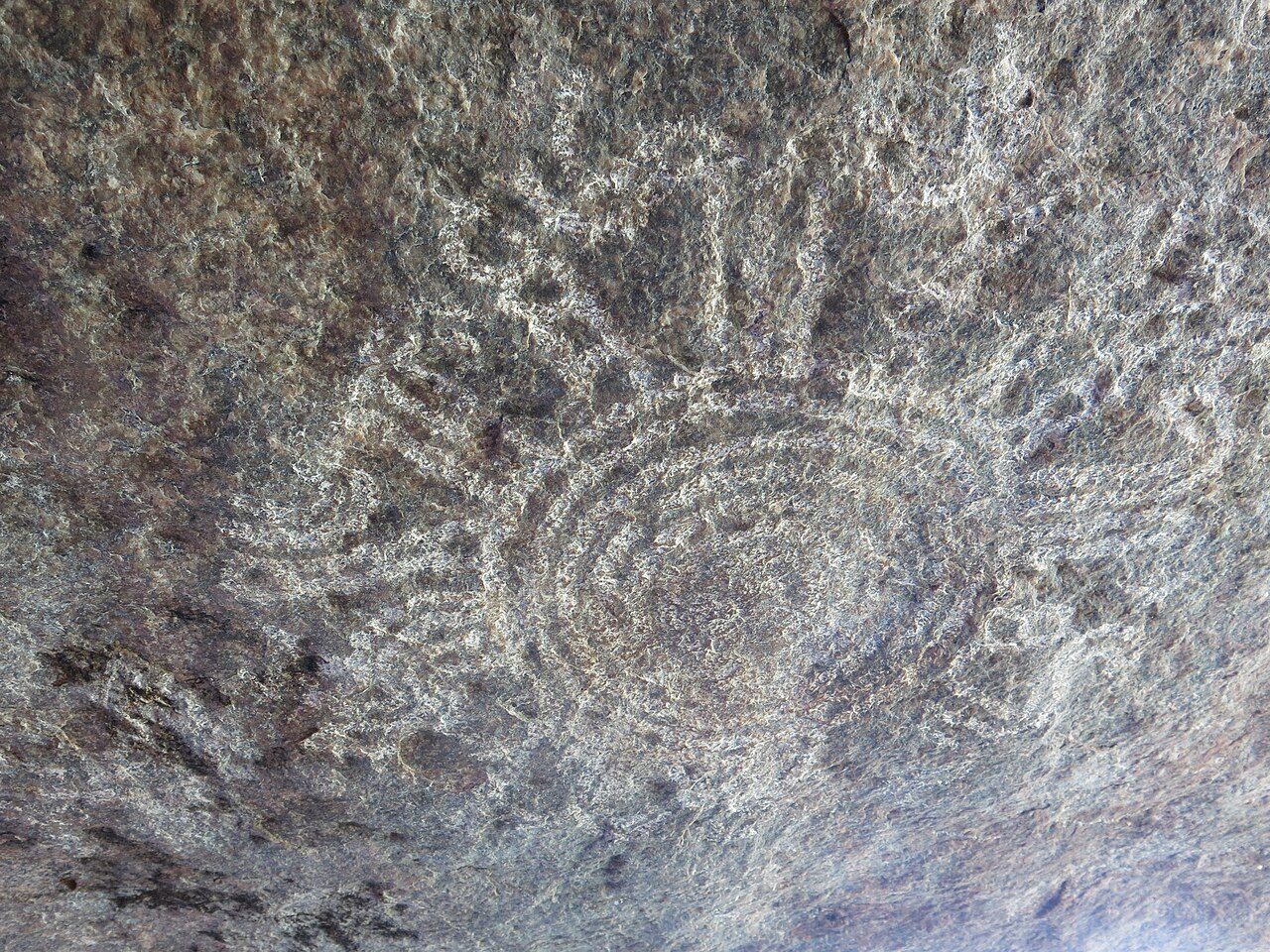
This is a small rock shelter formed by a low overhanging rock perched above three supporting rocks. On the outer edge of the overhang are six sets of concentric circles in white, together with paintings in the shape of ‘acacia pods’. 1
Nyero 2
This is the main shelter, it has a 10 m (32.8 ft) high vertical rock against the back wall and an overhang formed by the breaking away of an enormous boulder estimated to weigh at least 20,000 tons. The overhang protects the paintings from direct rain and rocks in front and to the sides protect the paintings from the sun. The paintings are all done in shades of red. Concentric circles are the dominant form and more than forty different drawings were identified. There is one large ‘acacia pod’ design that has also been called a canoe. On the south-eastern side of the shelter, a narrow passage between the boulders leads to a small, dark shelter where there is a small cavity known as the ‘pocket’ where the early inhabitants used to offer gifts to there gods after receiving help from them. Members of the local community still follow a tradition of placing money there either before or after receiving help from ancestral spirits. 1
Nyero 3
This shelter is at the far northern end of the Inselberg and about 8 minutes walk from Nyero 2. It is formed by a large boulder perched on top of supporting rocks with no standing room. Once inside the artificial protecting wall, visitors have to crouch low down to reach the far end where another artificial wall makes it less dangerous and allows a wide view of the land below. The painting consists of white concentric circles; the outer circles are surrounded by double curved designs, between which are double lines divided into smaller compartments. 1
The text above is adapted from the Wikipedia article “Nyero rock paintings”, available under the Creative Commons Attribution-ShareAlike 4.0 licence. 1
Nyero Rockpaintings is archaeological site in Uganda, according to the structured record cited below. This entry was generated automatically from that record and has not yet been reviewed by a person familiar with the tradition. 2
The source record links this tradition to 3 external registers, which can be verified through the citation. 2