The tradition & historical record
6 min read · 2 sourcesLuoshen Fu paintings (traditional Chinese: 洛神賦圖; simplified Chinese: 洛神赋图; pinyin: Luòshénfù Tú), also translated as Nymph of the Luo River paintings or The Goddess of the Luo River paintings, is the conventional title of a group of Chinese narrative paintings based on the fu poem Ode to Luoshen (Chinese: 洛神賦) by the Cao Wei prince and poet Cao Zhi. The lost original composition is traditionally attributed to Gu Kaizhi, an influential painter of the Eastern Jin dynasty, but none of the surviving versions can be securely identified as his own work. Several later copies and adaptations survive, most notably Song-dynasty handscrolls in the Palace Museum in Beijing, the Liaoning Provincial Museum in Shenyang and the Freer Gallery of Art in Washington, D.C. Other related versions are held by the National Palace Museum in Taipei and the British Museum. Although the individual scrolls differ in completeness, arrangement and style, they preserve a common pictorial tradition in which Cao Zhi's encounter with the goddess is represented as a sequence of episodes unfolding across a continuous landscape. The painting tradition is regarded as an important example of early Chinese narrative paintings. Its repeated figures, fine contour lines, restricted colour washes and comparatively schematic landscape have also made the surviving copies significant sources for the study of Chinese figure painting and the early development of Chinese landscape painting. 1
Literary background
The paintings illustrate Cao Zhi's Ode to the Luoshen, traditionally dated to around 222. According to the preface to the poem, Cao composed it after attending the imperial court and crossing the Luo River on his return journey. He recalls an account of the river goddess Fufei and describes an imaginary meeting between the mortal prince and the supernatural woman. In the poem, Cao Zhi first sees the goddess beside the river and describes her appearance through comparisons with birds, dragons, clouds, flowers and moonlight. He becomes attracted to her and offers a jade pendant as a token of affection. The goddess responds, but the prince begins to doubt whether a lasting union is possible. A procession of female spirits and mythical creatures then gathers around her, after which she departs in a cloud-borne carriage drawn by six dragons. Cao remains beside the river and later attempts to follow her, but the encounter ends because a human and a deity cannot inhabit the same realm. Later interpretations frequently associated the poem with Lady Zhen, the wife of Cao Zhi's elder brother Cao Pi, but the historical basis of this identification has been questioned. The paintings themselves generally present the narrative as a mythological encounter rather than identifying the goddess as a historical woman. 1
Attribution and dating
Gu Kaizhi was celebrated in later Chinese art history as a master of figure painting and as a theorist who emphasized the expression of a subject's inner character through outward form. Traditional catalogues attributed the original design of Godness of the Luo River to him, and the association became central to the later reputation of the painting. No surviving scroll, however, bears a reliable signature or contemporary inscription by Gu. The surviving handscrolls were produced centuries after Gu's death. Museums therefore normally describe them as Song- or Ming-dynasty copies of a composition traditionally attributed to him. The Palace Museum dates its principal Beijing scroll to the Song dynasty on the evidence of its silk, pigments and painting technique, while the National Museum of Asian Art dates its Freer copy to approximately 1150–1250. 1
Composition and narrative
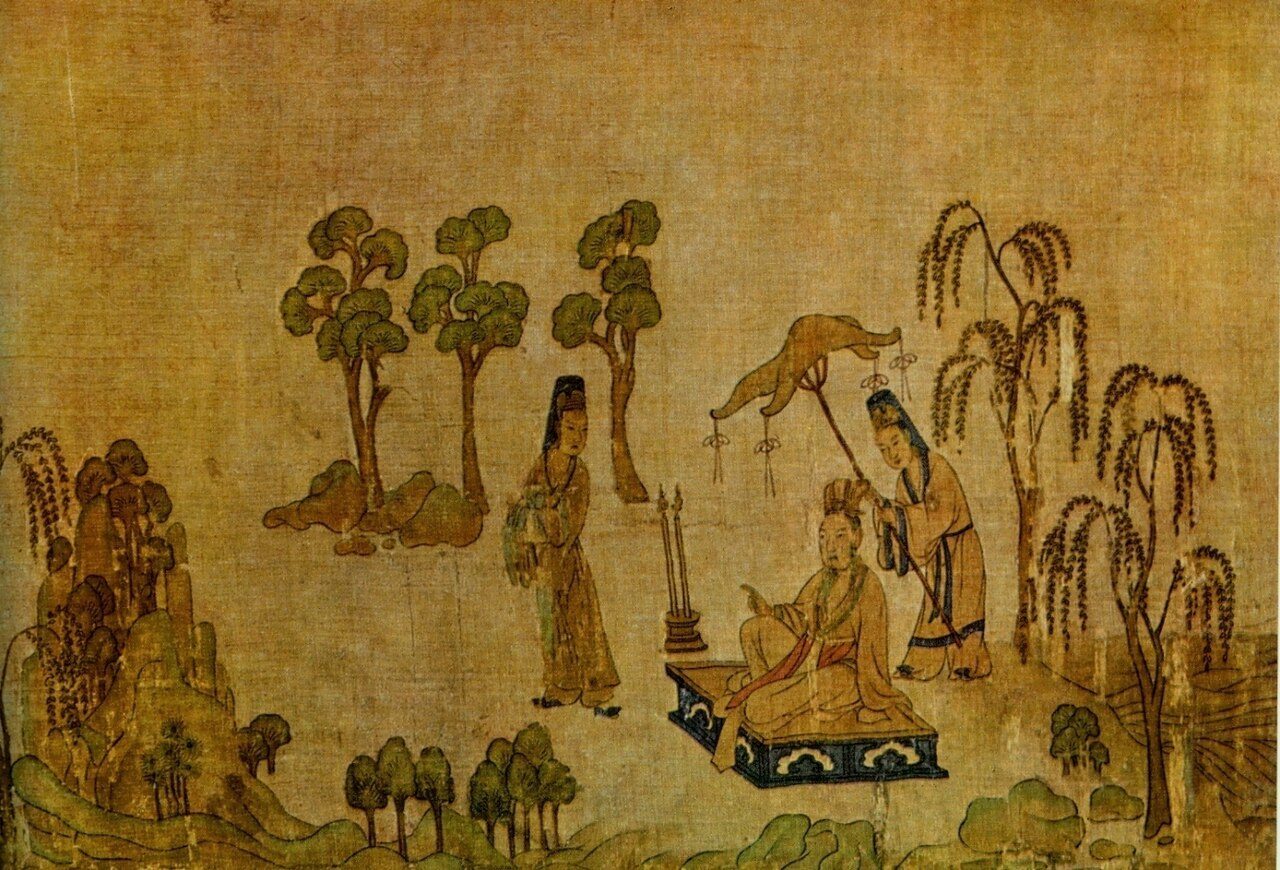
The best-known versions employ continuous narrative, a method in which successive moments appear within the same uninterrupted pictorial space. The scroll is viewed gradually from right to left. Cao Zhi, the goddess and their attendants appear repeatedly, allowing the viewer to follow the progression of the poem without dividing the work into framed panels. In the opening episodes, Cao Zhi and his attendants arrive beside the river. The prince looks towards the goddess, who appears at a distance among water, rocks and trees. The difference between the still, formally arranged human party and the floating ribbons and garments of the goddess visually separates the earthly and supernatural realms. Their gazes and gestures establish a connection even though they are rarely placed immediately beside one another. Later passages show the goddess moving across the river, meeting other female spirits and receiving Cao's declaration of affection. Mythical animals and aquatic beings transform the landscape into a supernatural environment. Among the creatures represented are dragons, fantastic fish and water birds described in Cao Zhi's poem. The goddess eventually rides away in a cloud carriage drawn by six dragons, accompanied by an elaborate procession. The final episodes return attention to Cao Zhi. In more complete versions, he travels by boat, waits beside the river during the night and prepares to continue his journey. His repeated backward glances and hesitation convey his unwillingness to leave the place of the encounter. The narrative therefore moves from wonder and attraction to separation and remembrance. Rocks, trees, riverbanks and stretches of water serve both as settings and as transitions between episodes. 1
Style and technique
The surviving principal scrolls are painted in ink and mineral or vegetable colours on silk. Figures and landscape forms are first defined by outlines and then filled with comparatively light colour washes. The contours of the bodies and clothing are slender and controlled, while long scarves and ribbons curve around the goddess and other supernatural figures to suggest movement through the air. The landscape is less naturalistic than the figures. Mountains, trees and riverbanks are frequently much smaller than the people placed beside them, and spatial depth is limited. Trees may be represented as simplified trunks with branches extending like outstretched fingers, while rocks are enclosed by contours and filled with colour rather than modelled through the textured brushstrokes characteristic of later Chinese landscape painting. These differences in scale are not necessarily errors of observation. The landscape functions primarily as a visual stage that identifies locations, separates narrative episodes and directs the viewer's movement through the scroll. The relative size of the figures also reflects their narrative importance. Cao Zhi and the goddess remain easily recognizable even when the surrounding river and mountains change. The treatment of the figures has traditionally been associated with Gu Kaizhi's reputation for fine, continuous line drawing. Nevertheless, stylistic details in the surviving copies reflect the periods in which they were produced. 1
Palace Museum version
The principal version in the Palace Museum is a Song-dynasty handscroll measuring 27.1 centimetres in height and 572.8 centimetres in le… 1
The text above is adapted from the Wikipedia article “Luoshen Fu paintings”, available under the Creative Commons Attribution-ShareAlike 4.0 licence. 1
Nymph of the Luo River is painting by Gu Kaizhi, according to the structured record cited below. This entry was generated automatically from that record and has not yet been reviewed by a person familiar with the tradition. 2
The source record links this tradition to 5 external registers, which can be verified through the citation. 2