The tradition & historical record
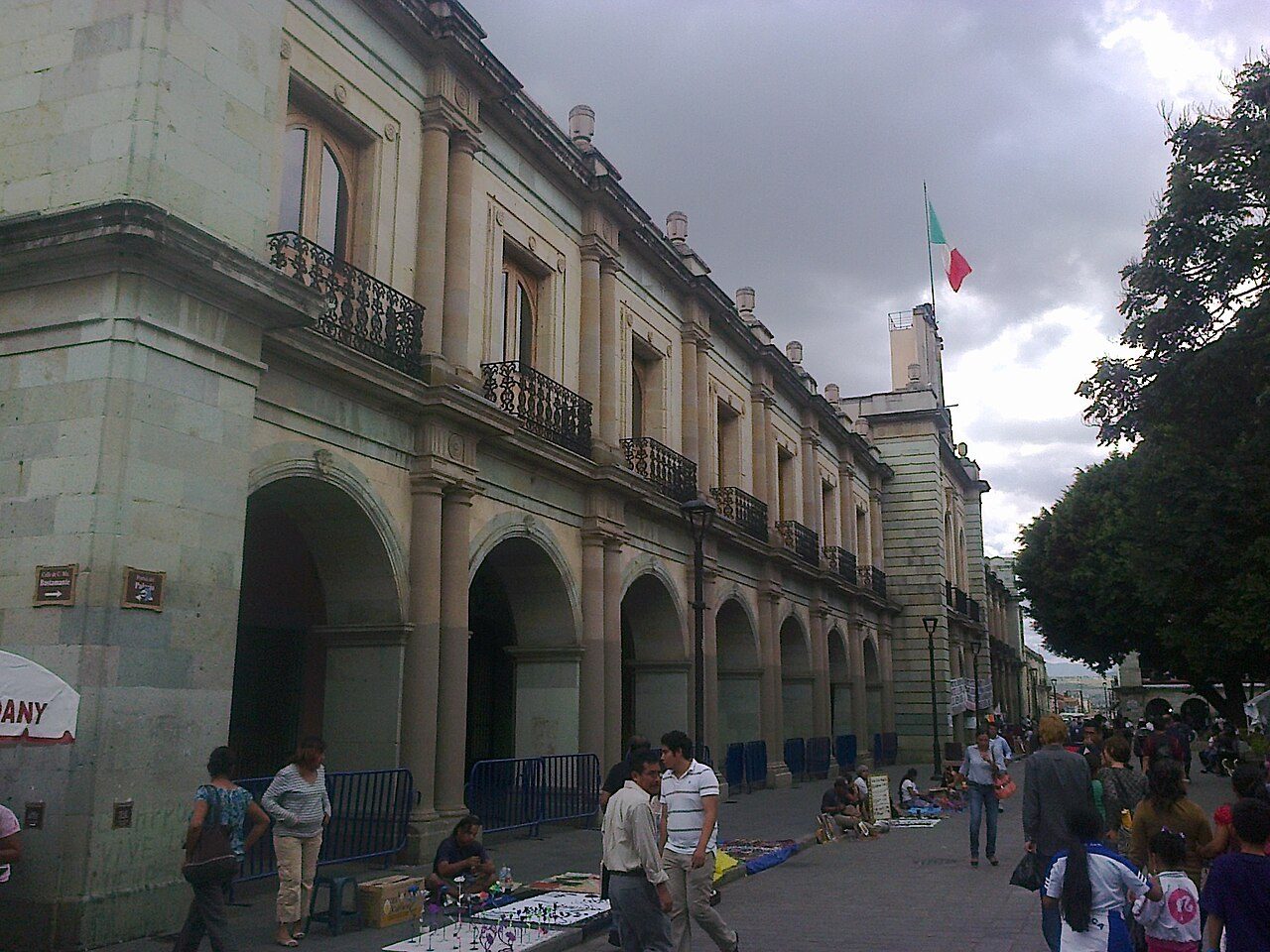
6 min read · 2 sourcesOaxaca en la historia y en el mito (English: Oaxaca in history and myth) is a huge mural created by Arturo García Bustos (1926-2017) and located in Oaxaca de Juárez, know in English as Oaxaca City. García Bustos was "an artist dedicated to the humanistic struggles and liberal ideals that he expressed profoundly in his art." He painted the mural in a stairwell in the Palacio de Gobierno in Oaxaca. In an earlier version of this article, the space where the mural is located was officially known as the Museo del Palacio Universum. But the museum has disappeared. And in 2025 the mural is seldom available for viewing. A pamphlet distributed to attendees at the inauguration described the mural as a "mapamundi oaxaqueño" or a Oaxacan worldmap. The mural is a visual history of Oaxaca from prehistoric times to modern times, with little detail past the Mexican Revolution. The images selected and not selected in a visual history are key to the final message. Bustos focused on images of the liberal traditions and reform in his interpretation of the history of Oaxaca, largely leaving out those who opposed liberal ideas, such as the church and monarchists and also played important roles in Oaxacan and Mexican history. 1
Opposition to Arturo García Bustos painting the mural
The contract to paint the mural was granted without competition, by the governor Eliseo Jiménez Ruiz after an initial conversation with the brother of García Bustos. Ruiz and Bustos followed up with a longer conversation and demonstration of a partial mock-up by the artist, hurriedly cobbled together in a local restaurant. Bustos was not new to Oaxaca. In the 1950s, he had taught art at the Universidad Autónoma Benito Juárez de Oaxaca (UABJO) to Francisco Toledo and other Oaxacan artists. He at that time traveled extensively in the state, until he was released from his teaching for his Marxist views, after he returned to Oaxaca from a trip to Russia in 1958. 1
García Bustos was not from Oaxaca. Whereas famous Mexican artists Rufino Tamayo, Francisco Toledo and Rodolfo Morales were from Oaxaca City or the State of Oaxaca, although they had not completed any murals in Oaxaca before Garcia Bustos started.After he started, opposition to Bustos painting the mural grew. On 27 May 1978, The Oaxacan artist Rufino Tamayo published a letter to the editor stating that the artistic experience of García Bustos, known better for his engravings, "nada tiene que ver con la pintura y mucho menos con la pintura mural." ("his engravings have nothing to do with painting, much less with mural painting.") However, after additional exchanges, on 5 June 1978, 18 Oaxacans, from different professional and artistic areas wrote a letter to the editor supporting García Bustos.Rufino Tamayo's branding of Garcia Bustos as inexperienced with mural painting was inaccurate. In the 1960s Garcia Bustos painted a large mural about Oaxaca in the National Museum of Antropologia. He painted other murals in Mexico cities. 1
The roots of Mexican Muralism
Mexican and Oaxacan muralism has deep roots. The murals on the interior wall of tombs of Monte Albán, for example, are around 1,500 years old, Tomb 104 has been carefully reproduced in the National Museum of Anthropology (Mexico), including the original murals.Modern mexican muralism received a boost after the Mexican Revolution. The man behind the program, José Vasconcelos Calderón (1882–1959) appears on the mural. After the Mexican Revolution ended in 1921, as the Secretary of Education, Vasconcelos obtained a large budget and generated projects to foster nationalism, especially through sponsoring large patriotic murals in public spaces. Arturo García Bustos, as a child, living in El Centro of Mexico City, observed Diego Rivera painting these patriotic murals. Later Bustos studied mural painting as part of the nationalist art movement with Frida Kahlo in a group called Los Fridos. Bustos collaborated with Kahlo on murals on a daily basis in the mid-1940s. In short, the mural Oaxaca en la historia y el mito springs from the roots of muralism and nationalism that José Vasconcelos planted some 50 years before García Bustos painted his mural in Oaxaca. 1
Vasconcelos, a man with deep, sometimes mystical, connections to the past, lived in Coyoacán, a colonial neighbourhood of Mexico City in the home that Hernán Cortés is said to have built for his interpreter-mistress. How we call this woman shows how we view her. At birth she seems to have been called Malintzin or some version of that. It appears that when she became enslaved to Cortés she was renamed Doña Marina. 1
General Description
The mural covers 220 m2 (2,400 sq ft) spread over three walls. It depicts some 100 life-size images of objects, people and events, making a semi-circle around a large internal stairwell. The artist used the elaborate, and time-consuming encaustic technique, using heated wax. The rough surface created by the wax covering the painted surface, reflects light and enlivens the mural. The mural tells the stories of Huaxyacac-Antequera-Oaxaca-Oaxaca de Juárez (0axaca City), the names given to Oaxaca City starting in the late 1400. The mural has three panels covering, three eras of Oaxacan history. In chronological order the panels are; Prehispanic, sometimes called the pre-Columbian era, of some 10,000 or maybe 20,000 years ago to 1521, the second era is colonial times when Spain ruled New Spain roughly from 1521 to 1821, and the third panel represents the 100 years of unrest punctuated by the Mexican War of Independence, the Reform War, the Second French Intervention and The Mexican Revolution, roughly from 1810 to 1921 and beyond. This third panel, the largest, lies in the middle. It is said by some that the bottom layer of each panel pictures everyday life. The middle layer illustrates forces and events shaping the history of Oaxaca. The third, or top layer of the mural, represents the ideals and leaders of Oaxaca through the three eras portrayed. 1
Prehispanic Panel
The term prehispanic refers to the period in Mesoamerica before the Spanish arrived. Critics of the use of the term prehispanic, reason as follows: "La palabra prehispánico tiene una connotación de "aparición" de los pueblos mesoamericanos en la historia a partir de la llegada de Hernán Cortés y de los hispanos que lo acompañaban. Previamente, Mesoamérica era una región habitada por civilizaciones y culturas diversas, muchas de ellas en contacto interétnico. Google Translate converts the above to: "The word pre-Hispanic has a connotation of "appearance" of the Mesoamerican peoples in history after the arrival of Hernán Cortés and the Hispanics who accompanied him. Previously, Mesoamerica was a region inhabited by diverse civilizations and cultures, many of them in interethnic contact." Although, the term prehispanic has replaced the term pre columbian in many places. So far there is not a universal term to replace prehispanic but if past is prologue, there will be a new term to replace prehispanic. 1
Mesoamerica
Mesoamerica refers to a cultural area. There were several civilizations within Mesoamerica, including … 1
The text above is adapted from the Wikipedia article “Oaxaca en la historia y en el mito”, available under the Creative Commons Attribution-ShareAlike 4.0 licence. 1
Oaxaca en la historia y en el mito is Oaxaca in history and myth, according to the structured record cited below. This entry was generated automatically from that record and has not yet been reviewed by a person familiar with the tradition. 2