The tradition & historical record
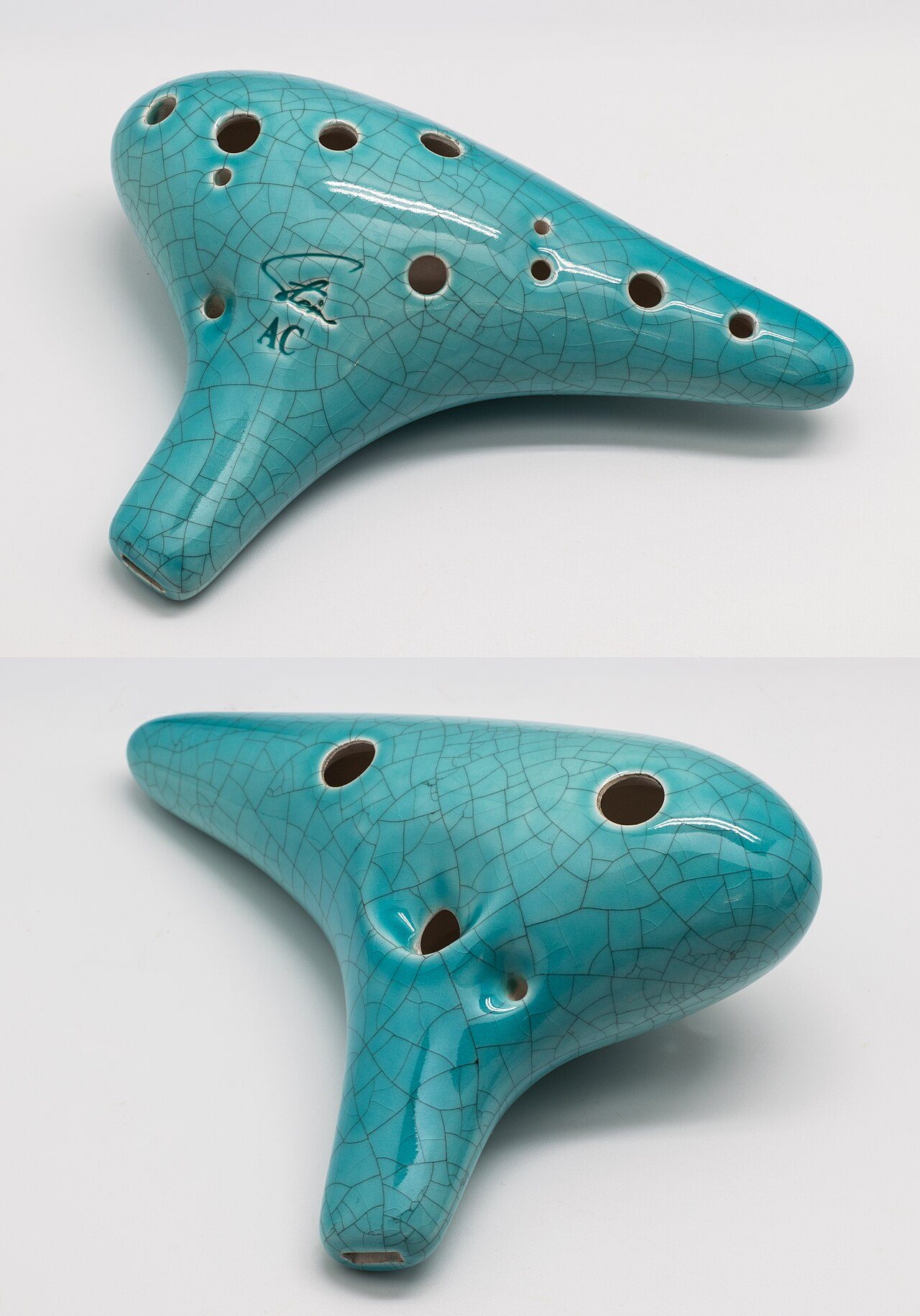
6 min read · 2 sourcesThe ocarina (otherwise known as a potato flute) is a wind musical instrument; it is a type of vessel flute. Variations exist, but a typical ocarina is an enclosed space with four to twelve finger holes and a mouthpiece that projects from the body. It is traditionally made from clay or ceramic, but other materials are also used, such as plastic, wood, glass, metal, or bone. The Italian Ocarina was invented in 1853 by 17-year-old Giuseppe Donati, who also gave it the name ocarina. Donati handmade each ocarina from clay, with anything from 7 to 10 finger-holes and a spout for a mouthpiece. 1
History
The ocarina belongs to a very old family of instruments, believed to date back over 12,000 years. Ocarina-type instruments have been of particular importance as first invented in Chinese and Mesoamerican cultures. For the Chinese, the instrument played an important role in their long history of song and dance. The ocarina has features similar to the xun (塤), another important Chinese instrument (but is different in that the ocarina uses an internal duct, whereas the xun is blown across the outer edge). In Korea, the xun is known as the hun (Korean: 훈; Hanja: 壎). In Japan, the xun is known as the tsuchibue (土笛; lit. 'earthen flute'). Different expeditions to Mesoamerica, including the one conducted by Cortés, resulted in the introduction of the ocarina to the courts of Europe. Both the Maya and Aztecs produced versions of the ocarina, but it was the Aztecs who brought to Europe the song and dance that accompanied the ocarina. The ocarina went on to become popular in European communities as a toy instrument. 1
One of the oldest ocarinas found in Europe is from Runik, Kosovo. The Runik ocarina is a Neolithic flute-like wind instrument, and is the earliest musical instrument ever reported in Kosovo. The modern European ocarina dates back to the 19th century, when Giuseppe Donati from Budrio, a town near Bologna, Italy, transformed the ocarina from a toy, which played only a few notes, into a more comprehensive instrument (known as the first "classical" ocarina). The word ocarina derives from ucaréṅna, which in the Bolognese dialect means "little goose". 1
Uses
French composer Pierre Arvay (1924–1980) wrote several pieces of library music for the ocarina. One of these – Merry ocarina – became well known in the UK when it was used as a regular musical segment in the BBC children's programme Vision On, broadcast between 1964 and 1976. Hungarian-Austrian composer György Ligeti (1923–2006) called for four ocarinas (to be performed by woodwind players who play their own instruments during the rest of the piece) in his Violin Concerto, completed in 1993. In 1974, the Polish composer Krzysztof Penderecki (1933–2020) incorporated 12 ocarinas in his composition The Dream of Jacob. Later, he incorporated 50 in the final section of his Symphony No. 8, completed in 2008, where they are meant to be played by members of the choir. 1
Types
There are many different styles of ocarinas varying in shape and the number of holes: 1
Transverse (Sweet potato) – This is the best-known style of ocarina. It has a rounded shape and is held with two hands horizontally. Depending on the number of holes, the player opens one more hole than the previous note to ascend in pitch. The two most common transverse ocarinas are 10-hole (invented by Giuseppe Donati in Italy) and 12-hole. They have a range of between an octave plus a fourth and an octave plus a minor sixth. Pendants: English Pendant – These are usually very small and portable, and use the English fingering system devised by John Taylor (4–6 holes). This fingering system allows them to achieve a range of between an octave and an octave plus a major second. Peruvian Pendant – Dating from the time of the Incas, used as instruments for festivals, rituals, and ceremonies. They are often seen with designs of animals. They usually have 8–9 holes. Inline – These ocarinas are usually rectangular or oval-shaped and are constructed so that the instrument points away from the musician when played. Most inline ocarinas have a similar or identical fingering system to transverse ocarinas. Multi-chambered ocarinas (usually called "double ocarina" or "triple ocarina" according to the number of chambers) – These are essentially separate ocarinas molded into one body, each chamber having its own mouthpiece and its own set of finger holes. This construction usually either expands the range of the instrument or allows multiple notes to be played at once. Although multi-chamber ocarinas can be made in transverse, inline, or pendant style, the transverse style is the most common. 1
Tone production and acoustics
How an ocarina works: 1
Air enters through the windway Air strikes the labium, producing sound Air pulses in and out of the ocarina, as the vessel resonates a specific pitch (see Helmholtz resonator) Covering holes lowers the pitch; uncovering holes raises the pitch Blowing more softly lowers the pitch; blowing harder raises it. Breath force can change the pitch by several semitones, of which about a third of a semitone either way is useful. Using too much or too little air will create an unpleasant tone. The fact that small changes to the flow of air will change the tuning (rather than the loudness) is why ocarinas generally have no tuning mechanism or dynamic range, and why it is hard to learn to play one in tune. The airstream is directed toward the labium by a fipple or internal duct, which is a narrowing rectangular slot in the mouthpiece, rather than relying on the player's lips to aim the airstream as in a transverse flute. Like other flutes, the airstream alternates quickly between the inner and outer face of the labium as the pressure in the ocarina chamber oscillates. At first, the sound is a broad-spectrum "noise" (i.e. "chiff"), but those frequencies that are identical with the fundamental frequency of the resonating chamber (which depends on the fingering), are selectively amplified. A Helmholtz resonating chamber is unusually selective in amplifying a single frequency. Most resonators also amplify more overtones. As a result, ocarinas and other vessel flutes have a distinctive overtoneless sound. Unlike many flutes, ocarinas do not rely on pipe length to produce a particular tone. Instead, the tone is dependent on the ratio of the total surface area of opened holes to the total cubic volume enclosed by the instrument. 1
Musical notation and tablature
Ocarina music is written in three main ways. The most apparent is the use of sheet music. There are archives of sheet music either specifically written for ocarinas, or adapted from piano sheet music. Since some ocarinas are fully chromatic and can be played in professional musical situations, including classical and folk, sheet music is an ideal notation for ocarinas. Second is the use of numerical tablature, which expresses the musical notes as numbers. 1
The text above is adapted from the Wikipedia article “Ocarina”, available under the Creative Commons Attribution-ShareAlike 4.0 licence. 1
ocarina is small egg-shaped wind instrument with a mouthpiece and finger holes, according to the structured record cited below. This entry was generated automatically from that record and has not yet been reviewed by a person familiar with the tradition. 2
The source record links this tradition to 49 external registers, which can be verified through the citation. 2