The tradition & historical record
5 min read · 2 sourcesOpishnia decorative ceramics (Ukrainian: Опішнянська кераміка) are a type of traditional Ukrainian ceramics from the village of Opishnia in Poltava Oblast, which is one of the largest centers of pottery production in Ukraine. The distinctive decoration emerged during the second half of the nineteenth century, and the region consolidated its reputation for pottery production. Opishnia painting is mostly of plant ornaments: flowers, bunches of grapes, bouquets and wreaths. Characteristic features are the light yellow of the pattern on a red-brown, white or green background. During the twentieth century, there were further developments in style inspired by Soviet political ideology. Political repression in the 1930s and 1950s affected the pottery industry, with potters and other people associated with the industry being sentenced to death or imprisonment. The industry consolidated in the 1960s, and in 1986, the Pottery Museum was founded in the village. In 2001, the museum became the National Museum-Reserve of Ukrainian Pottery concerned with the study, preservation and popularization of Ukraine's pottery heritage. Famous ceramicists include Olga Shiyan, Oleksandra Selyuchenko and Yavdokha Poshyvaylo. 1
History
In the first half of the nineteenth century, ceramics from Opishnia were characterised by geometric motifs. During the second half of the century, these motifs were exchanged for the recognisable fliandrivka decoration. One of the most noted potters of this era was Ostap Nochovnyk, who was best known for his figurative works. By 1893, there were 288 potters working in Opishna; for most of them, pottery was their only source of income. During the twentieth century, the pottery art of Opishnia actively responded to innovations in the social and artistic life of the state. One of the innovations was the use of easel painting elements, which were influenced by Soviet political ideology. The introduction of easel painting elements into Opishnia pottery was initiated by the drawing teacher, icon painter, and painter Petro Kononenko, a graduate of the Stroganov School of Technical Drawing. Potteries in the area also produced ceramic tiles as building decoration in the early twentieth century. In the early 1930s, images of Red Army soldiers began to appear on pottery based on the influence of Soviet ideology. Semen Datsinka, a resident of Opishnia, born in 1917, recalled: 1
I studied [at the Opishnya Ceramic Industrial School] until 1933, because students began to die of hunger. My cousin Yemen died in 1933, he was also a student, we sat at the desk together. I did not finish school, no one finished, it was falling apart, there was hunger. However, they gave us [food], we went to the collective farm, we earned money.... Those were school days, it was spring. 1933. I was trading for pears for 15 rubles in Poltava and went to Dnipropetrovsk. There was work there, as a welder. They gave us a kilogram [of bread]. 1
Manufacture
The potters of Opishnia create their products without any preliminary sketches. Pottery is made from a local type of clay. It has a grayish color, and when fired, it acquires a light yellow hue. The ceramics undergo a 40-day manufacturing cycle. First, the clay is kneaded on special equipment. After a few days, the craftsman begins to shape the product on the potter's wheel. After molding, the clay dries for a week in natural conditions, without additional heating or ventilation. Then the product is fired in a kiln at 850 to 900 °C, after which it is glazed or painted, and then fired again at the same temperature. 1
Decoration
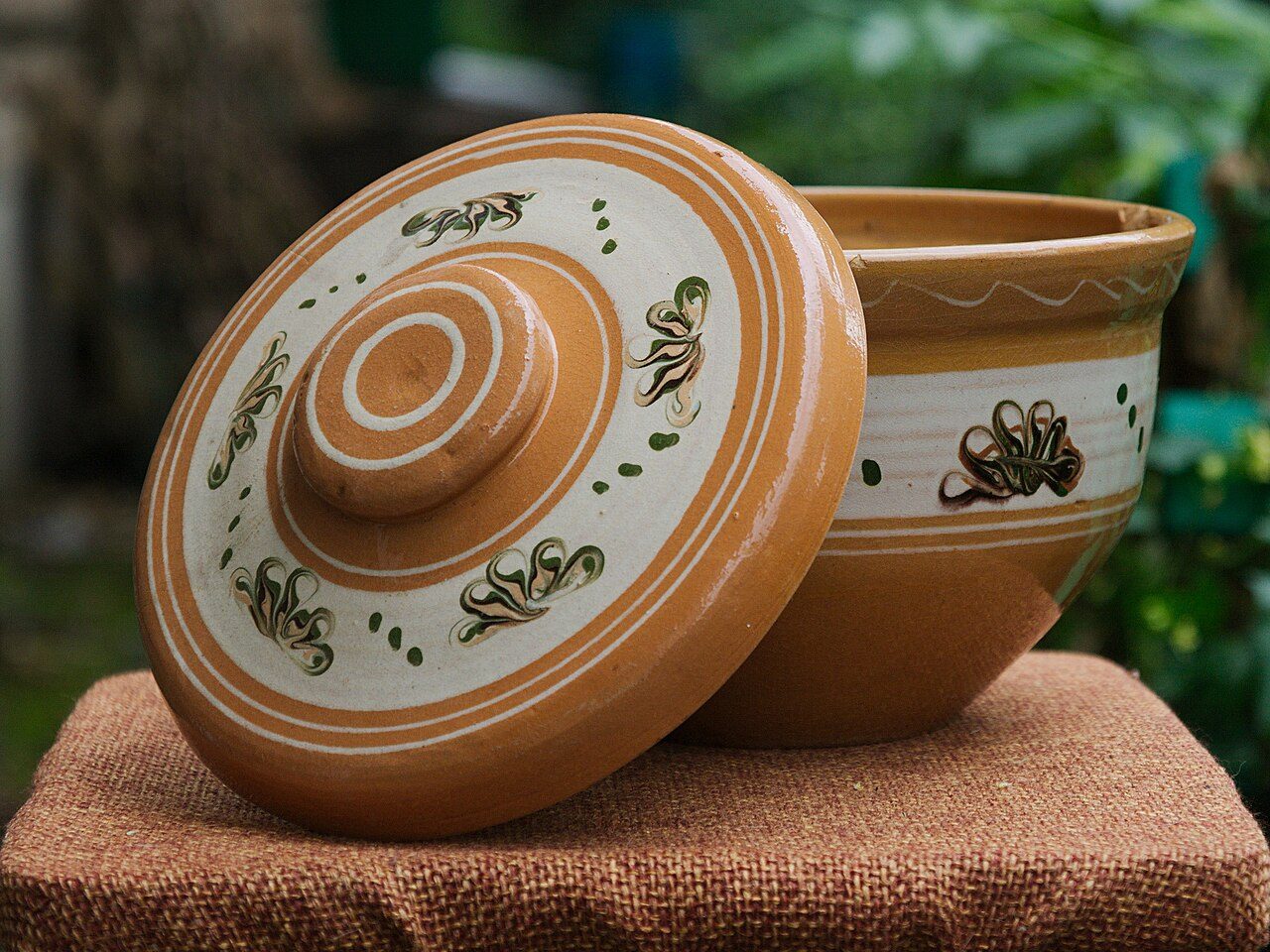
Opishnia painting is mostly of plant ornaments: flowers, bunches of grapes, bouquets and wreaths. Characteristic features are the light yellow color of the pattern, made with the natural color of clay, on a red-brown, white or green background. Colored engobes are used for painting. Products formed on a potter's wheel are first poured with liquid-colored clay, which creates a uniform tone. After a second drying, they are painted using a rubber bulb with a straw on the end; this technique is known as rizhkuvannia. To paint the bowls, an original technique is used, known as fliandrivka, where colours are applied to the vessel with subsequent stretching with a special cooper hook. 1
Notable practitioners
Tykhin Shulzhenko was a Ukrainian ceramic master of the late 19th and early 20th centuries. Olga Shiyan (1914–2001) was a master of folk ceramic toys and sculpture. Oleksandra Selyuchenko (1921–1987) was a Ukrainian ceramist and folk craftswoman. Vasyl Porosny (1873–1942) was a Ukrainian Soviet People's Master of Artistic Ceramics. Havrylo Poshyvaylo (1909–1991) was a representative of the Opishnya school of artistic ceramics. Yavdokha Poshyvaylo (1910–1994) was a pottery artist and representative of the Opishnya school of artistic painting. Vasyl Omelyanenko (born 1925) is a potter from Opishnya. Honored Master of Folk Art of the Ukrainian SSR, Laureate of the Danylo Shcherbakivskyi Prize and the Taras Shevchenko National Prize of Ukraine. Mykhailo Kytrysh (born 1936) is a Ukrainian potter and sculptor. Laureate of the Taras Shevchenko National Prize of Ukraine. Ivan Loboychenko (born 1957) is a Ukrainian potter who specialises in toys and figurines. 1
The text above is adapted from the Wikipedia article “Opishnia decorative ceramics”, available under the Creative Commons Attribution-ShareAlike 4.0 licence. 1
Opishnia decorative ceramics is Traditional ceramics from Poltava region, according to the structured record cited below. This entry was generated automatically from that record and has not yet been reviewed by a person familiar with the tradition. 2
The source record links this tradition to 1 external register, which can be verified through the citation. 2