The tradition & historical record
6 min read · 2 sourcesDecoration in Ottoman architecture takes on several forms, the most prominent of which include tile decoration, painted decoration, and stone carving. Beginning in the 14th century, early Ottoman decoration was largely a continuation of earlier Seljuk styles in Anatolia as well as other predominant styles of decoration found in Islamic art and architecture at the time. Over the course of the next few centuries, a distinctive Ottoman repertoire of motifs evolved, mostly floral motifs, such as rumî, hatayî, and saz styles. Calligraphic inscriptions, most characteristically in a thuluth script, were also a mainstay. From the 18th century onward, this repertoire became increasingly influenced by Western European art and architecture and went as far as directly borrowing techniques and styles from the latter. 1
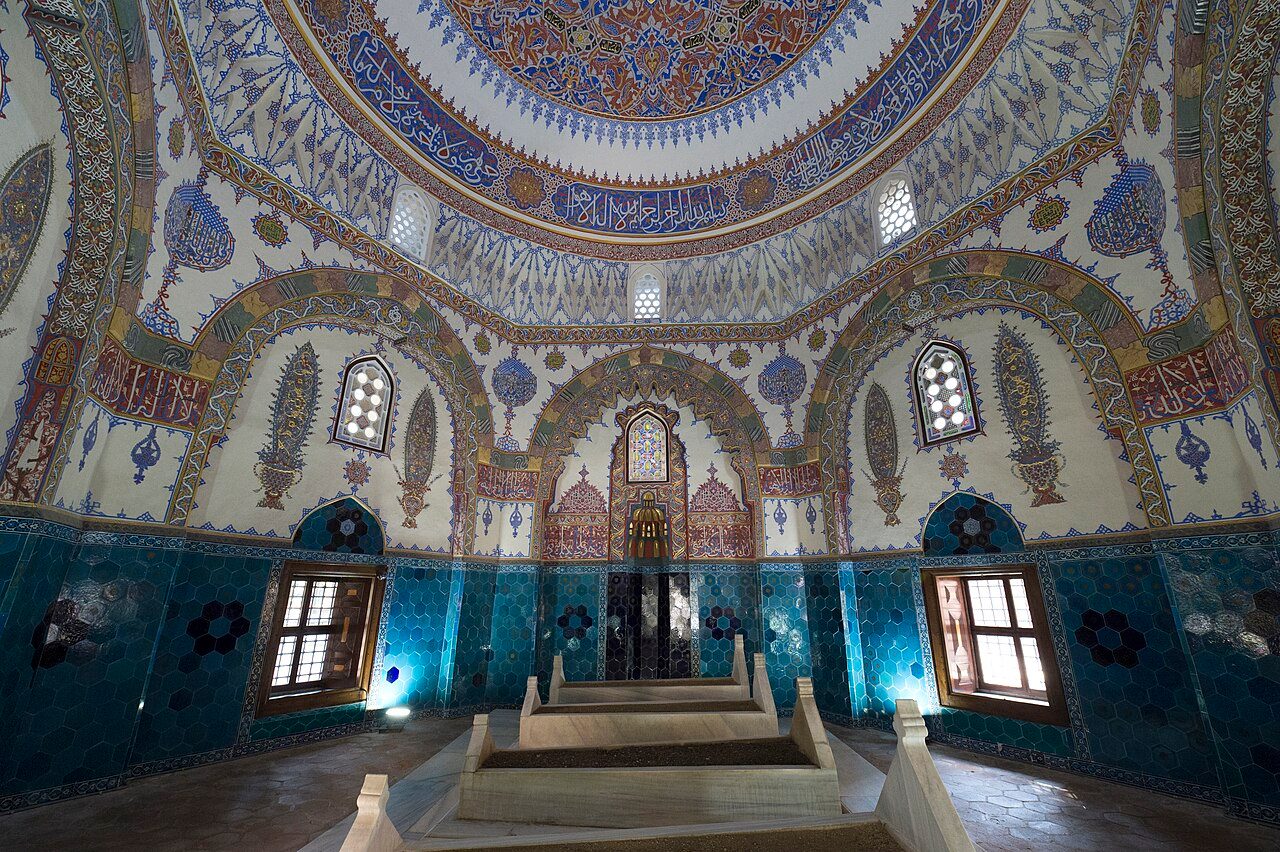
Ottoman tiles attained a prominent role in decoration. Starting in the early 15th century, cuerda seca tiles in vivid colours were widely used in various buildings, using mostly vegetal arabesque motifs, of which the most dramatic early example is the Green Mosque and Green Tomb in Bursa (circa 1424). Various examples of tilework from this century seem to show possible Iranian influence and connections to Timurid art. A distinctive style of blue-and-white fritware, influenced by Chinese motifs and often attributed to an early stage of Iznik tilework, is evidenced by the late 15th century and characterizes the early 16th century. 1
Early Ottoman tilework
Some of the earliest known tile decoration in Ottoman architecture is found in the Green Mosque in Iznik (late 14th century), whose minaret incorporates glazed tiles forming patterns in the brickwork (although the current tiles are modern restorations). This technique was inherited from the earlier Seljuk period. Glazed tile decoration in the cuerda seca technique was used in other early Ottoman monuments, particularly in the Green Mosque and the associated Green Tomb in Bursa (early 15th century). The tiles of the Green Mosque complex generally have a deep green ground mixed with combinations of blue, white, and yellow forming arabesque motifs. A large portion of the tiles are cut into hexagonal and triangular shapes that were then fitted together to form murals. Some of the tiles are further enhanced with arabesque motifs applied in gilt gold glazing over these colours. Inscriptions in the mosque record that the decoration was completed in 1424 by Nakkaş Ali, a craftsman native to Bursa who had been transported to Samarkand by Timur after the Ottoman defeat at the Battle of Ankara in 1402. In Samarkand, he was exposed to Timurid architecture and decoration and brought this artistic experience back with him later. Other inscriptions record the tilemakers as being "Masters of Tabriz", suggesting that craftsmen of Iranian origin were involved. Tabriz was historically a major center of ceramic art in the Islamic world, and its artists appear to have emigrated and worked in many regions from Central Asia to Egypt. The artistic style of these tiles – and of other Ottoman art – was influenced by an "International Timurid" taste that emerged from the intense artistic patronage of the Timurids, who controlled a large empire across the region. 1
Classical Iznik tiles
The city of Iznik had been a center of pottery production under the Ottomans since the 15th century, but until the mid-16th century it was mainly concerned with producing pottery vessels. There is little evidence of large-scale tile manufacture in Iznik before this time. In the late 15th century, in the 1470s or 1480s, the Iznik industry had grown in prominence and patronage and began producing a new "blue-and-white" fritware which adapted and incorporated Chinese motifs in its decoration. Some of these blue-and-white ceramics appear in tile form in the decoration in the Hafsa Hatun Mosque (1522) in Manisa and in the Çoban Mustafa Pasha Mosque (1523) in Gebze. The Hadim Ibrahim Pasha Mosque (1551) also contains panels of well-executed tiles featuring calligraphic and floral decoration in cobalt blue, white, olive green, turquoise, and pale manganese purple. 1
The most extraordinary tile panels from this period are a series of panels on the exterior of Circumcision Pavilion (Sünnet Odası) in Topkapı Palace. The tiles in this composition have been dated to various periods within the 16th century and some were probably moved here during a restoration of the pavilion in the first half of the 17th century. Nonetheless, at least some of the tiles are believed to date from the 1520s and feature large floral motifs in blue, white, and turquoise. Both the Topkapı tiles and the mosque tiles from this early-16th-century period are traditionally attributed to Iznik, but they may have been produced in Istanbul itself in ceramic workshops located at Tekfursaray. Even if they come from Tekfursaray, their style is related to the style of ceramics being made in Iznik around the same time. 1
Tekfursaray, Kütahya, and late period tiles
Tile production in Iznik came to an end in the 18th century. Ahmet III and his grand vizier attempted to revive the tile industry by establishing a new workshop between 1719 and 1724 at Tekfursaray in Istanbul, where a previous workshop had existed in the early 16th century. Production continued here for a while but the tiles from this period are not comparable to earlier Iznik tiles. Pottery production also continued and even increased at Kütahya, where new styles developed alongside imitations of older classical Ottoman designs. The colours of tiles in this period were mostly turquoise and dark cobalt blue, while a brownish-red, yellow, and a deep green also appearing. The background was often discoloured, colours often ran together slightly, and the patterns were again typically limited to single tiles. The earliest recorded Tekfursaray tiles are those made in 1724–1725 for the mihrab of the older Cezeri Kasım Pasha Mosque (1515) in Eyüp, Istanbul. Tekfursaray tiles are also found in the Hekimoğlu Ali Pasha Mosque (1734), on the Ahmed III Fountain (1729) near Hagia Sophia, and in some of the rooms and corridors of the Harem section in Topkapı Palace. Kütahya tiles are present in Istanbul in the Yeni Valide Mosque in Üsküdar (1708–1711), the Beylerbeyi Mosque (1777–1778), and arts of Topkapı Palace, and well as in mosques in other cities like Konya and Antalya. The Kütahya and Tekfursary kilns notably produced a number of tiles and groups of tiles that were painted with illustrations of the Great Mosque of Mecca. These appear in multiple buildings the 18th century, but some examples of this appeared even earlier in Iznik tiles from the late 17th century. Earlier examples show the Kaaba and the surrounding colonnades of the mosque in a more abstract style. 1
Painted decoration
Painting was an essential part of the decoration of Ottoman buildings and it covered interior walls, ceilings, and the inside of domes. 1
Early trends
Early examples indicate that Ottoman decoration developed a preference for floriate motifs. 1
The text above is adapted from the Wikipedia article “Ottoman decoration”, available under the Creative Commons Attribution-ShareAlike 4.0 licence. 1
Ottoman architectural decoration is recorded in open cultural data. The structured record cited below does not describe the practice, and this entry has not yet been reviewed by a person familiar with the tradition. 2