The tradition & historical record
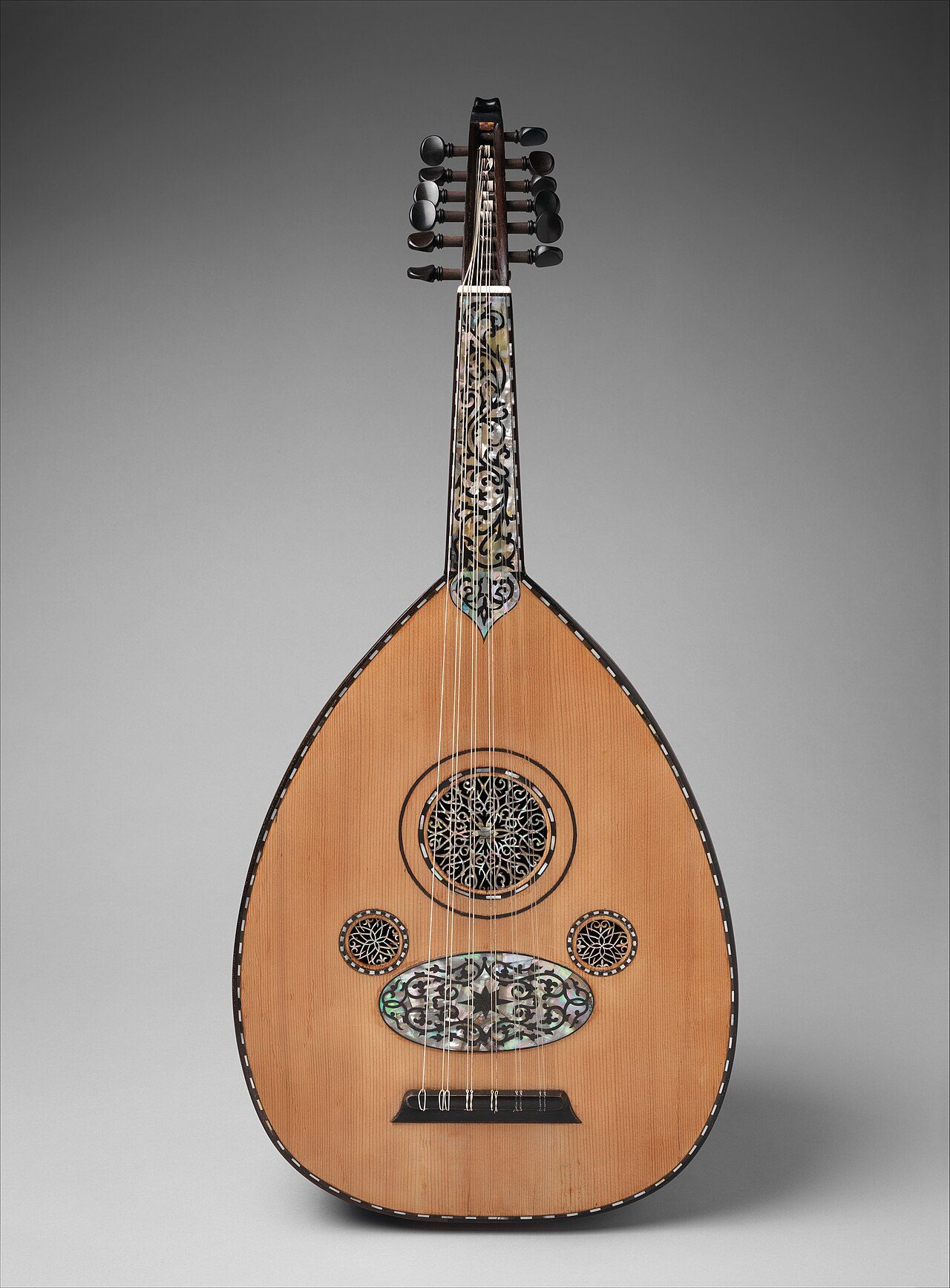
6 min read · 2 sourcesThe oud ( OOD; Arabic: عُود, romanized: ʿūd, pronounced [ʕuːd]) is a Middle Eastern short-neck lute-type, pear-shaped, fretless stringed instrument (a chordophone in the Hornbostel–Sachs classification of instruments), usually with 11 strings grouped in six courses, but some models have five or seven courses, with 10 or 13 strings respectively. The oud is similar to other types of lute, and to Western lutes which developed out of the Medieval Islamic oud. Similar instruments have been used in the Middle East, some predating Islam, such as the barbat from Persia. Different versions of the oud are used in Arabia, Turkey, and other Middle Eastern and Balkan regions. The oud, as a fundamental difference with the western lute, has no frets and a smaller neck. It is the direct successor of the Persian barbat lute. The oldest surviving oud is thought to be in Brussels, at the Museum of Musical Instruments. An early description of the "modern" oud was given by 11th-century musician, singer and author Al-Hasan Ibn al-Haytham (c. 965–1040) in his compendium on music Ḥāwī al-Funūn wa Salwat al-Maḥzūn. The first known complete description of the ‛ūd and its construction is found in the epistle Risāla fī-l-Luḥūn wa-n-Nagham by 9th-century philosopher of the Arabs Yaʻqūb ibn Isḥāq al-Kindī. Kindī's description stands thus: 1
[and the] length [of the ‛ūd] will be: thirty-six joint fingers—with good thick fingers—and the total will amount to three ashbār. And its width: fifteen fingers. 1
Names and etymology
The Arabic: العود (al-ʿūd or oud) literally denotes a thin piece of wood similar to the shape of a straw. It may refer to the wooden plectrum traditionally used for playing the oud, to the thin strips of wood used for the back, or to the wooden soundboard that distinguishes it from similar instruments with skin-faced bodies. Henry George Farmer considers the similitude between al-ʿūd and al-ʿawda ("the return" – of bliss). Multiple theories have been proposed for the origin of the Arabic name oud. The word oud (عود) means "from wood" and "stick" in Arabic. In 1940 Curt Sachs contradicted or refined that idea, saying oud meant flexible stick, not wood. A western scholar of Islamic musical subjects, Eckhard Neubauer, suggested that oud may be an Arabic borrowing from the Persian word rōd or rūd, which meant string. Another researcher, archaeomusicologist Richard J. Dumbrill, suggests that rud came from the Sanskrit rudrī (रुद्री, meaning "string instrument") and transferred to Arabic (a Semitic language) through a Semitic language. While the authors of these statements about the meanings or origins of the word may have accessed linguistic sources, they were not linguists. However, another theory according to Semitic language scholars, is that the Arabic ʿoud is derived from Syriac ʿoud-a, meaning "wooden stick" and "burning wood"—cognate to Biblical Hebrew ’ūḏ, referring to a stick used to stir logs in a fire. Names for the instrument in different languages include Arabic: عود ʿūd or ʿoud (Arabic pronunciation: [ʕu(ː)d, ʢuːd], plural: أعواد aʿwād), Armenian: ուդ, Syriac: ܥܘܕ ūd, Greek: ούτι oúti, Hebrew: עוּד ud, Persian: بربت barbat (although the barbat is a different lute instrument), Turkish: ud or ut, and Azeri: ud 1
Musical instruments from pre-history
The entire complete history of the development of the lute family is not fully compiled at this date, only some of it. The highly influential organologist Curt Sachs distinguished between the "long-necked lute" and the short-necked variety. Douglas Alton Smith argues the long-necked variety should not be called lute at all because it existed for at least a millennium before the appearance of the short-necked instrument that eventually evolved into what is now known as the lute. Musicologist Richard Dumbrill today uses the word more categorically to discuss instruments that existed millennia before the term "lute" was coined. Dumbrill documented more than 3000 years of iconographic evidence for the lutes in Mesopotamia, in his book The Archaeomusicology of the Ancient Near East. According to Dumbrill, the lute family included instruments in Mesopotamia prior to 3000 BC. He points to a cylinder seal as evidence; dating from c. 3100 BC or earlier (now in the possession of the British Museum); the seal depicts on one side what is thought to be a woman playing a stick "lute". Like Sachs, Dumbrill saw length as distinguishing lutes, dividing the Mesopotamian lutes into a long-necked variety and a short. He focuses on the longer lutes of Mesopotamia, and similar types of related necked chordophones that developed throughout the ancient world: Greek, Egyptian (in the Middle Kingdom), Elamites, Hittite, Roman, Bulgar, Turkic, Indian, Chinese, Armenian/Cilician, Canaanite/Phoenician, Israelite/Judean, and various other cultures. He names among the long lutes, the pandura, the panduri, tambur and tanbur. The line of short-necked lutes was further developed to the east of Mesopotamia, in Bactria and Gandhara, into a short, almond-shaped lute. 1
Spread of oud to Europe
When the Umayyads conquered Hispania in 711, they brought their ud along. An oud is depicted as being played by a seated musician in Qasr Amra of the Umayyad dynasty, one of the earliest depictions of the instrument as played in early Islamic history. During the 8th and 9th centuries, many musicians and artists from across the Islamic world flocked to al-Andalus. Among them was Abu l-Hasan ‘Ali Ibn Nafi‘ (789–857), a prominent musician who had trained under Ishaq al-Mawsili (d. 850) in Baghdad and was exiled to al-Andalus before 833 AD. He taught and has been credited with adding a fifth string to his oud and with establishing one of the first schools of music in Córdoba. By the 11th century, Muslim Iberia had become a center for the manufacture of instruments. These goods spread gradually to Provence, influencing French troubadours and trouvères and eventually reaching the rest of Europe. While Europe developed the lute, the oud remained a central part of Arab music, and broader Ottoman music as well, undergoing a range of transformations. Although the major entry of the short lute was in western Europe, leading to a variety of lute styles, the short lute entered Europe in the East as well; as early as the sixth century, the Bulgars brought the short-necked variety of the instrument called Komuz to the Balkans. 1
Origins theory from religious and philosophical beliefs
According to Abū Ṭālib al-Mufaḍḍal (a-n-Naḥawī al-Lughawī) ibn Salma (9th century), who himself refers to Hishām ibn al-Kullā, the oud was invented by Lamech, the descendant of Adam and Cain. Another hypothetical attribution says that its inventor was Mani. Ibn a-ṭ-Ṭaḥḥān adds two possible mythical origins: the first involves the Devil, who would have lured the "People of David" into exchanging (at least part of) their instruments with the oud. He writes himself that this version is not credible. The second version attributes, as in many other cultures influenced by Greek philosophy, the invention of the oud to "Philosophers". 1
Central Asia
One theory is that the oud origina… 1
The text above is adapted from the Wikipedia article “Oud”, available under the Creative Commons Attribution-ShareAlike 4.0 licence. 1
oud is pear-shaped stringed instrument, according to the structured record cited below. This entry was generated automatically from that record and has not yet been reviewed by a person familiar with the tradition. 2
The source record links this tradition to 29 external registers, which can be verified through the citation. 2