The tradition & historical record
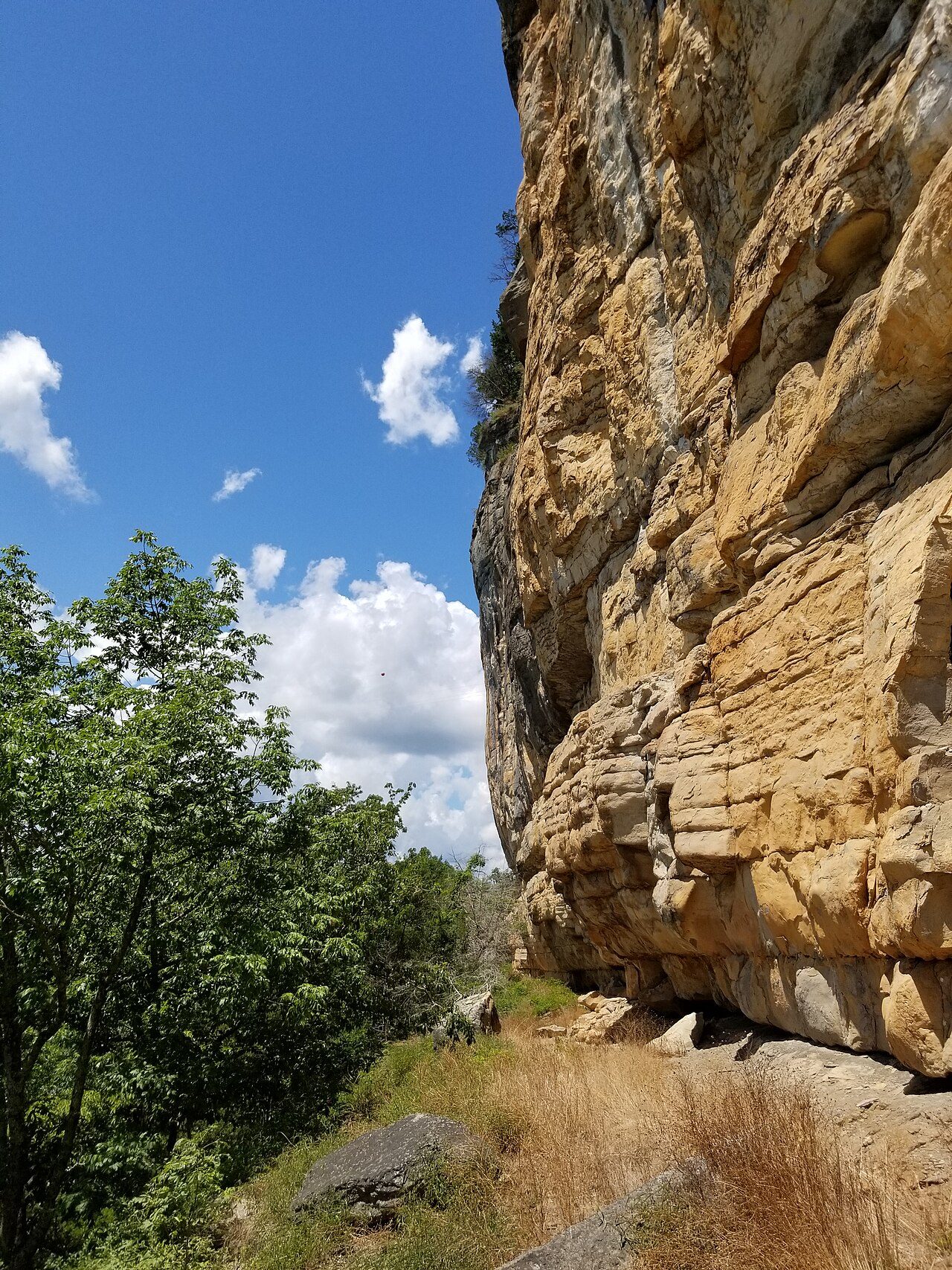
5 min read · 2 sourcesPainted Bluff is a cliff overlooking the Tennessee River in Marshall County, Alabama that features over 130 individual prehistoric Native American pictographs and petroglyphs. Painted Bluff is located about 4 miles (6.4 km) downstream from the Guntersville Dam and is only accessible by boat. The bluff is divided into three levels: the low ledge along the river, a middle ledge above it, and a high ledge near the top of the cliff face. A small cave is located along the low ledge. Due to the humid environment, open-air rock art sites are rare in the Southeastern United States. TVA archaeologist Erin Pritchard considers Painted Bluff to be "one of, if not the, most significant open-air rock art occurrence[s]" in the region. The bluff has been subject to graffiti from the earliest days of its discovery by European Americans, with the oldest graffiti dating to the nineteenth century. Painted Bluff is protected by the Archaeological Resources Protection Act of 1979, meaning that damaging or destroying any property is considered a felony. 1
History
Painted Bluff is a rocky outcropping of limestone that overlooks the Tennessee River. The carboniferous limestone that comprises the bluff formed between 359 and 323 million years ago, predating the formation of the North American contentment. It is mainly composed of Bangor Limestone. Painted Bluff was inhabited by humans throughout the Woodland period into the Mississippian period, from about 800 BC to 1500 AD. The first written references to Painted Bluff are from the nineteenth-century jurist and historian John Haywood in his 1823 book The Natural and Aboriginal History of Tennessee. Haywood moved to Nashville, Tennessee from his home state of North Carolina in 1807 and became fascinated by the prehistoric artifacts and monuments in the region. He believed that these artifacts and monuments were left by one of the Lost Tribes of Israel. In 1959, the rock art of Painted Bluff was the subject of one of the first chemical analyses on rock art pigment ever published. 1
Rock art
Archaeologists have identified a total of 137 prehistoric images at Painted Bluff. Most of the images, 133 in total, are painted pictographs. The remaining four are engraved petroglyphs. These images are distributed across the three ledges of the bluff. There are 5 images located on the low ledge, 115 images on the middle ledge, and 17 images on the high ledge. The rock art images at the painted bluff can be categorized into nine different motifs. These motifs are: circles, lines and curves, boxes and rectangles, patches or swatches, maces, fish, birds, quadrupeds or mammals, anthropomorphs, and others. 1
The most common motif found in the rock art of Painted Bluff is circular shapes. Of the 137 total images, 47 images are various forms of circles. These include "simple rings, solid disks, concentric circles," and "circles filled with lines or crosses. Circles filled with crosses, or "cross-in-circle(s)", are a common Native American religious icon from the Mississippian Period. All but one of the pictographs on the high ledge are circuital motifs. The second most common motif found in the rock art of Painted Bluff is linear forms. Of the 137 total images, 31 are composed of various forms of lines and curves. These include simple line segments, curved lines, groups of overlapping lines, and more complex arrangements such as crosshatching. All four of the engraved petroglyphs are classified in this category. Of the 137 total images, 6 are boxes or rectangles. These pictographs are rectilinear shapes with clear right angles. Some of the examples are not complete or closed rectangles; some of them are either incomplete rectangles with open sides or are partially eroded. 1
Preservation efforts
Beginning in 2004, the TVA partnered with the University of Tennessee's Archaeological research team to document and research Painted Bluff. They discovered that both natural weathering and human activities were damaging the rock art and the site. There was extensive graffiti on the walls of the cliff, more of which continued to appear over the years. The site was also being damaged by rock climbers, who were driving steel anchors into the fragile surface of the cliff and writing climbing routes onto the walls of the rock. In 2013, the Alabama Historical Commission listed Painted Bluff as one of its Places in Peril. In early 2014, a project took place to remove the graffiti from the site. During this project, as many as 122 different instances of graffiti were removed or camouflaged. Historic graffiti older than 50 years was left in place, which was required by the National Historic Preservation Act. In 2016, the project of preservation and graffiti removal at Painted Bluff received the Chairman's Award for Achievement in Historic Preservation from the Advisory Council on Historic Preservation. 1
List of parties involved in preservation efforts
The following organizations and Native American tribes are involved with the preservation efforts at Painted Bluff: 1
The text above is adapted from the Wikipedia article “Painted Bluff”, available under the Creative Commons Attribution-ShareAlike 4.0 licence. 1
Painted Bluff is cliff in Marshall County, Alabama, United States, according to the structured record cited below. This entry was generated automatically from that record and has not yet been reviewed by a person familiar with the tradition. 2
The source record links this tradition to 2 external registers, which can be verified through the citation. 2