The tradition & historical record
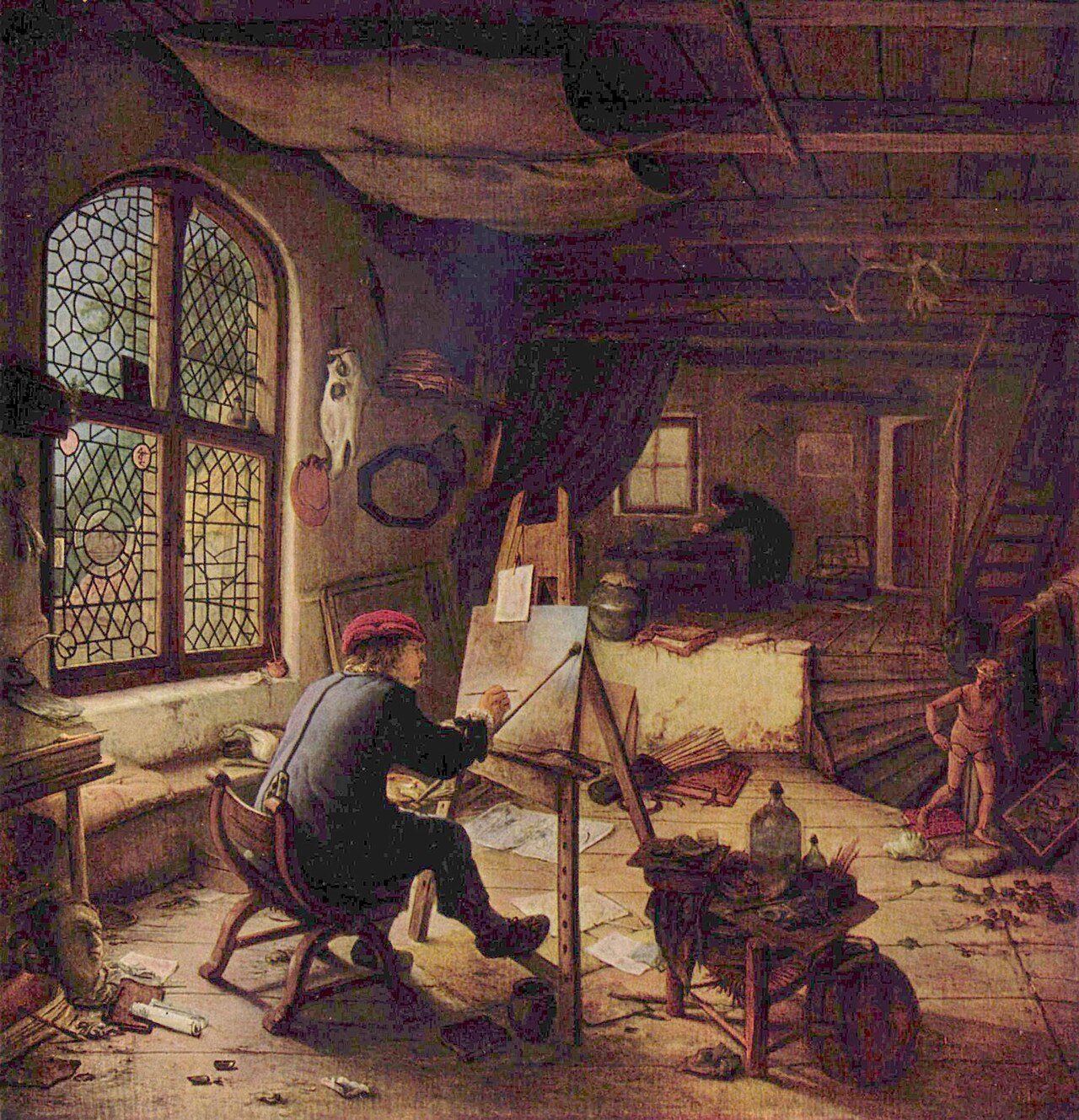
6 min read · 2 sourcesPainting is a visual art, characterized by the practice of applying paint, pigment, color, or other medium to a solid surface. The medium is commonly applied to the base with a brush. Other implements, such as palette knives, sponges, airbrushes, the artist's fingers, or even a dripping technique that uses gravity may be used. One who produces paintings is called a painter. In art, the term "painting" describes both the act and the result of the action (the final work is called "a painting"). The support for paintings includes such surfaces as walls, paper, canvas, wood, glass, lacquer, pottery, leaf, banners, copper and concrete; the painting may incorporate other materials, in single or multiple form, including sand, clay, paper, cardboard, newspaper, plaster, gold leaf, and even entire objects. Painting is an important form of visual art, bringing in elements such as drawing, composition, gesture, narration, and abstraction. Paintings can be naturalistic and representational (as in portraits, still life and landscape painting—though these genres can also be abstract), photographic, abstract, narrative, symbolist (as in Symbolist art), emotive (as in Expressionism) or political in nature (as in Artivism). A significant share of the history of painting in both Eastern and Western art is dominated by religious art. 1
History
The oldest known paintings are more than 40,000–60,000 years old (art of the Upper Paleolithic) and are found in the caves in the district of Maros (Sulawesi, Indonesia). The oldest are often constructed from hand stencils and simple geometric shapes. 1
In November 2018, scientists reported the discovery of the then-oldest known figurative art painting, over 40,000 (perhaps as old as 52,000) years old, of an unknown animal, in the cave of Lubang Jeriji Saléh on the Indonesian island of Borneo. In December 2019, cave paintings portraying pig hunting within the Maros-Pangkep karst region in Sulawesi were discovered to be even older, with an estimated age of at least 43,900 years. This finding was recognized as "the oldest known depiction of storytelling and the earliest instance of figurative art in human history." In 2021, cave art of a pig found in Sulawesi, Indonesia, and dated to over 45,500 years ago, has been reported. On July 3, 2024, the journal Nature published research findings indicating that the cave paintings which depict anthropomorphic figures interacting with a pig and measure 36 by 15 inches (91 by 38 cm) in Leang Karampuang are approximately 51,200 years old, establishing them as the oldest known paintings in the world. There are examples of cave paintings all over the world—in Indonesia, France, Spain, Portugal, Italy, China, India, Australia, Mexico, etc. In Western cultures, oil painting and watercolor painting have rich and complex traditions in style and subject matter. In the East, ink and color ink historically predominated the choice of media, with equally rich and complex traditions. The invention of photography had a major impact on painting. 1
Color and tone
Color, made up of hue, saturation, and value, dispersed over a surface is the essence of painting, just as pitch and rhythm are the essence of music. Color is highly subjective, but has observable psychological effects, although these can differ from one culture to the next. Black is associated with mourning in the West, but in the East, white is. Some painters, theoreticians, writers, and scientists, including Goethe, Kandinsky, and Newton, have written their own color theory. Moreover, the use of language is only an abstraction of color equivalent. The word "red", for example, can cover a wide range of variations from the pure red of the visible spectrum of light. There is not a formalized register of different colors in the way that there is agreement on different notes in music, such as F or C♯. For a painter, color is not simply divided into basic (primary) and derived (complementary or mixed) colors (such as red, blue, green, brown, etc.). Painters deal practically with pigments, so "blue" for a painter can be any of the blues: phthalocyanine blue, Prussian blue, indigo, Cobalt blue, ultramarine, and so on. Psychological and symbolical meanings of color are not, strictly speaking, means of painting. Colors only add to the potential, derived context of meanings, and because of this, the perception of a painting is highly subjective. The analogy with music is quite clear—sound in music (like a C note) is analogous to "light" in painting, "shades" to dynamics, and "coloration" is to painting as the specific timbre of musical instruments is to music. These elements do not necessarily form a melody (in music) of themselves; rather, they can add different contexts to it. 1
Non-traditional elements
Modern artists have extended the practice of painting considerably to include, as one example, collage, which began with Cubism and is not painting in the strict sense. Some modern painters incorporate different materials such as metal, plastic, sand, cement, straw, leaves or wood for the texture. Examples of this are the works of Jean Dubuffet and Anselm Kiefer. There is a growing community of artists who use computers to "paint" color onto a digital "canvas" using programs such as Adobe Photoshop, Corel Painter, and many others. These images can be printed onto traditional canvas if required. 1
Rhythm
Jean Metzinger's mosaic-like Divisionist technique had its parallel in literature; a characteristic of the alliance between Symbolist writers and Neo-Impressionist artists: 1
I ask of divided brushwork not the objective rendering of light, but iridescences and certain aspects of color still foreign to painting. I make a kind of chromatic versification and for syllables, I use strokes which, variable in quantity, cannot differ in dimension without modifying the rhythm of a pictorial phraseology destined to translate the diverse emotions aroused by nature. (Jean Metzinger, c. 1907) 1
Rhythm, for artists such as Piet Mondrian, is important in painting as it is in music. If one defines rhythm as "a pause incorporated into a sequence", then there can be rhythm in paintings. These pauses allow creative force to intervene and add new creations—form, melody, coloration. The distribution of form or any kind of information is of crucial importance in the given work of art, and it directly affects the aesthetic value of that work. This is because the aesthetic value is functionality dependent, i.e. the freedom (of movement) of perception is perceived as beauty. Free flow of energy, in art as well as in other forms of "techne", directly contributes to the aesthetic value. Music was important to the birth of abstract art since music is abstract by nature—it does not try to represent the exterior world, but expresses in an immediate way the inner feelings of the soul. Wassily Kandinsky often used musical terms to identify his works; he called his most spontaneous paintings "improvisations" and described more elaborate works as "compositions". 1
Aesthetics and theory
Aesthetics is the stu… 1
The text above is adapted from the Wikipedia article “Painting”, available under the Creative Commons Attribution-ShareAlike 4.0 licence. 1
painting is practice of applying paint, pigment, color or other medium to a surface, according to the structured record cited below. This entry was generated automatically from that record and has not yet been reviewed by a person familiar with the tradition. 2
The source record links this tradition to 65 external registers, which can be verified through the citation. 2