The tradition & historical record
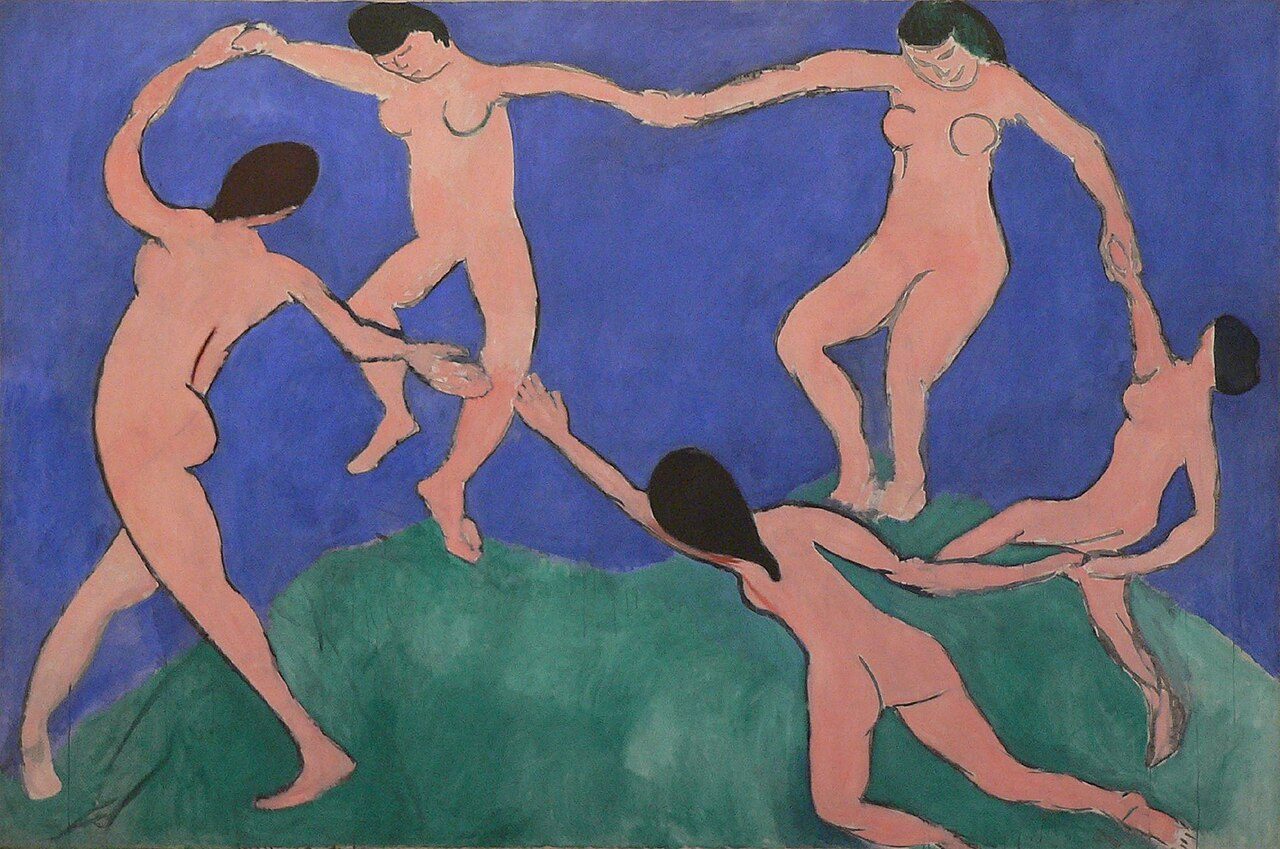
6 min read · 2 sources20th-century Western painting begins with the heritage of late-19th-century painters Vincent van Gogh, Paul Cézanne, Paul Gauguin, Georges Seurat, Henri de Toulouse-Lautrec, and others who were essential for the development of modern art. At the beginning of the 20th century, Henri Matisse and several other young artists including the pre-cubist Georges Braque, André Derain, Raoul Dufy and Maurice de Vlaminck, revolutionized the Paris art world with "wild", multi-colored, expressive landscapes and figure paintings that the critics called Fauvism. Matisse's second version of The Dance signified a key point in his career and in the development of modern painting. It reflected Matisse's incipient fascination with primitive art: the intense warm color of the figures against the cool blue-green background and the rhythmical succession of the dancing nudes convey the feelings of emotional liberation and hedonism. Initially influenced by Toulouse-Lautrec, Gauguin, and other late-19th-century innovators, Pablo Picasso made his first cubist paintings based on Cézanne's idea that all depiction of nature can be reduced to three solids: cube, sphere, and cone. With the painting Les Demoiselles d'Avignon (1907; see gallery) Picasso created a new and radical picture depicting a raw and primitive brothel scene with five prostitutes, violently painted women, reminiscent of African tribal masks and his own new proto-Cubist inventions. 1
Pioneers of abstraction
Wassily Kandinsky, a Russian painter, printmaker and art theorist, is generally considered the first important painter of modern abstract art. As an early modernist, in search of new modes of visual expression, and spiritual expression, he theorized—as did contemporary occultists and theosophists—that pure visual abstraction had corollary vibrations with sound and music. They posited that pure abstraction could express pure spirituality. His earliest abstractions were generally titled (as the example in the above gallery) Composition VII, making connection to the work of the composers of music. Kandinsky included many of his theories about abstract art in his book Concerning the Spiritual in Art. Piet Mondrian's art was also related to his spiritual and philosophical studies. In 1908 he became interested in the theosophical movement launched by Helena Petrovna Blavatsky in the late 19th century. Blavatsky believed that it was possible to attain a knowledge of nature more profound than that provided by empirical means, and much of Mondrian's work for the rest of his life was inspired by his search for that spiritual knowledge. Other major pioneers of early abstraction include Swedish painter Hilma af Klint, Russian painter Kazimir Malevich, and Swiss painter Paul Klee. Robert Delaunay was a French artist who is associated with Orphism, (reminiscent of a link between pure abstraction and cubism). His later works were more abstract, reminiscent of Paul Klee. His key contributions to abstract painting refer to his bold use of color, and a clear love of experimentation of both depth and tone. 1
Fauvism, Der Blaue Reiter, Die Brücke
Les Fauves (French for The Wild Beasts) were early-20th-century painters, experimenting with freedom of expression through color. The name was given, humorously and not as a compliment, to the group by art critic Louis Vauxcelles. Fauvism was a short-lived and loose grouping of artists whose works emphasized painterly qualities and the imaginative use of deep color over the representational values. Fauvists made the subject of the painting easy to read and exaggerated perspectives. A prescient prediction of the Fauves was expressed in 1888 by Paul Gauguin to Paul Sérusier: "How do you see these trees? They are yellow. So, put in yellow; this shadow, rather blue, paint it with pure ultramarine; these red leaves? Put in vermilion." The leaders of the movement were Henri Matisse and André Derain—friendly rivals of a sort, each with his own followers. Ultimately Matisse became the yang to Picasso's yin in the 20th century. Fauvist painters included Albert Marquet, Charles Camoin, Maurice de Vlaminck, Raoul Dufy, Othon Friesz, the Dutch painter Kees van Dongen, and Picasso's partner in Cubism, Georges Braque amongst others. Fauvism, as a movement, had no concrete theories, and was short lived, beginning in 1905 and ending in 1907. The Fauves had only three exhibitions. Matisse was seen as the leader of the movement, due to his seniority in age and prior self-establishment in the academic art world. His 1905 portrait of Mme. Matisse, The Green Line (above), caused a sensation in Paris when it was first exhibited. He said he wanted to create art to delight; art as a decoration was his purpose and it can be said that his use of bright colors tries to maintain serenity of composition. 1
Expressionism, Symbolism, American Modernism, Bauhaus
Expressionism and Symbolism are broad rubrics encompassing several important and related movements in 20th-century painting that dominated much of the avant-garde art being made in Western, Eastern, and Northern Europe. Expressionist works were painted largely between World War I and World War II, mostly in France, Germany, Norway, Russia, Belgium, and Austria. Expressionist styles are related to those of both Surrealism and Symbolism and are each uniquely and somewhat eccentrically personal. Fauvism, Die Brücke, and Der Blaue Reiter are three of the best known groups of Expressionist and Symbolist painters. Artists as interesting and diverse as Marc Chagall, whose painting I and the Village, (above) tells an autobiographical story that examines the relationship between the artist and his origins, with a lexicon of artistic Symbolism. Gustav Klimt, Egon Schiele, Edvard Munch, Emil Nolde, Chaïm Soutine, James Ensor, Oskar Kokoschka, Ernst Ludwig Kirchner, Yitzhak Frenkel Frenel, Max Beckmann, Franz Marc, Käthe Schmidt Kollwitz, Georges Rouault, Amedeo Modigliani and some of the Americans abroad like Marsden Hartley, and Stuart Davis, were considered influential expressionist painters. Although Alberto Giacometti is primarily thought of as an intense Surrealist sculptor, he made intense expressionist paintings as well. In the USA during the period between World War I and World War II painters tended to go to Europe for recognition. Modernist artists like Marsden Hartley, Patrick Henry Bruce, Gerald Murphy and Stuart Davis, created reputations abroad. While Patrick Henry Bruce, created cubist related paintings in Europe, both Stuart Davis and Gerald Murphy made paintings that were early inspirations for American pop art and Marsden Hartley experimented with expressionism. 1
Dada and Surrealism
Marcel Duchamp came to international prominence in the wake of the New York City Armory Show in 1913 where his Nude Descending a Staircase became the cause célèbre. He subsequently created The Bride Stripped Bare by Her Bachelors, Even, Large Glass. The Large Glass pushed the art of painting to radical new limits being part painting, part collage, part construction. 1
Neue Sachlichkeit, Social realism, regionalism, American Scene painting, Symbolism
During the 1920s and the 1930s and the Great Depression, the European art … 1
The text above is adapted from the Wikipedia article “20th-century Western painting”, available under the Creative Commons Attribution-ShareAlike 4.0 licence. 1
painting of the 20th century is art in the Western world during the 20th century, according to the structured record cited below. This entry was generated automatically from that record and has not yet been reviewed by a person familiar with the tradition. 2
The source record links this tradition to 1 external register, which can be verified through the citation. 2