The tradition & historical record
4 min read · 2 sourcesThe painting of the Tarnovo Artistic School was the mainstream of the Bulgarian fine arts between 13th and 14th centuries named after the capital and the main cultural center of the Second Bulgarian Empire, Tarnovo. Although it was influenced by some tendencies of the Palaeogan Renaissance in the Byzantine Empire, the Tarnovo painting had its own unique features which makes it a separate artistic school. It includes mural decoration of churches, easel painting icons, and illuminated manuscripts. A few remains of mosaics have been found during archaeological excavation which shows that this technique was only rarely used in the Bulgarian Empire. The works of that school have some degree of realism, individualised portraits and psychological insight. 1
Illuminated manuscripts
The most famous manuscripts are the Sofia Psalter, 1337, Tomić Psalter, c 1360, and the Gospels of Tsar Ivan Alexander, 1355–1356, now in Sofia, Moscow and London respectively. All are heavily illuminated. 1
Mural painting
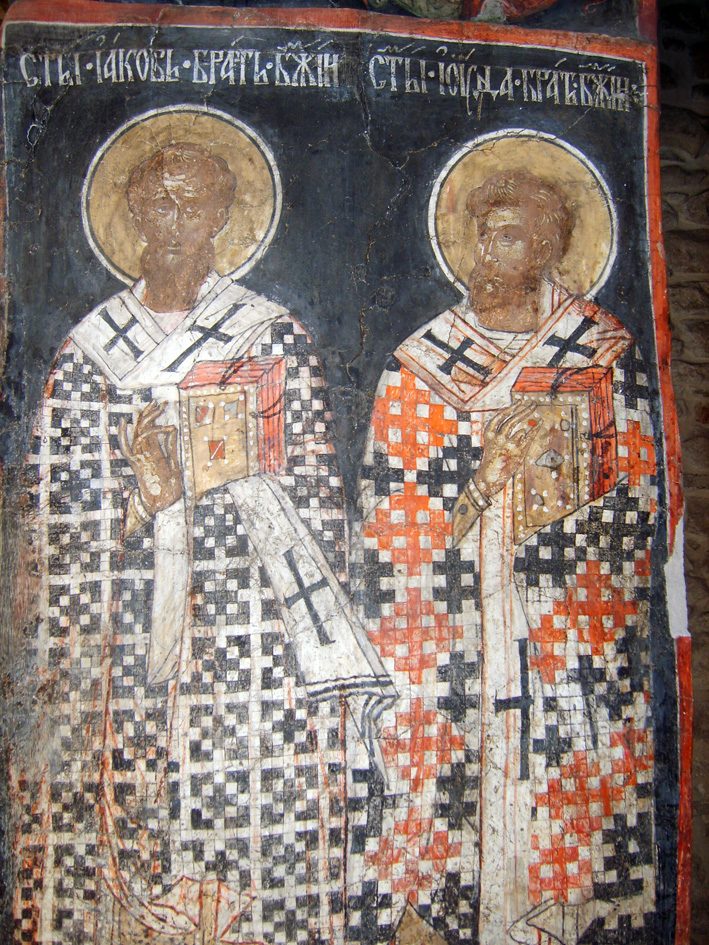
For the first time in Eastern Europe the tempera method became widespread in the murals of the Tarnovo School of Art. That technique allowed the work to proceed slower than the fresco method as well brighter and more saturated colouring and had potential for more additional colours. The fresco technique continued to be used, for instance in the beautiful frescoes of the Rock-hewn Churches of Ivanovo and the chapel of the Hrelyo Tower in the Rila Monastery. During the Second Empire the murals on the church walls closely encompassed every part of the surface: walls, vaults, columns, wall piers, arches, apses. Their positioning was in horizontal layers according to the church canon. 1
On the first layer were depicted saints who were usually stepped on a high painted plinth, which is one of the characteristic features of the School. Its lines imitated the panel plates of coloured marble. The selection of saints depended on the preferences of the ktitors or on the general theme of the frescoes. Typical feature of the Tarnovo Artistic School are the numerous depictions of warrior-saints. For instance, in the Boyana Church there are ten warrior-saints. Widely spread was the image St Demetrius of Salonica, the patron saint of the Asen dynasty, who was particularly popular in Bulgaria in 13th and 14th centuries. The ktitors were depicted in the narthex of the churches. Portraits of many noble Bulgarians from the Middle Ages have survived throughout the centuries due to that practice. In the Boyana Church are preserved the images of Emperor Constantine Tikh Asen, his wife Irina, sebastokrator Kaloyan and his wife Desislava. 1
Icons
The Tarnovo school continued and enriched the traditions and icon design of the First Bulgarian Empire. Some notable icons include St Eleusa (13th century) from Nessebar which is currently kept in the Alexander Nevski Cathedral in Sofia and St John of Rila (14th century) kept in the Rila Monastery. Like the Boyana Church frescoes in the second one there is realism and non-canonical design. Another feature of the school's iconography were the large icons which were made to fascinate the viewer. An example of such icon is the Poganovo icon in the cathedral of Sofia depicting St Mary with John the Baptist which was produced in 1395. It is double-sided and with a size of 93x61 cm. The icons were produced with varied material. The famous ceramics icon from the Preslav School during the First Empire remained relatively popular during 13th century. Icons for domestic use were usually 30x35 cm while those in the church altar could reach very large sizes. Bulgarian icon painting declined after the Ottoman conquest of the country but those traditions were continued during the Bulgarian National Revival. 1
The text above is adapted from the Wikipedia article “Painting of the Tarnovo Artistic School”, available under the Creative Commons Attribution-ShareAlike 4.0 licence. 1
Painting of the Tarnovo Artistic School is 13th- to 14th-century Bulgarian painting, according to the structured record cited below. This entry was generated automatically from that record and has not yet been reviewed by a person familiar with the tradition. 2
The source record links this tradition to 1 external register, which can be verified through the citation. 2