The tradition & historical record
7 min read · 2 sourcesA panel painting is a painting made on a flat panel of wood, either a single piece or a number of pieces joined together. Until canvas became the more popular support medium in the 16th century, panel painting was the normal method, when not painting directly onto a wall (fresco) or on vellum (used for miniatures in illuminated manuscripts). Wood panels were also used for mounting vellum paintings. 1
History
Panel painting is very old; it was a very prestigious medium in Greece and Rome, but only very few examples of ancient panel paintings have survived. A series of 6th century BC painted tablets from Pitsa (Greece) represent the oldest surviving Greek panel paintings. Most classical Greek paintings that were famous in their day seem to have been of a size comparable to smaller modern works – perhaps up to a half-length portrait size. However, for a generation in the second quarter of the fifth-century BC there was a movement, called the "new painting" and led by Polygnotus, for very large painted friezes, apparently painted on wood, decorating the interiors of public buildings with very large and complicated subjects containing numerous figures at least half life-size, and including battle scenes. We can only attempt to imagine what these looked like from some detailed literary descriptions and vase-paintings that appear to echo their compositions. The first century BC to third century AD Fayum mummy portraits, preserved in the exceptionally dry conditions of Egypt, provide the bulk of surviving panel painting from the Imperial Roman period – about 900 face or bust portraits survive. The Severan Tondo, also from Roman Egypt (about 200 AD), is one of the handful of non-funerary Graeco-Roman specimens to survive. Wood has always been the normal support for the Icons of Byzantine art and the later Orthodox traditions, the earliest of which (all in Saint Catherine's Monastery) date from the 5th or 6th centuries, and are the oldest panel paintings which seem to be of the highest contemporary quality. Encaustic and tempera are the two techniques used in antiquity. 1
Panel construction and preparation
The technique is known to us through Cennino Cennini's "The Craftsman's Handbook" (Il libro dell' arte) published in 1390, and other sources. It changed little over the centuries. It was a laborious and painstaking process: 1
A carpenter would construct a solid wood piece the size of the panel needed. Usually a radial cut piece was preferred (across rather than along the length of the tree; the opposite of most timber cuts), with the outer sapwood excluded. In Italy it was usually seasoned poplar, willow or linden. It would be planed and sanded and if needed, joined with other pieces to obtain the desired size and shape. The wood would be coated with a mixture of animal-skin glues and resin and covered with linen (the mixture and linen combination was known as a "size"); this might be done by a specialist, or in the artists studio. Once the size had dried, layer upon layer of gesso would be applied, each layer sanded down before the next applied, sometimes as many as 15 layers, before a smooth hard surface emerged, not unlike ivory. This stage was not necessarily done after the 16th century, or darker grounds were used. 1
Painting techniques
Once the panel construction was complete, the design was laid out, usually in charcoal. The usual ancient painting technique was encaustic, used at Al-Fayum and in the earliest surviving Byzantine icons, which are at the Saint Catherine's Monastery. This uses heated wax as the medium for the pigments. This was replaced before the end of first millennium by tempera, which uses an egg-yolk medium. Using small brushes dipped in a mixture of pigment and egg-yolk, the paint was applied in very small, almost transparent, brushstrokes. Thin layers of paint would be used to create volumetric forms. By the beginning of the 15th century, oil painting was developed. This was more tolerant, and allowed the exceptional detail of Early Netherlandish art. This used a very painstaking multi-layered technique, where the painting, or a particular part of it, had to be left for a couple of days for one layer to dry before the next was applied. 1
Conservation and scientific analysis
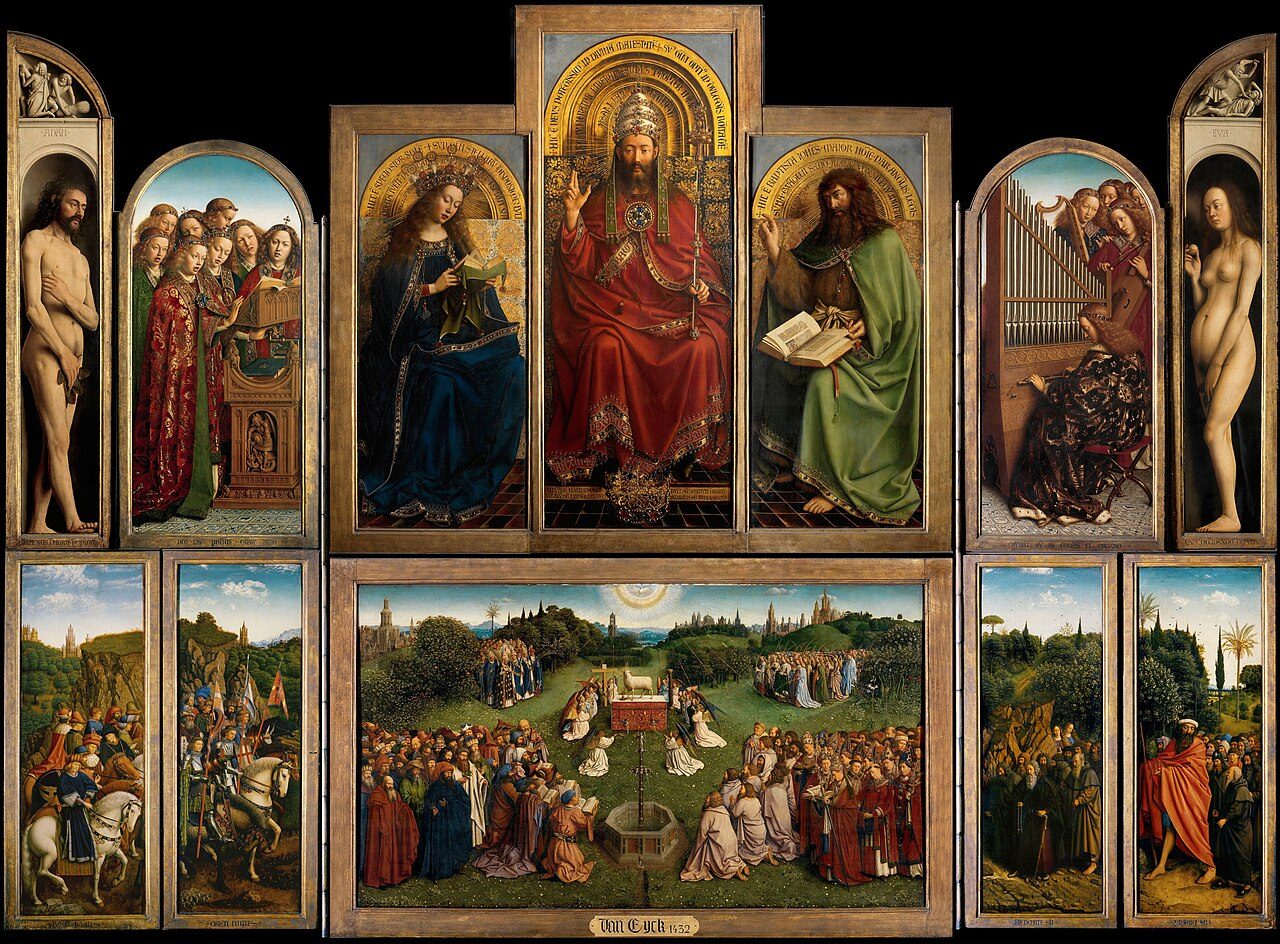
Wood panels, especially if kept with too little humidity, often warp and crack with age, and from the 19th century, when reliable techniques were developed, many have been transferred to canvas or modern board supports. This can result in damage to the paint layer, as historical transfer techniques were rather brutal. Paintings on wood panel that were expanded, such as Rubens' A View of Het Steen in the Early Morning (which consists of eighteen separate panels, seventeen added as the artist enlarged his composition), often suffer greatly over time. Each warps in its own way, tearing the overall piece apart at the seams. Wood panel is now rather more useful to art historians than canvas, and in recent decades there has been great progress in extracting this information. Many fakes have been discovered and mistaken datings corrected. Specialists can identify the tree species used, which varied according to the area where the painting was made. Carbon-dating techniques can give an approximate date-range (typically to a range of about 20 years), and dendrochronology sequences have been developed for the main source areas of timber for panels. Italian paintings used local or sometimes Dalmatian wood, most often poplar, but including chestnut, walnut, oak and other woods. The Netherlands ran short of local timber early in the 15th century, and most Early Netherlandish masterpieces are Baltic oak, often Polish, cut north of Warsaw and shipped down the Vistula, across the Baltic to the Netherlands. 1
Types of wood
Artists would typically use wood native to the region. Albrecht Dürer (1471–1528), for example, painted on poplar when he was in Venice and on oak when in the Netherlands and southern Germany. Leonardo da Vinci (1452–1519) used oak for his paintings in France; Hans Baldung Grien (1484/85–1545) and Hans Holbein (1497/98–1543) used oak while working in southern Germany and England. In the Middle Ages, spruce and lime were used in the Upper Rhine and often in Bavaria. Outside of the Rhineland, softwood (such as pinewood) was mainly used. Of a group of twenty Norwegian altar frontals from the Gothic period (1250–1350) fourteen were made of fir, two of oak, and four of pine (Kaland 1982). Large altars made in Denmark during the fifteenth century used oak for the figures as well as for the painted wings. Lime was popular with Albrecht Altdorfer (c. 1480–1538), Baldung Grien, Christoph Amberger (d. 1562), Dürer, and Lucas Cranach the Elder (1472–1553). Cranach often used beech wood—an unusual choice. In Northern Europe, poplar is very rarely found, but walnut and chestnut are not uncommon. In the northeast and south, coniferous trees such as spruce, and various types of fir, and pine have been used. Fir wood is shown to have been used in the Upper and Middle Rhine, Augsburg, Nuremberg, and Saxony. 1
The text above is adapted from the Wikipedia article “Panel painting”, available under the Creative Commons Attribution-ShareAlike 4.0 licence. 1
panel painting is painting made on a flat panel made of wood, according to the structured record cited below. This entry was generated automatically from that record and has not yet been reviewed by a person familiar with the tradition. 2
The source record links this tradition to 18 external registers, which can be verified through the citation. 2