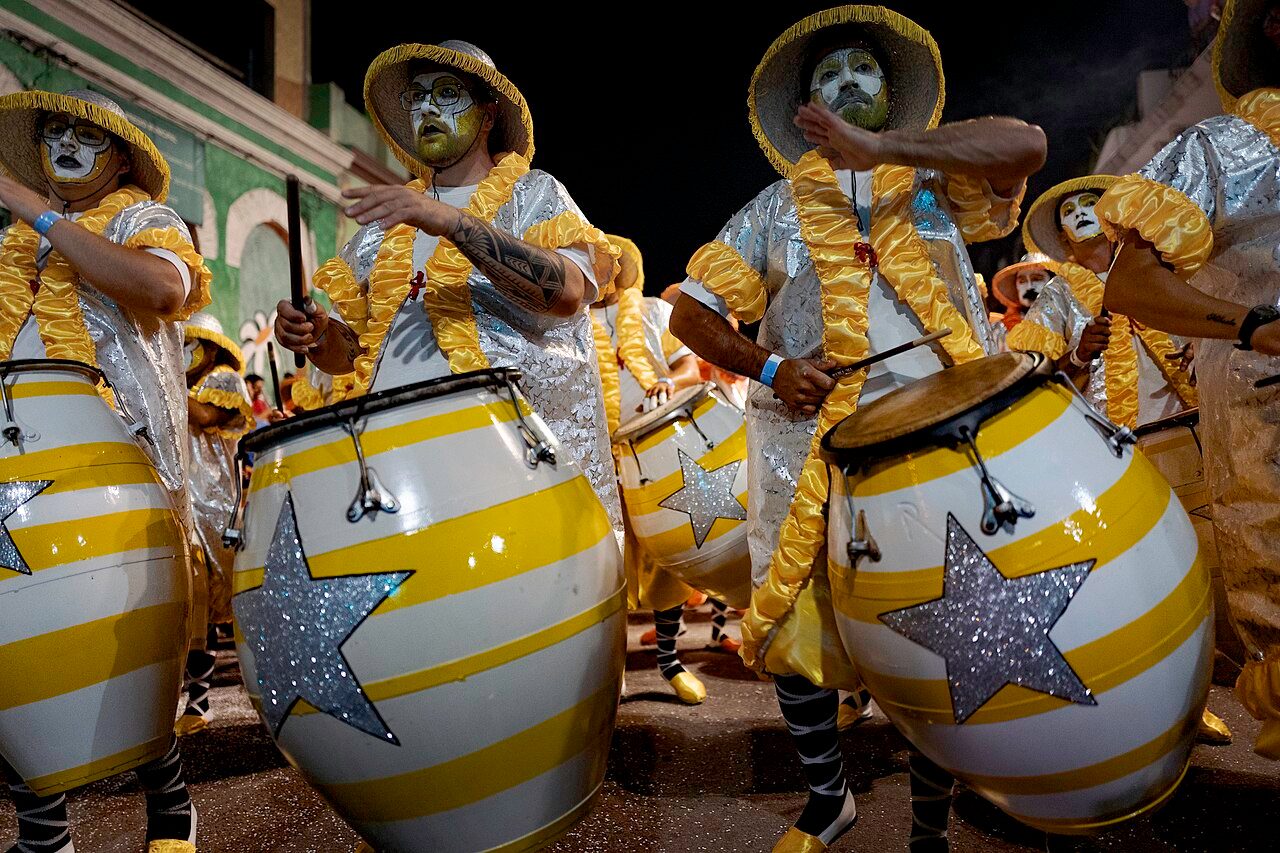
The tradition & historical record
5 min read · 2 sourcesA percussion instrument is a musical instrument that is sounded by being struck or scraped by a beater including attached or enclosed beaters or rattles struck, scraped or rubbed by hand or struck against another similar instrument. Excluding zoomusicological instruments and the human voice, the percussion family is believed to include the oldest musical instruments. In spite of being a very common term to designate instruments, and to relate them to their players, the percussionists, percussion is not a systematic classificatory category of instruments, as described by the scientific field of organology. It is shown below that percussion instruments may belong to the organological classes of idiophone, membranophone, aerophone and chordophone. The percussion section of an orchestra most commonly contains instruments such as the timpani, snare drum, bass drum, tambourine, belonging to the membranophones, and cymbals and triangle, which are idiophones. However, the section can also contain aerophones, such as whistles and sirens, or a blown conch shell. Percussive techniques can even be applied to the human body itself, as in body percussion. On the other hand, keyboard instruments, such as the celesta, are not normally part of the percussion section, but keyboard percussion instruments such as the glockenspiel and xylophone (which do not have piano keyboards) are included. 1
Function
Percussion instruments may play not only rhythm, but also melody and harmony. Percussion is commonly referred to as "the backbone" or "the heartbeat" of a musical ensemble, often working in close collaboration with bass instruments, when present. In jazz and other popular music ensembles, the pianist, bassist, drummer and sometimes the guitarist are referred to as the rhythm section. Most classical pieces written for full orchestra since the time of Haydn and Mozart are orchestrated to place emphasis on the strings, woodwinds, and brass. However, often at least one pair of timpani is included, though they rarely play continuously. Rather, they serve to provide additional accents when needed. In the 18th and 19th centuries, other percussion instruments (like the triangle or cymbals) have been used, again generally sparingly. The use of percussion instruments became more frequent in the 20th century classical music. In almost every style of music, percussion plays a pivotal role. In military marching bands and pipes and drums, it is the beat of the bass drum that keeps the soldiers in step and at a regular speed, and it is the snare that provides that crisp, decisive air to the tune of a regiment. In classic jazz, one almost immediately thinks of the distinctive rhythm of the hi-hats or the ride cymbal when the word-swing is spoken. In more recent popular-music culture, it is almost impossible to name three or four rock, hip-hop, rap, funk or even soul charts or songs that do not have some sort of percussive beat keeping the tune in time. Because of the diversity of percussive instruments, it is not uncommon to find large musical ensembles composed entirely of percussion. Rhythm, melody, and harmony are all represented in these ensembles. 1
Percussion notation
Music for pitched percussion instruments can be notated on a staff with the same treble and bass clefs used by many non-percussive instruments. Music for percussive instruments without a definite pitch can be notated with a specialist rhythm or percussion-clef. The guitar also has a special "tab" staff. More often a bass clef is substituted for rhythm clef. 1
Classification
Percussion instruments are classified by various criteria sometimes depending on their construction, ethnic origin, function within musical theory and orchestration, or their relative prevalence in common knowledge. The word percussion derives from the Latin verb percussio to beat, strike in the musical sense, and the noun percussus, a beating. As a noun in contemporary English, Wiktionary describes it as the collision of two bodies to produce a sound. The term is not unique to music, but has application in medicine and weaponry, as in percussion cap. However, all known uses of percussion appear to share a similar lineage beginning with the original Latin percussus. In a musical context then, the percussion instruments may have been originally coined to describe a family of musical instruments including drums, rattles, metal plates, or blocks that musicians beat or struck to produce sound. The Hornbostel–Sachs system has no high-level section for percussion. Most percussion instruments as the term is normally understood are classified as idiophones and membranophones. However the term percussion is instead used at lower-levels of the Hornbostel–Sachs hierarchy, including to identify instruments struck with either a non sonorous object hand, stick, striker or against a non-sonorous object human body, the ground. This is opposed to concussion, which refers to instruments with two or more complementary sonorous parts that strike against each other and other meanings. 1
By methods of sound production
Many texts, including Teaching Percussion by Gary Cook of the University of Arizona, begin by studying the physical characteristics of instruments and the methods by which they can produce sound. This is perhaps the most scientifically pleasing assignment of nomenclature whereas the other paradigms are more dependent on historical or social circumstances. Based on observation and experimentation, one can determine how an instrument produces sound and then assign the instrument to one of the following four categories: 1
Idiophone
"Idiophones produce sounds through the vibration of their entire body." Examples of idiophones: 1
The text above is adapted from the Wikipedia article “Percussion instrument”, available under the Creative Commons Attribution-ShareAlike 4.0 licence. 1
percussion instrument is type of musical instrument that produces a sound by directly hitting it, according to the structured record cited below. This entry was generated automatically from that record and has not yet been reviewed by a person familiar with the tradition. 2
The source record links this tradition to 47 external registers, which can be verified through the citation. 2