The tradition & historical record
6 min read · 2 sourcesA Persian miniature (Persian: نگارگری ایرانی, romanized: negârgari-ye Irâni) is a small Persian painting on paper, whether a book illustration or a separate work of art intended to be kept in an album of such works called a muraqqa. The techniques are broadly comparable to the Western Medieval and Byzantine traditions of miniatures in illuminated manuscripts. Although there is an equally well-established Persian tradition of wall-painting, the survival rate and state of preservation of miniatures is better, and miniatures are much the best-known form of Persian painting in the West, and many of the most important examples are in Western, or Turkish, museums. Miniature painting became a significant genre in Persian art in the 13th century, receiving Chinese influence after the Mongol conquests, and the highest point in the tradition was reached in the 15th and 16th centuries. The tradition continued, under some Western influence, after this, and has many modern exponents. The Persian miniature was the dominant influence on other Islamic miniature traditions, principally the Ottoman miniature in Turkey, and the Mughal miniature in the Indian subcontinent. Persian art under Islam had never completely forbidden the human figure, and in the miniature tradition the depiction of figures, often in large numbers, is central. This was partly because the miniature is a private form, kept in a book or album and only shown to those the owner chooses. 1
Style
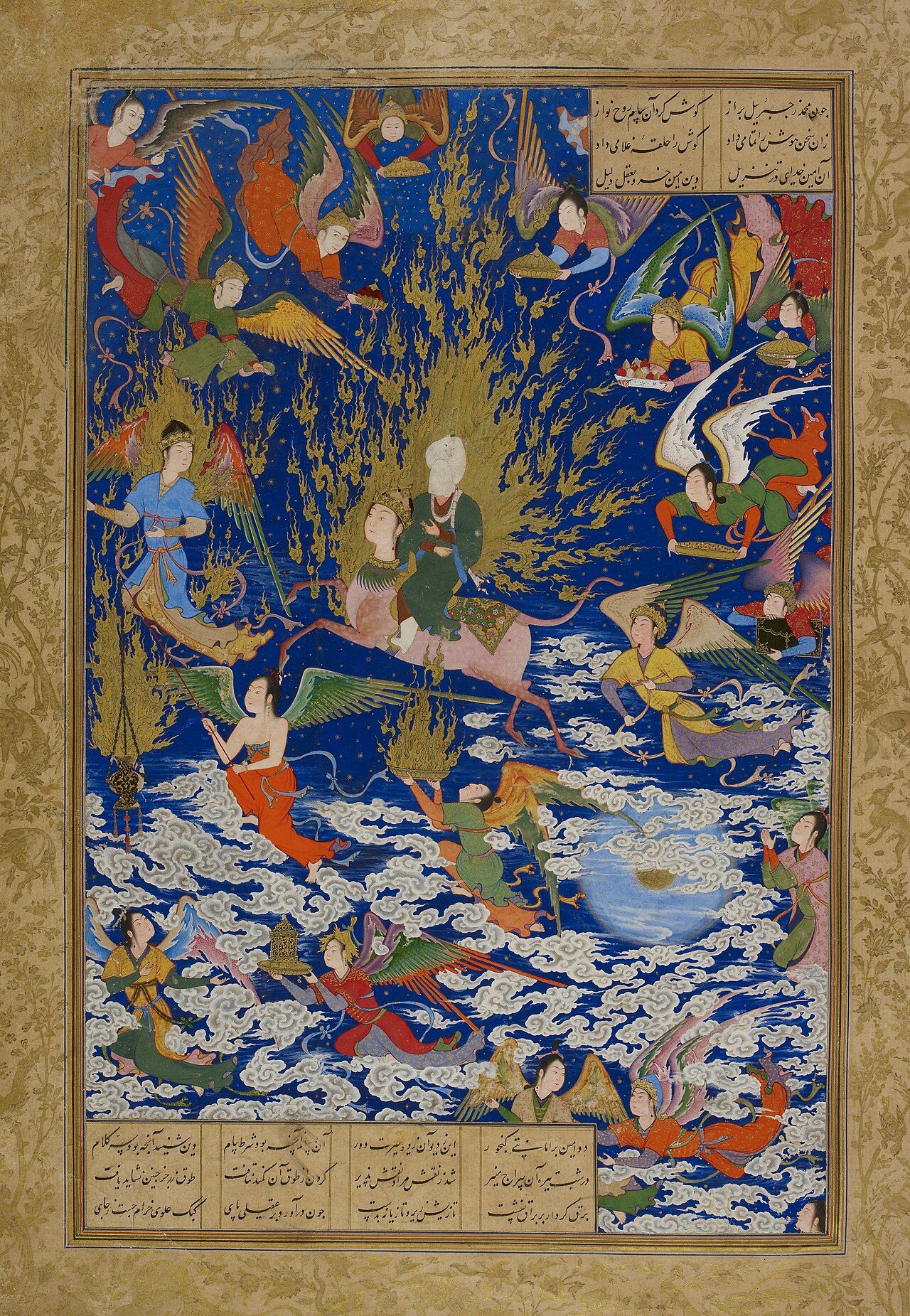
The bright and pure colouring of the Persian miniature is one of its most striking features. Normally all the pigments used are mineral-based ones which keep their bright colours very well if kept in proper conditions, the main exception being silver, mostly used to depict water, which will oxidize to a rough-edged black over time. The conventions of Persian miniatures changed slowly; faces are normally youthful and seen in three-quarters view, with a plump rounded lower face better suited to portraying typical Central Asian or Chinese features than those of most Persians. Lighting is even, without shadows or chiaroscuro. Walls and other surfaces are shown either frontally, or as at (to modern eyes) an angle of about 45 degrees, often giving the modern viewer the unintended impression that a building is (say) hexagonal in plan. Buildings are often shown in complex views, mixing interior views through windows or "cutaways" with exterior views of other parts of a facade. Costumes and architecture are always those of the time. Many figures are often depicted, with those in the main scene normally rendered at the same size, and recession (depth in the picture space) indicated by placing more distant figures higher up in the space. More important figures may be somewhat larger than those around them, and battle scenes can be very crowded indeed. Great attention is paid to the background, whether of a landscape or buildings, and the detail and freshness with which plants and animals, the fabrics of tents, hangings or carpets, or tile patterns are shown is one of the great attractions of the form. The dress of figures is equally shown with great care, although artists understandably often avoid depicting the patterned cloth that many would have worn. 1
Artists and technique
In the classic period artists were exclusively male, and normally grouped in workshops, of which the royal workshop (not necessarily in a single building) was much the most prestigious, recruiting talented artists from the bazaar workshops in the major cities. However the nature of the royal workshop remains unclear, as some manuscripts are recorded as being worked on in different cities, rulers often took artists with them on their travels, and at least some artists were able to work on private commissions. As in Europe, sons very often followed their father into the workshop, but boys showing talent from any background might be recruited; at least one notable painter was born a slave. There were some highly placed amateur artists, including Shah Tahmasp I (reigned 1524–1576), who was also one of the greatest patrons of miniatures. Persian artists were highly sought after by other Islamic courts, especially those of the Ottoman and Mughal Empires, whose own traditions of miniature were based on Persian painting but developed rather different styles. The work was often divided between the main painter, who drew the outlines, and less senior painters who coloured in the drawing. In Mughal miniatures at least, a third artist might do just the faces. Then there might be the border paintings; in most books using them these are by far the largest area of painted material as they occur on text pages as well. The miniatures in a book were often divided up between different artists, so that the best manuscripts represent an overview of the finest work of the period. 1
History
The ancient Persian religion of Manichaeism made considerable use of images; not only was the founding prophet Mani (c.216–276) a professional artist, at least according to later Islamic tradition, but one of the sacred books of the religion, the Arzhang, was illustrated by the prophet himself, whose illustrations (probably essentially cosmological diagrams rather than images with figures) were regarded as part of the sacred material and always copied with the text. Unfortunately, the religion was repressed strongly from the Sasanian era and onwards so that only tiny fragments of Manichean art survive. These no doubt influenced the continuing Persian tradition, but little can be said about how. It is also known that Sasanian palaces had wall-paintings, but only fragments of these have survived. There are narrative scenes in pottery (Mina'i ceramics), though it is hard to judge how these relate to lost contemporary book painting. Recent scholarship has noted that, although surviving early examples are now uncommon, human figurative art was also a continuous tradition in Islamic lands in secular contexts (such as literature, science, and history); as early as the 9th century, such art flourished during the Abbasid Caliphate (c. 749-1258, across Spain, North Africa, Egypt, Syria, Turkey, Mesopotamia, and Persia). 1
Earliest illustrated manuscript in Persian (c.1250)
The great period of the Persian miniature began when Persia was ruled by a succession of foreign dynasties, who came from the east and north. Before the Mongol Ilkhanate (1253–1353), narrative representations are only known in Persia in architecture and ceramics. With the large tradition of Arabic manuscripts in the 12th-13th centuries, illustrated manuscripts probably also existed in Persia, but none are known. The earliest known illustrated manuscript in the Persian language is an early 13th century copy of the epic Varka and Golshah, which was most probably created in Konya in Central Anatolia, under the Seljuk Sultanate of Rum. It is the only Persian-language illustrated manuscript securely datable to before Mongol conquest, and it can be dated to circa 1250. 1
Mongol era (1260–1335)
The traumatic Mongol invasion of 1219 onwards established the Ilkhanate as a… 1
The text above is adapted from the Wikipedia article “Persian miniature”, available under the Creative Commons Attribution-ShareAlike 4.0 licence. 1
Persian miniature is small Persian painting on paper, according to the structured record cited below. This entry was generated automatically from that record and has not yet been reviewed by a person familiar with the tradition. 2
The source record links this tradition to 5 external registers, which can be verified through the citation. 2