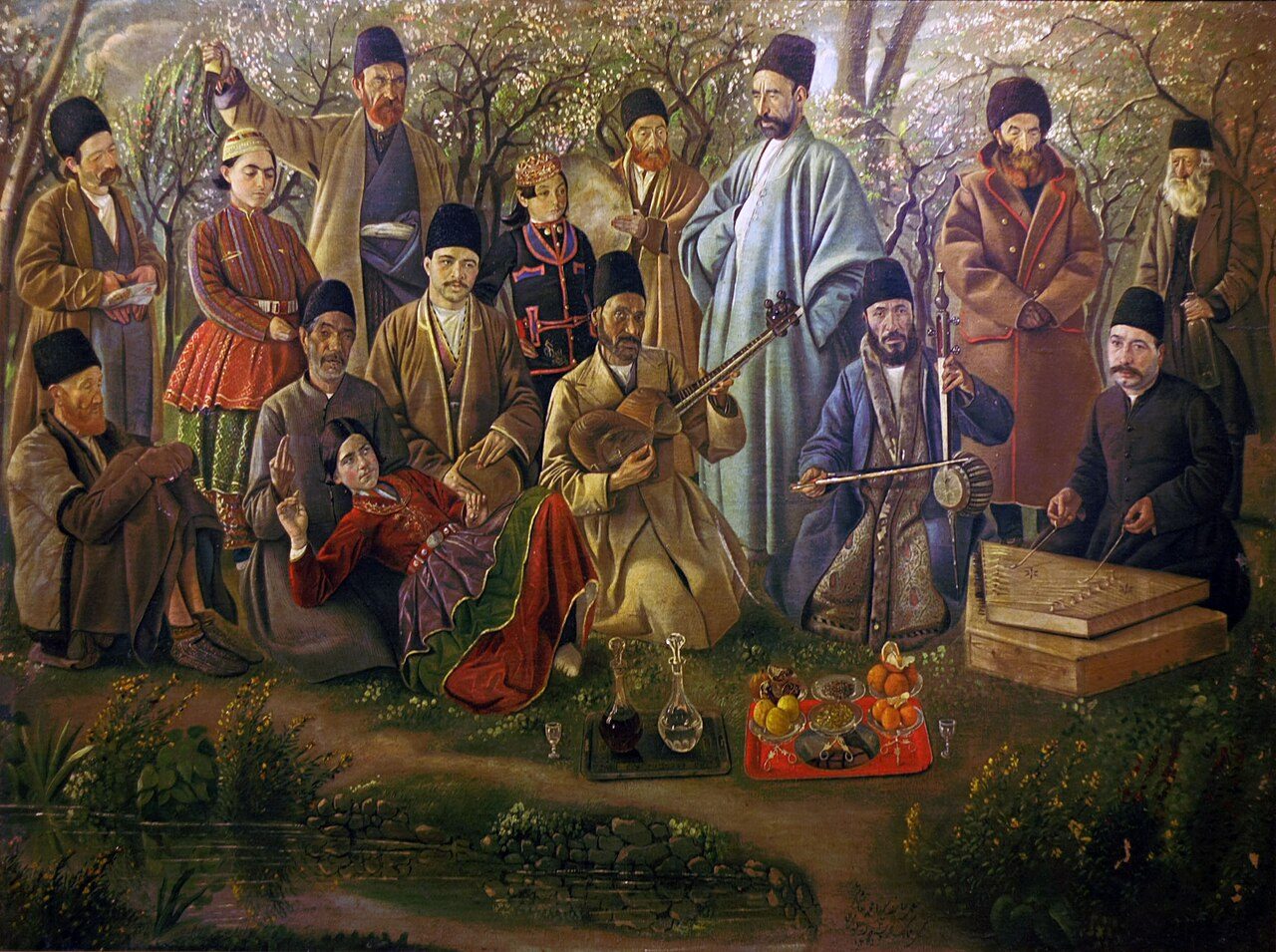
The tradition & historical record
2 min read · 2 sourcesPersian musical instruments or Iranian musical instruments can be broadly classified into three categories: classical, Western and folk. Most Persian musical instruments spread in regions under the control of former Persian Empires across West Asia and the Caucasus, Central Asia and through adaptation, relations, and trade, to Europe and the far regions of Asia. In the ancient era, the Silk Road had an effective role in this distribution. 1
String instruments
Orchestral 1
Tar Setar Kamancheh Ghaychak Barbat Chang (instrument)/Angular harp Santur Qānūn Shurangiz 1
Folklore 1
Dutar Tanbur Tar (Azerbaijani instrument) Divan (diwan or divan sazı, type of Bağlama) Sallaneh Sorahi Suroz Rubab (instrument) 1
Wind instruments
Orchestral 1
Ney Folklores 1
Balaban (instrument) Donali Duduk Dozaleh Garmon Karna Ney-anbān Sorna Historical 1
Nafir 1
Percussion instruments
While Arabic and Persian are separate languages, to a great extent the cultures intermixed during and after the Muslim conquest of Persia. Arabic became the lingua franca from North Africa to Central and South Asia, much as Latin was in Europe. As a result, the list below may contain Arabic words that don't belong, but may also include words shared by both languages. An example is daf (دف), for which the Arab word is also daf or duff (plural dofuf). Similarly, conquests and cultural intermixing have made Turkish words available, such as kudum. 1
Images from Turkestan
These images are from the Russian Turkestan, circa 1865-1872, an area in which Persian, Turkish, Arab/Islamic and Mongol peoples conquered and settled over the ages. When the Russians conquered, both Turkish and Persian languages were being spoken. The images of musical instruments show the mixing of cultures; some such as the tanbur appear normal for Persian culture. But there are variations, such as a kamanche that appears to be a bowed tanbur, and the kauz or kobyz, which is a Turkish word for an instrument that is closely related to the Ghaychak, a Persian instrument. 1
Others
The electronic keyboard is a popular western instrument. There are numerous native musical instruments used in folk music. 1
The text above is adapted from the Wikipedia article “Persian musical instruments”, available under the Creative Commons Attribution-ShareAlike 4.0 licence. 1
Persian musical instrument is musical instruments that originated from Persia, according to the structured record cited below. This entry was generated automatically from that record and has not yet been reviewed by a person familiar with the tradition. 2
The source record links this tradition to 1 external register, which can be verified through the citation. 2