The tradition & historical record
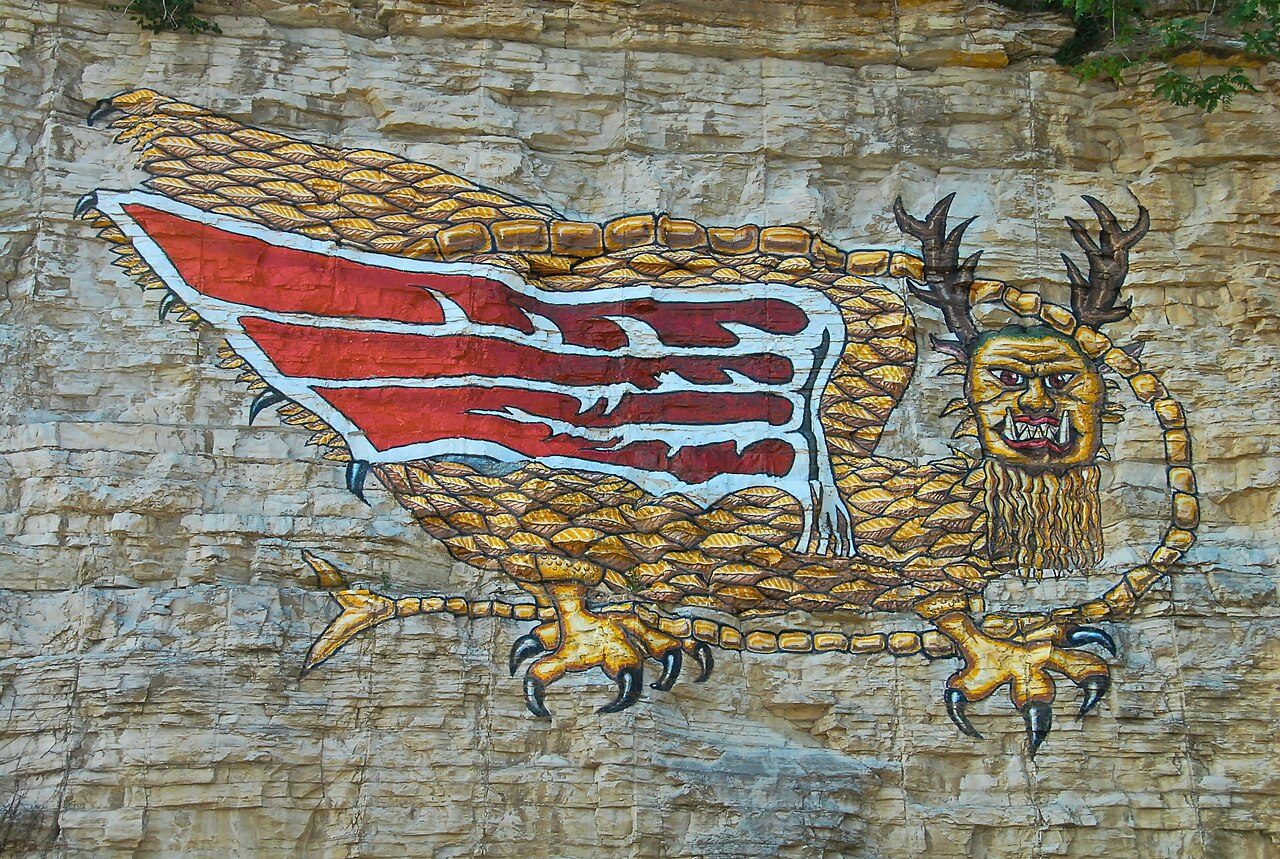
6 min read · 2 sourcesThe Piasa ( PY-ə-saw) or Piasa Bird (aka Paillissa, Piesa) is a later name applied to the creature or creatures depicted from Native American mythology, and depicted in a mural painted by Native Americans high on cliffsides above the Mississippi River near Alton, Illinois. The origin of the word piasa is uncertain, but originally described the cliffs rather than the creature or mural. The oldest known written reference to the mural dates to 1673 from French explorers, and the oldest known sketches date to 1678 and 1682 also from French sources. These sketches show a four-legged creature with a spotted or scaled semi-feline body, an antlered head, and a long tail. This mural is now believed to have depicted a legendary creature known as the underwater panther. By the mid-1800s it was common to depicts the creature with wings, but wings were not an original feature on the mural and appeared in later retelling and interpretation. A second mural site depicting creatures similar to mermen was also rumored, but its existence is much less certain. The wall where the original paintings existed at Alton was probably destroyed circa 1850s. The mural has been subsequently been restored with replicas a number of times. 1
Overview
The original petrographs were described by French explorers Jacques Marquette and Louis Jolliet (1673) and described as a multicolored human-faced creature with a long tail terminating in fish-like fin. They made a sketch, a copy of which is preserved in maps created by cartographer Jean-Baptiste-Louis Franquelin (1678, 1681), and 19th century copies thereof. This creature is identifiable as the underwater panther of native lore. The beast's body features a number of concentric rings, purported to be scales (cf. § Scale iconography) Subsequent French explorers and missionaries learned of a second mural location painted with tritons (man-fish or mermen), but claimed not to be able to find either, or that there were only red-colored horse pictures on lower walls, or already effaced or gone by 1698. The monster paintings recorded by the Jesuit Marquette (1673) were the "object of Indian worship" that alarmed even Marquette himself on the ongoing idolatry, according to the interpretation of some commentators. The rival Recollects order which explored the area afterwards described the natives offering tobacco to the paintings in order to appease the Manitou great spirits at the Cape St. Anthony site where the Miami and the Matsigamea (Mitchigamea) clashed. The sheer high cliffs in question were called the "Piasas" by the 18th century, attested in American maps. The painted monsters themselves were being called piesa by 1812, and were claimed to be still visible. At least one petrograph allegedly remained, described as the "piasa bird" and made famous by writer John Russell (1836, 1848). There were also pictorial winged depictions of the piasa, one by painter Henry Lewis (sketched c. 1
Nomenclature
The petrographs of two monstrous creatures in question were described in the 17th century by the French missionary and explorer Jacques Marquette and Louis Jolliet. Some tacitly assume the term "piasa" was the term used by the natives to refer to the creatures, but the term is unattested in Marquette's journal (cf. § Discovery of the murals). Early usage of Piasa as a geological or geographical label occurs, e.g., on Hutchins's map (1789) where it is labeled "Piasas" ((without any explanation) on the bend of the Mississippi just before the confluence with the Missouri. Later, "Piesa" is attested as a word actually used to refer to the "Painted Monsters", in Stoddard (1812). But before John Russell (1836, 1848) used the term "piasa" ("piasa bird") and popularized it, the rock painting monster at or near Alton, was more commonly referred to as "dragon" or "flying dragon", according to McAdams. Linguist Ives Goddard did not think the term was attested in the Algonquian languages, and that piasa could only derived from native terms via implausible "distortions" (hence § French placename etymology Nevertheless, one or another native etymology (cf. § Thunderbird etymology, § Tiger, panther, or dragon etymology, etc.) has been suggested, gaining acceptance by more recent commentators (cf. § Little people etymology) as explained below. The etymology theories are intertwined with the identification of creature, which will be discussed first. 1
Identification of creatures
The identity of the piasa creature was identified early on by J. P. Dunn (1917, etc.), as Lĕn'-nĭ-pĭn'-ja or "Man-cat" of the Miami, Illinois, and Peoria people, known as Mĭ-cĭ-bĭ-sĭ ("Big Cat" or "Panther", var. mishibizhii, mishipeshu) to the more northerly Ojibwe tribe; these are all names for what is also called the underwater panther. Esarey, Costa, Wood, et al. (2015) also endorse the underwater panther identification, stressing how wings were never mentioned in the § 1673 Marquette party journals. This group endorses the payiihsa (i.e., § Little people etymology and believe that the original associated folktale involved an aquatic pair of evil twin dwarfs (plural: payiihsaki) who have overtaken a certain den and has left their footprints, the den which the hero Wissakatchakwa had conquered from a water manitou who had abducted him there Russell mangled the native tale along this line into his own short story about a piasa bird. The Underwater Panther origin is also supported by research conducted by Dr. Mark J. Wagner, Director, Center for Archaeological Investigations and Professor, Department of Anthropology, Southern Illinois University at Carbondale. Still, there had been others in the past who were more conducive to the identification of the piasa with some sort of monster bird myth, e.g., Perry A. Armstrong (1887), who demonstrated that certain mythical birds (white, giant bird of myth, "devil bird" in the narrative summrized below) were associated with the rock pictographs in local native lore. Writer Clara Kern Bayliss (1908, 1909) later made connection to the widespread thunderbird across many Amerindian tribes. 1
Commentators also hazarded a guess that Marquette/Joliette's beast probably resembled the "Medicine animal of the Winnebagoes" (cf. 1
Thunderbird etymology
The linguist J. N. B. Hewitt (before 1910) has pointed out Piasa could be explained as a cognate of Cree piyesiw for 'thunderbird', probably also cognate with Ojibwe binĕssi 'large bird'. The above is not inconsistent with the assertion by Russell that Piasa means "bird that devours men" in the native Illinois language (Illiniwek). 1
Little people etymology
However, piasa was not in the vocabulary of the Illini according to Jacob Piatt Dunn (1917, 1919, etc.), possibly overstating his case. According to Dunn, piasa actually referred to Pa-i'-sa (pl. Pa-i'-sa-ki) denoting a race of Little People, and the cliffs where the pictographs occur are actually called Pa-i'sa Rock by the Illinois people. This etymology of Piasa derived from páyiihsa (=Pa-i'-sa) 'little people'/'small supernatural' being is reiterated by, e.g., David J. 1
The text above is adapted from the Wikipedia article “Piasa”, available under the Creative Commons Attribution-ShareAlike 4.0 licence. 1
Piasa is legendary Native American creature, according to the structured record cited below. This entry was generated automatically from that record and has not yet been reviewed by a person familiar with the tradition. 2
The source record links this tradition to 3 external registers, which can be verified through the citation. 2