The tradition & historical record
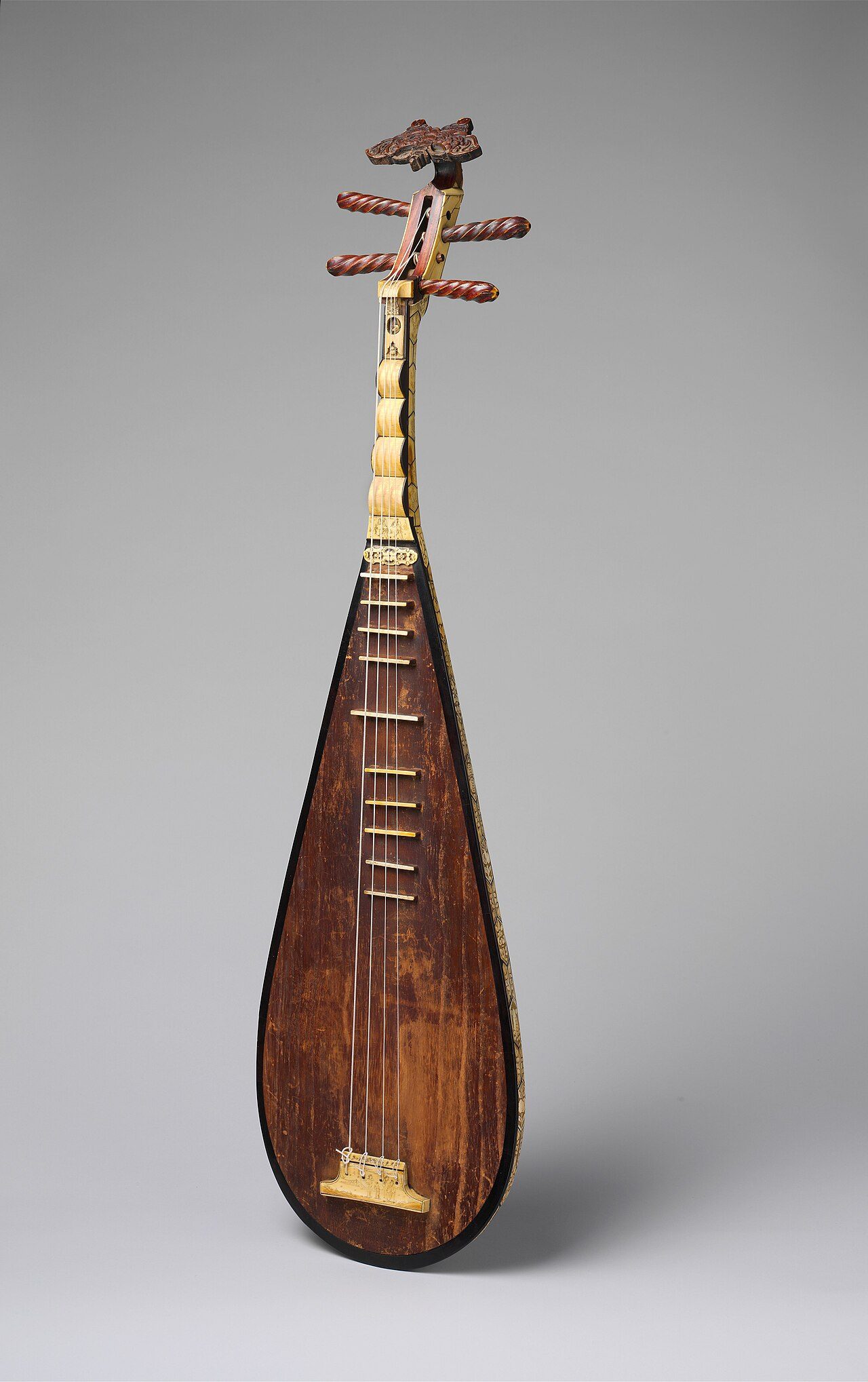
7 min read · 2 sourcesThe pipa (Chinese: 琵琶; pinyin: pípá; Wade–Giles: p'i-p'a) is a traditional Chinese musical instrument belonging to the plucked category of instruments. Sometimes called the "Chinese lute", the instrument has a pear-shaped wooden body with a varying number of frets ranging from 12 to 31. Another Chinese four-string plucked lute is the liuqin, which looks like a smaller version of the pipa. The pear-shaped instrument may have existed in China as early as the Han dynasty, and although historically the term pipa was once used to refer to a variety of plucked chordophones, its usage since the Song dynasty refers exclusively to the pear-shaped instrument. The pipa is one of the most popular Chinese instruments and has been played for almost two thousand years in China. Several related instruments are derived from the pipa, including the Japanese biwa and Korean bipa in East Asia, and the Vietnamese đàn tỳ bà in Southeast Asia. The Korean instrument is the only one of the three that is no longer widely used. 1
History
There are some confusions and disagreements about the origin of pipa. This may be due to the fact that the word pipa was used in ancient texts to describe a variety of plucked chordophones of the period from the Qin to the Tang dynasty, including the long-necked spiked lute and the short-necked lute, as well as the differing accounts given in these ancient texts. Traditional Chinese narrative prefers the story of the Han Chinese Princess Liu Xijun sent to marry a barbarian Wusun king during the Han dynasty, with the pipa being invented so she could play music on horseback to soothe her longings. Modern researchers such as Laurence Picken, Shigeo Kishibe, and John Myers suggested a non-Chinese origin. The earliest mention of pipa in Chinese texts appeared late in the Han dynasty around the 2nd century AD. According to Liu Xi's Eastern Han dynasty Dictionary of Names, the word pipa may have an onomatopoeic origin (the word being similar to the sounds the instrument makes), although modern scholarship suggests a possible derivation from the Persian word "barbat", the two theories however are not necessarily mutually exclusive. Liu Xi also stated that the instrument called pipa, though written differently (枇杷; pípá or 批把; pībǎ) in the earliest texts, originated from amongst the Hu people (a general term for non-Han people living to the north and west of ancient China). Another Han dynasty text, Fengsu Tongyi, also indicates that, at that time, pipa was a recent arrival, although later 3rd-century texts from the Jin dynasty suggest that pipa existed in China as early as the Qin dynasty (221–206 BC). 1
In Chinese literature
Early literary tradition in China, for example in a 3rd-century description by Fu Xuan, Ode to Pipa, associates the Han pipa with the northern frontier, Wang Zhaojun and other princesses who were married to nomad rulers of the Wusun and Xiongnu peoples in what is now Mongolia, northern Xinjiang and Kazakhstan. Wang Zhaojun in particular is frequently referenced with pipa in later literary works and lyrics, for example Ma Zhiyuan's play Autumn in the Palace of Han (漢宮秋), especially since the Song dynasty (although her story is often conflated with other women including Liu Xijun), as well as in music pieces such as Zhaojun's Lament (昭君怨, also the title of a poem), and in paintings where she is often depicted holding a pipa. There are many references to pipa in Tang literary works, for example, in A Music Conservatory Miscellany Duan Anjie related many anecdotes associated with pipa. The pipa is mentioned frequently in the Tang dynasty poetry, where it is often praised for its expressiveness, refinement and delicacy of tone, with poems dedicated to well-known players describing their performances. A famous poem by Bai Juyi, "Pipa xing" (琵琶行), contains a description of a pipa performance during a chance encounter with a female pipa player on the Yangtze River: 1
The encounter also inspired a poem by Yuan Zhen, Song of Pipa (琵琶歌). Another excerpt of figurative descriptions of a pipa music may be found in a eulogy for a pipa player, Lament for Shancai by Li Shen: 1
During the Song dynasty, many of the literati and poets wrote ci verses, a form of poetry meant to be sung and accompanied by instruments such as pipa. They included Ouyang Xiu, Wang Anshi, and Su Shi. 1
Playing and performance
The name "pipa" is made up of two Chinese syllables, "pí" (琵) and "pá" (琶). These, according to the Han dynasty text by Liu Xi, refer to the way the instrument is played – "pí" is to strike outward with the right hand, and "pá" is to pluck inward towards the palm of the hand. The strings were played using a large plectrum in the Tang dynasty, a technique still used now for the Japanese biwa. It has however been suggested that the long plectrum depicted in ancient paintings may have been used as a friction stick like a bow. The plectrum has now been largely replaced by the fingernails of the right hand. The most basic technique, tantiao (彈挑), involves just the index finger and thumb (tan is striking with the index finger, tiao with the thumb). The fingers normally strike the strings of pipa in the opposite direction to the way a guitar is usually played, i.e. the fingers and thumb flick outward, unlike the guitar where the fingers and thumb normally pluck inward towards the palm of the hand. Plucking in the opposite direction to tan and tiao are called mo (抹) and gou (勾) respectively. When two strings are plucked at the same time with the index finger and thumb (i.e. the finger and thumb separate in one action), it is called fen (分), the reverse motion is called zhi (摭). A rapid strum is called sao (掃), and strumming in the reverse direction is called fu (拂). A distinctive sound of pipa is the tremolo produced by the lunzhi (輪指) technique which involves all the fingers and thumb of the right hand. It is however possible to produce the tremolo with just one or more fingers.The left hand techniques are important for the expressiveness of pipa music. 1
Repertoire
Pipa has been played solo, or as part of a large ensemble or small group since the early times. Few pieces for pipa survived from the early periods, some, however, are preserved in Japan as part of togaku (Tang music) tradition. In the early 20th century, twenty-five pieces were found amongst 10th-century manuscripts in the Mogao caves near Dunhuang, most of these pieces however may have originated from the Tang dynasty. The scores were written in tablature form with no information on tuning given, there are therefore uncertainties in the reconstruction of the music as well as the decipherment of other symbols in the score. Three Ming dynasty pieces were discovered in the High River Flows East (高河江東, Gaohe Jiangdong) collection dating from 1528 and they are very similar to those performed today, such as "The Moon on High" (月兒高, Yue-er Gao). During the Qing dynasty, scores for pipa were collected in Thirteen Pieces for Strings. 1
Schools
There are a number of different traditions with different styles of … 1
The text above is adapted from the Wikipedia article “Pipa”, available under the Creative Commons Attribution-ShareAlike 4.0 licence. 1
pipa is Chinese plucked lute, according to the structured record cited below. This entry was generated automatically from that record and has not yet been reviewed by a person familiar with the tradition. 2
The source record links this tradition to 23 external registers, which can be verified through the citation. 2