The tradition & historical record
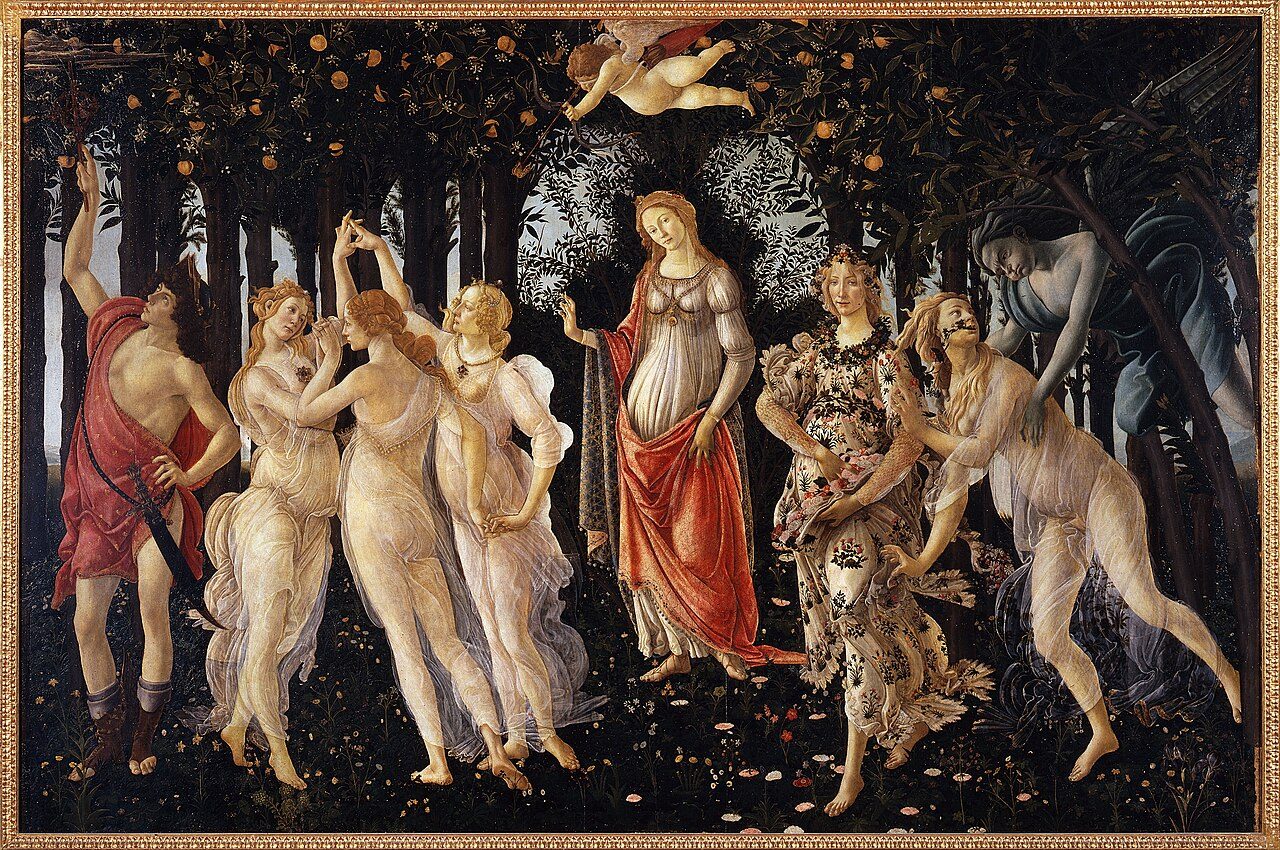
6 min read · 2 sourcesPrimavera (Italian pronunciation: [primaˈvɛːra], meaning "Spring") is a large panel painting in tempera paint by the Italian Renaissance painter Sandro Botticelli made in the late 1470s or early 1480s (datings vary). It has been described as "one of the most written about, and most controversial paintings in the world", and also "one of the most popular paintings in Western art". The painting depicts a group of figures from classical mythology in a garden, but no story has been found that brings this particular group together. Most critics agree that the painting is an allegory based on the lush growth of Spring, but accounts of any precise meaning vary, though many involve the Renaissance Neoplatonism which then fascinated intellectual circles in Florence. The subject was first described as Primavera by the art historian Giorgio Vasari who saw it at Villa Castello, just outside Florence, by 1550. Although the two are now known not to be a pair, the painting is inevitably discussed with Botticelli's other very large mythological painting, The Birth of Venus, also in the Uffizi. They are among the most famous paintings in the world, and icons of the Italian Renaissance; of the two, the Birth is even better known than the Primavera. 1
Composition
The painting features six female figures and two male, along with a cupid, in an orange grove. The movement of the composition is from right to left, so following that direction the standard identification of the figures is as follows: At the far right, "Zephyrus, the biting wind of March, kidnaps and possesses the nymph Chloris, whom he later marries and transforms into a deity; she becomes the goddess of Spring, eternal bearer of life, and is seen scattering roses on the ground." The transformation is indicated by the flowers coming out of Chloris’ mouth. She either is shown twice, or the statuesque figure of Flora is a different person. In the centre (but not exactly so) and somewhat set back from the other figures, stands Venus, a red-draped woman in blue. The trees behind her form a broken arch to draw the eye. In the air above her, a blindfolded Cupid aims his bow to the left. On the left of the painting, the Three Graces, a group of three females also in diaphanous white, join hands in a dance. At the extreme left Mercury, clothed in red with a sword and a helmet, raises his caduceus or wooden rod towards some wispy gray clouds. The interactions between the figures are enigmatic. Zephyrus and Chloris are looking at each other. Flora and Venus look out of the picture, Venus returns the viewer's gaze. The Cupid is blindfolded, and Mercury has turned his back on the others, and looks up at the clouds. The central Grace looks towards him, while the other two seem to look at each other. Flora's smile was very unusual in painting at this date. The pastoral scenery is elaborate. There are 500 identified plant species depicted in the painting, with about 190 different flowers, of which at least 130 can be specifically identified. 1
Meaning
Various interpretations of the figures have been set forth, but it is generally agreed that at least at one level the painting is "an elaborate mythological allegory of the burgeoning fertility of the world." It is thought that Botticelli had help devising the composition of the painting and whatever meanings it was intended to contain, as it appears that the painting reflects a deep knowledge of classical literature and philosophy that Botticelli is unlikely to have possessed. Poliziano is usually thought to have been involved in this, though Marsilio Ficino, another member of Lorenzo de' Medici's circle and a key figure in Renaissance Neoplatonism, has also often been mentioned. One aspect of the painting is a depiction of the progress of the season of spring, reading from right to left. The wind of early Spring blows on the land and brings forth growth and flowers, presided over by Venus, goddess of April, with at the left Mercury, the god of the month of May in an early Roman calendar, chasing away the last clouds before summer. As well as being part of a sequence over the season, Mercury in dispelling the clouds is acting as the guard of the garden, partly explaining his military dress and his facing out of the picture space. A passage in Virgil's Aeneid describes him clearing the skies with his caduceus. A more positive, Neoplatonist view of the clouds is that they are "the benificent veils through which the splendour of transcendent truth may reach the beholder without destroying him." Venus presides over the garden – an orange grove (a Medici symbol). It is also the Garden of the Hesperides of classical myth, from which the golden apples used in the Judgement of Paris came; the Hellenistic Greeks had decided that these were citrus fruits, exotic to them. 1
History
The origin of the painting is unclear. Botticelli was away in Rome for many months in 1481/82, painting in the Sistine Chapel, and suggested dates are in recent years mostly later than this, but still sometimes before. Thinking has been somewhat changed by the publication in 1975 of an inventory from 1499 of the collection of Lorenzo di Pierfrancesco de' Medici. The 1499 inventory records it hanging in the city palace of Lorenzo di Pierfrancesco de' Medici and his brother Giovanni "Il Popolano". They were the cousins of Lorenzo de' Medici ("Lorenzo il Magnifico"), who was effectively the ruler of Florence, and after their father's early death had been his wards. It hung over a large lettuccio, an elaborate piece of furniture including a raised base, a seat and a backboard, probably topped with a cornice. The bottom of the painting was probably at about the viewer's eye-level, so rather higher than it is hung today. 1
In the same room was Botticelli's Pallas and the Centaur, and also a large tondo with the Virgin and Child. The tondo is now unidentified, but is a type of painting especially associated with Botticelli. This was given the highest value of the three paintings, at 180 lire. A further inventory of 1503 records that the Primavera had a large white frame. In the first edition of his Life of Botticelli, published in 1550, Giorgio Vasari said that he had seen this painting, and the Birth of Venus, hanging in the Medici country Villa di Castello. Before the inventory was known it was usually believed that both paintings were made for the villa, probably soon after it was acquired in 1477, either commissioned by Lorenzo di Pierfrancesco or perhaps given to him by his older cousin and guardian Lorenzo de' Medici. 1
The text above is adapted from the Wikipedia article “Primavera (Botticelli)”, available under the Creative Commons Attribution-ShareAlike 4.0 licence. 1
Primavera is painting by Sandro Botticelli, according to the structured record cited below. This entry was generated automatically from that record and has not yet been reviewed by a person familiar with the tradition. 2
The source record links this tradition to 27 external registers, which can be verified through the citation. 2