The tradition & historical record
5 min read · 2 sourcesA qanbūs (Arabic: قنبوس) is a short-necked lute that originated in Yemen and spread throughout the Arabian Peninsula. Sachs considered that it derived its name from the Turkic komuz, but it is more comparable to the oud. The instrument was related to or a descendant of the barbat, a (possibly) skin-topped lute from Central Asia. The qanbūs has 6 or 7 nylon strings that are plucked with a plectrum to generate sound. Unlike many other lute-family instruments, the gambus has no frets. Its popularity declined in Yemen during the early 20th century reign of Imam Yahya; by the beginning of the 21st century, the oud had replaced the qanbūs as the instrument of choice for Middle-Eastern lutenists. 1
Yemen migration saw the instrument spread to different parts of the Indian Ocean. In Muslim Southeast Asia (especially Indonesia, Malaysia and Brunei), called the gambus, it sparked a whole musical genre of its own. Nowadays it is played in the traditional dance of Zapin and other genres, such as the Malay ghazal and an ensemble known as kumpulan gambus ("gambus group"). In the Comoros it is known as gabusi, and in Zanzibar as gabbus. 1
In Yemen and Oman
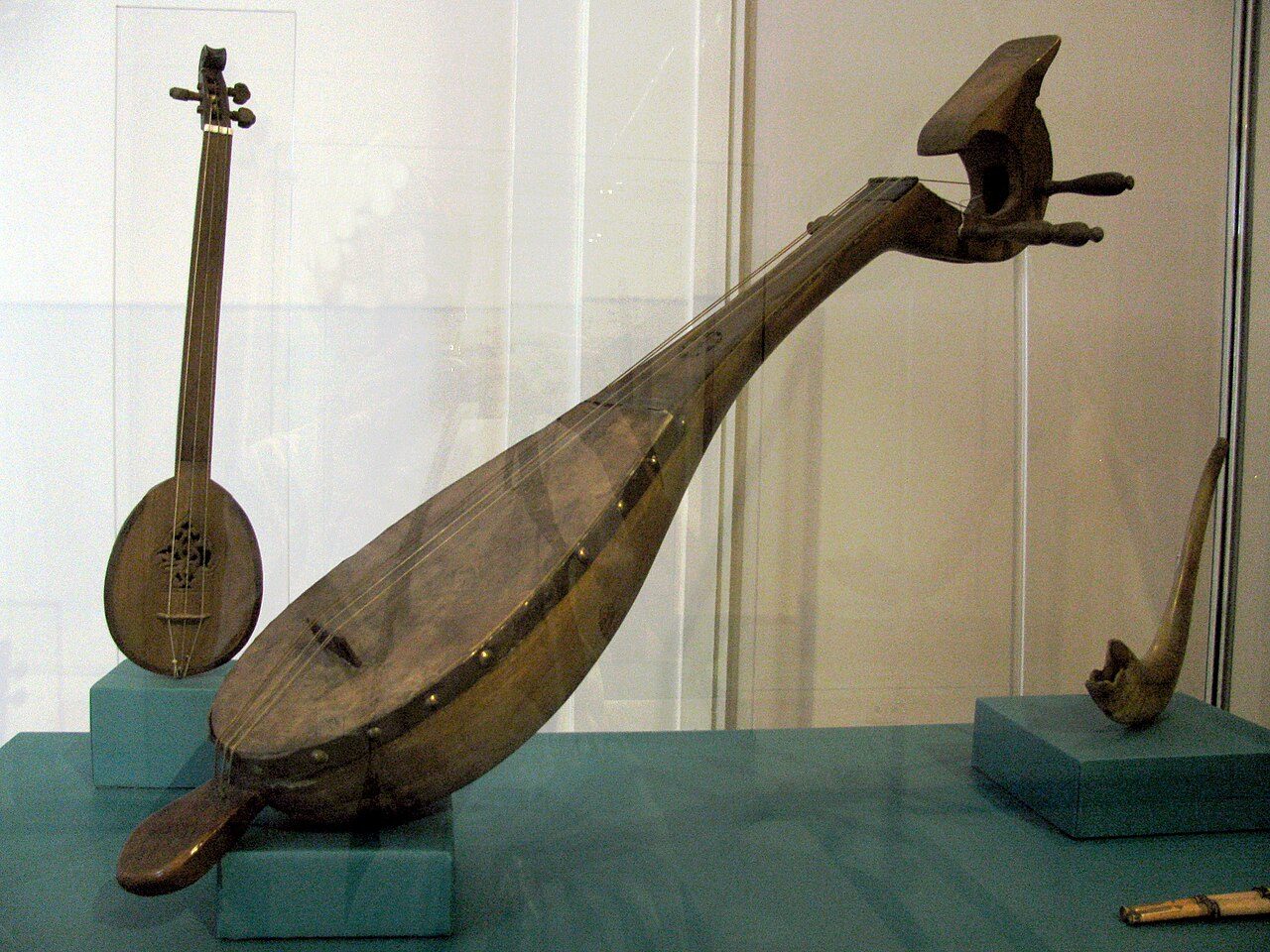
The qanbus is a traditional instrument from Yemen carved from a single block of wood. It is also played in Oman, where it is called gabbus. The lower half of the top is covered in skin, and the upper half has a wooden soundboard, often with small soundholes. It has a floating bridge, a sickle-shaped pegbox and usually 7 nylon or gut strings in 4 courses, with the lowest course single. There also exist 3-course versions, with 6 or 5 strings, though these are less common. The Yemeni lute has 7 strings in four courses, tuned low note to high C DD GG CC. The first C string is a single string; strings D G and C are all pairs. 1
In East Africa
In Kenya and Tanzania, a related instrument was called the Kibangala. It used to be built and strung in the same way as the Qanbus. In the Comoros islands, a related instrument called the Gambusi is played, which is built in the same way but often has a flat-shaped pegbox, rather than the sickle-shape, and sometimes has a differently shaped soundbox. Both usually have 4 courses of strings, which can be double or single. Several structural nuances exist between the original design (Anjouan, Mwali) and the later avatars in Mayotte. The corrupted pronunciations Gaboussi, Gabusi, or Gaboussa are also found in Mayotte, and obviously preaches for a joined etymology with the Kabosy chordophone in N-W Madagascar. 1
In Southeast Asia
The word gambus (Jawi: ݢمبوس) covers a variety of instruments in the Malay world; some with skin soundboards, some with wooden soundboards, some that are shaped like the Yemeni quanbūs, and some that are shaped like the Arabian oud. The instruments may have 3, 4 or 5 courses of strings, plus a single base string. To avoid confusion, various descriptors are used in the names by academic researchers. There are two types of gambus: the gambus Melayu and the gambus Hadhramaut. "Gambus" can be used to refer simply to either type of instrument, however The instruments are different than the Hasapi boat lutes. The instruments were "transmitted" from the Muslim world to the Malay world at an undermined time. Links to the Middle East begin as early as the 5th-6th centuries C.E., with trading networks and occupation in the 15th century. Experts have tentatively given dates for the instruments' arrival between the 9th and 15th centuries C.E. In looking for origins, musicologists have also noted some similarities with the Chinese pipa. The two types of gambus likely arrived at different times; the gambus Melayu likely arriving as the quanbus or barbat and developing over centuries. The gambus Hadhramaut likely developed in the 19th century after the arrival of the oud. 1
Some modern luthiers in Indonesia and other countries have begun to make hybrid instruments, combining the gambus or dambus (?) with other instruments, such as the ud (Sabah), the Hawaiian ukulele (Flores) or the bluegrass mandoline (Lombok) The pronunciation dambus is met in Bangka Belitung Islands and also in a limited area from Sukamara Regency and Pangkalan Bun (Central Kalimantan). 1
Gambus Melayu or gambus Hijaz
The gambus Melayu –also known as gambus Hijaz ("Hijazi gambus"), panting, gita nangka, gambus seludang ("palm spathe gambus"), gambus perahu ("perahu gambus"), and gambus biawak – retains a shape similar to the original qanbūs, but equipped with a skin soundboard. The sounds of this gambus accommodate to native Malay music more than its more conservative Hadhramaut counterpart. Tuning: 1
Riau Islands: G3 D4D4 G4G4 C5C5 for wire strings or A3 D4D4 G4G4 C5C5 for nylon strings Eastern Sumatra: G AA B DD AA EE (double courses tuned in unison) elsewhere in Indonesia and Malay Peninsula: A3 D4D4 G4G4 C5C5 Brunei: E3E3 A3A3 D4D4 or DD GG CC 1
Gambus Hadhramaut
The gambus Hadhramaut is a gambus that resembles an oud. The name Hadhramaut refers to Eastern Yemen, and this form of the instrument may have arrived in Indonesia (and a wider extent to another Malay world countries) with immigrants from there in the 19th century, joining Muslim communities already established centuries earlier. The bowl is made of light woods, the neck of a hardwood. It has a wooden soundboard. It is a fretless instrument with 11 strings in 6 courses, tuned low note to high: 1
(Notes in scientific pitch notation) Arab tuning for oud: C2 F2F2 A2A2 D3D3 G3G3 C4C4 Alternate for oud C EE AA DD GG CC Circle of fifths: B2 E3E3 A3A3 D4D4 G4G4 C5C5 Circle of fifths: B EE AA DD GG BB Ghazal: A, DD, GG, CC, FF, BbBb 1
The text above is adapted from the Wikipedia article “Qanbūs”, available under the Creative Commons Attribution-ShareAlike 4.0 licence. 1
qanbūs is chordophone of Southern Asia, according to the structured record cited below. This entry was generated automatically from that record and has not yet been reviewed by a person familiar with the tradition. 2
The source record links this tradition to 3 external registers, which can be verified through the citation. 2