The tradition & historical record
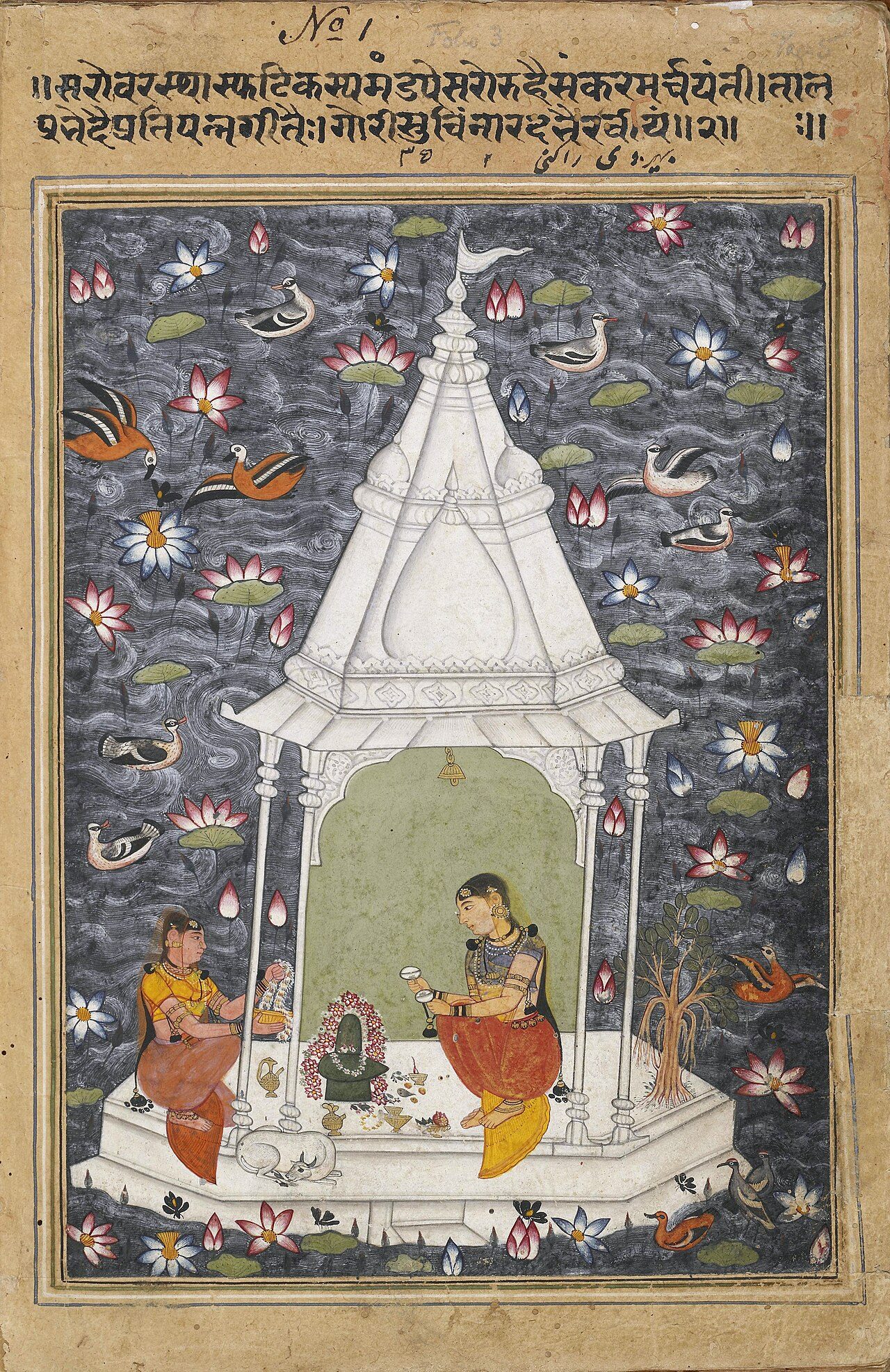
4 min read · 2 sourcesRagamala paintings are a form of Indian miniature painting, a set of illustrative paintings of the Ragamala or "Garland of Ragas", depicting variations of the Indian musical modes called ragas. They stand as a classical example of the amalgamation of art, poetry and classical music in medieval India. From the 16th through the 17th centuries, Ragamala paintings were created in most schools of Indian painting. Today, they are named accordingly as Pahari Ragamala, Rajasthan or Rajput Ragamala, Deccan Ragamala, and Mughal Ragamala. The tradition originated in Rajasthan. In these painting each raga is personified by a colour, mood, a verse describing a story of a hero and heroine (nayaka and nayika), it also elucidates the season and the time of day and night in which a particular raga is to be sung; and finally most paintings also demarcate the specific Hindu deities attached with the raga, like Bhairava or Bhairavi to Shiva, Sri to Devi etc. The paintings depict not just the Ragas, but also their wives, (raginis), their numerous sons (ragaputra) and daughters (ragaputri). The six principal ragas present in the Ragamala are Bhairava, Deepak, Sri, Malkaunsa, Megha and Hindola and these are meant to be sung during the six seasons of the year – summer, monsoon, autumn, early winter, winter and spring. 1
History
Sangita Ratnakara is an important 12th century CE treatise on the classification of Indian Ragas, which for the first time mentions the presiding deity of each raga. From the 14th century onwards, they were described in short verses in Sanskrit, for dhyana, 'contemplation', and later depicted in a series of paintings, called the Ragamala paintings. Some of the best available works of Ragamala are from the 16th and 17th centuries, when the form flourished under royal patronage, though by the 19th century, it gradually faded. 1
Extant works
In 1570, Kshemakarna, a priest of Rewa in Central India, compiled a poetic text on the Ragamala in Sanskrit, which describes six principal Ragas—Bhairava, Malakoshika, Hindola, Deepak, Shri, and Megha—each having five Raginis and eight Ragaputras, except Raga Shri, which has six Raginis and nine Ragaputras, thus making a Ragamala family of 86 members Most of the extant works of Ragamala are from Deccan style, where Ibrahim Adil Shah II of Bijapur, was himself also a fine painter and illustrator, though some Rajput style also exist of which the work of an artist of the 'Chawand' (a part of Mewar) school of painting, Sahibdin, whose Ragamala (musical modes) series dated 1628, are now in National Museum of India. Ragamala sets discovered in Odisha are in the Pattachitra style, based on the ragas of Odissi music and show distinct iconography and raga groups from other regions. 1
The Ragas in Ragamala
Six are male (parent) ragas; the thirty raginis are their wives and the remaining forty-eight are their sons. These are listed is as follows: 1
(1) Parent Raga: Bhairav raga Wives: Bhairavi, Bilawali, Punyaki, Bangali, Aslekhi. Sons: Pancham, Harakh, Disakh, Bangal, Madhu, Madhava, Lalit, Bilaval. 1
(2) Parent Raga: Malkaus raga Wives: Gaundkari, Devagandhari, Gandhari, Seehute, Dhanasri. Sons: Maru, Mustang, Mewara, Parbal, Chand, Khokhat, Bhora, Nad. 1
(3) Parent Raga: Hindol raga Wives: Telangi, Devkari, Basanti, Sindhoori, Aheeri. Sons: Surmanand, Bhasker, Chandra-Bimb, Mangalan, Ban, Binoda, Basant, Kamoda. 1
(4) Parent Raga: Deepak raga Wives: Kachheli, Patmanjari, Todi, Kamodi, Gujri. Sons: Kaalanka, Kuntal, Rama, Kamal, Kusum, Champak, Gaura, Kanra [36]. 1
(5) Parent Raga: Sri raga Wives: Bairavi, Karnati, Gauri, Asavari, Sindhavi. Sons: Salu, Sarag, Sagra, Gaund, Gambhir, Gund, Kumbh, Hamir. 1
(6) Parent Raga: Megh raga Wives: Sorath, Gaundi-Malari, Asa, Gunguni, Sooho. Sons: Biradhar, Gajdhar, Kedara, Jablidhar, Nut, Jaldhara, Sankar, Syama. 1
The text above is adapted from the Wikipedia article “Ragamala paintings”, available under the Creative Commons Attribution-ShareAlike 4.0 licence. 1
Ragamala painting is form of Indian miniature painting, according to the structured record cited below. This entry was generated automatically from that record and has not yet been reviewed by a person familiar with the tradition. 2
The source record links this tradition to 2 external registers, which can be verified through the citation. 2