The tradition & historical record
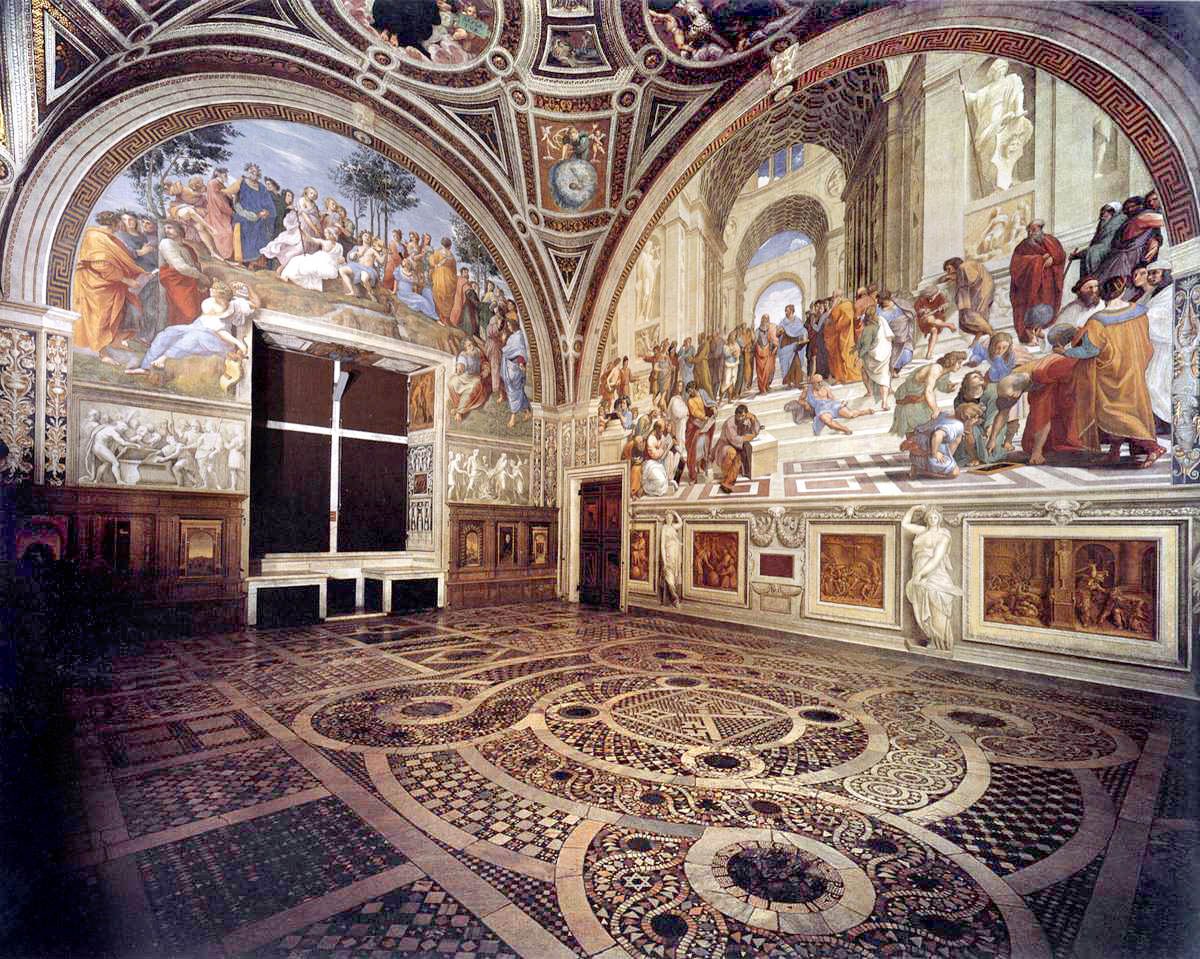
3 min read · 2 sourcesThe four Raphael Rooms (Italian: Stanze di Raffaello) form a suite of reception rooms in the Apostolic Palace, now part of the Vatican Museums, in Vatican City. They are famous for their frescoes, painted by Raphael and his workshop. Together with Michelangelo's Sistine Chapel ceiling frescoes, they are the grand fresco sequences that mark the High Renaissance in Rome. The Stanze, as they are commonly called, were originally intended as a suite of apartments for Pope Julius II. He commissioned Raphael, then a relatively young artist from Urbino, and his studio in 1508 or 1509 to redecorate the existing interiors of the rooms entirely. It was possibly Julius' intent to outshine the apartments of his predecessor (and rival) Pope Alexander VI, as the Stanze are directly above Alexander's Borgia Apartment. They are on the second floor, overlooking the south side of the Belvedere Courtyard. Running from east to west, as a visitor would have entered the apartment, but not following the sequence in which the Stanze were frescoed, the rooms are the Sala di Costantino ("Hall of Constantine"), the Stanza di Eliodoro ("Room of Heliodorus"), the Stanza della Segnatura ("Room of the Signatura"), and the Stanza dell'Incendio del Borgo ("The Room of the Fire in the Borgo"). After the death of Julius in 1513, with two rooms frescoed, Pope Leo X continued the program. 1
Scheme
The scheme of the works is as follows: 1
Sala di Costantino
The largest of the twelve rooms is the Sala di Costantino ("Hall of Constantine"). Its paintings were not begun until Pope Julius and, indeed Raphael himself, had died. The room is dedicated to the victory of Christianity over paganism. Its frescoes represent this struggle from the life of the Roman Emperor Constantine, and are the work of Giulio Romano, Gianfrancesco Penni and Raffaellino del Colle. Because they are not by the master himself, the frescos are less famous than works in the neighboring rooms. Continuing a long tradition of flattery, Raphael's assistants gave the features of the current pontiff, Clement VII, to Pope Sylvester in the paintings. 1
The Vision of the Cross
The fresco of The Vision of the Cross depicts the legendary story of a great cross appearing to Constantine as he marched to confront his rival Maxentius. The vision in the sky is painted with the words in Greek "Εν τούτω νίκα" ("By this, conquer", better known as the Latin In hoc signo vinces) written next to it. 1
The Battle of Milvian Bridge
The Battle of Milvian Bridge shows the battle that took place on October 28, 312, following Constantine's vision. 1
The Baptism of Constantine
The third painting in the sequence, The Baptism of Constantine, was most likely painted by Gianfrancesco Penni, and shows the emperor being baptised by Pope Sylvester I in the Lateran Baptistery at Rome. This follows the account of Constantine's baptism given in the Acts of Sylvester and the Liber Pontificalis, rather than the alternate deathbed version recounted in Eusebius's Life of Constantine. In The Baptism of Constantine, Pope Sylvester I has the physical features of Pope Clement VII (1523–1534), who ordered the completion of the Raphael Rooms. 1
The text above is adapted from the Wikipedia article “Raphael Rooms”, available under the Creative Commons Attribution-ShareAlike 4.0 licence. 1
Raphael Rooms is suite of reception rooms in the Palace of the Vatican painted by Raphael and his workshop between 1509 and 1524, according to the structured record cited below. This entry was generated automatically from that record and has not yet been reviewed by a person familiar with the tradition. 2
The source record links this tradition to 9 external registers, which can be verified through the citation. 2