The tradition & historical record
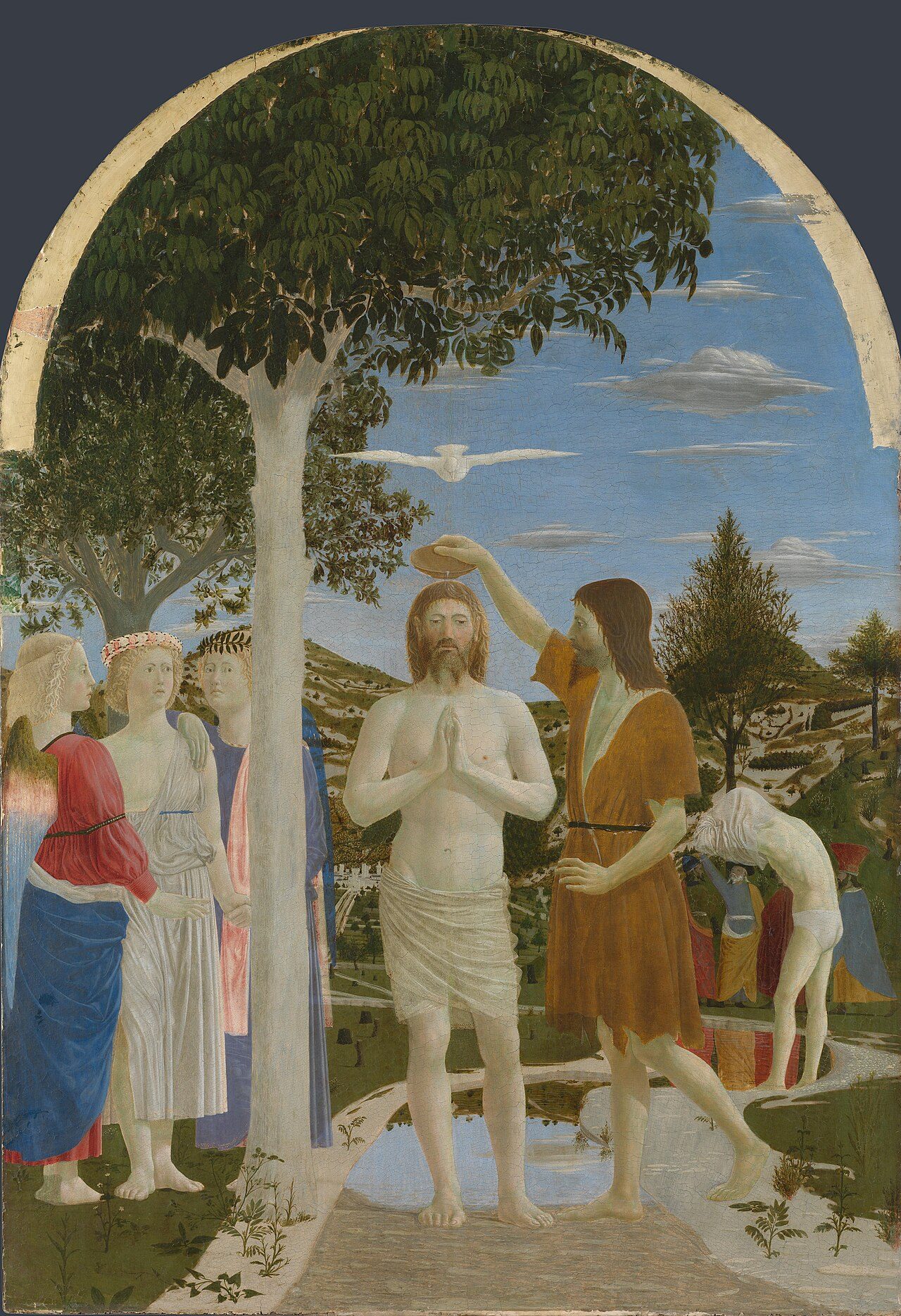
6 min read · 2 sourcesRenaissance art (1350 – 1620) is the painting, sculpture, and decorative arts of the period of European history known as the Renaissance, which emerged as a distinct style in Italy in about AD 1400, in parallel with developments which occurred in philosophy, literature, music, science, and technology. Renaissance art took as its foundation the art of Classical antiquity, perceived as the noblest of ancient traditions, but transformed that tradition by absorbing recent developments in the art of Northern Europe and by applying contemporary scientific knowledge. Along with Renaissance humanist philosophy, it spread throughout Europe, affecting both artists and their patrons with the development of new techniques and new artistic sensibilities. For art historians, Renaissance art marks the transition of Europe from the medieval period to the Early Modern age. 1
The body of art, including painting, sculpture, architecture, music and literature identified as "Renaissance art" was primarily produced during the 14th, 15th, and 16th centuries in Europe under the combined influences of an increased awareness of nature, a revival of classical learning, and a more individualistic view of man. Scholars no longer believe that the Renaissance marked an abrupt break with medieval values, as is suggested by the French word renaissance, literally meaning "rebirth". In many parts of Europe, Early Renaissance art was created in parallel with Late Medieval art. 1
Origins
Many influences on the development of Renaissance men and women in the early 15th century have been credited with the emergence of Renaissance art; they are the same as those that affected philosophy, literature, architecture, theology, science, government, and other aspects of society. The following list presents a summary of changes to social and cultural conditions that have been identified as factors that contributed to the development of Renaissance art. Each is dealt with more fully in the main articles cited above. The scholars of the Renaissance period focused on present life and ways to improve human life. They did not pay much attention to medieval philosophy or religion. During this period, scholars and humanists like Erasmus, Dante, and Petrarch criticized superstitious beliefs and also questioned them. The concept of education also widened its spectrum and focused more on creating 'an ideal man' who would have a fair understanding of arts, music, poetry and literature and would have the ability to appreciate these aspects of life. 1
Classical texts, lost to European scholars for centuries, became available. 1
Proto-Renaissance in Italy, 1280–1400
In Italy in the late 13th and early 14th centuries, the sculpture of Nicola Pisano and his son Giovanni Pisano, working at Pisa, Siena and Pistoia shows markedly classicising tendencies, probably influenced by the familiarity of these artists with ancient Roman sarcophagi. Their masterpieces are the pulpits of the Baptistery and Cathedral of Pisa. Contemporary with Giovanni Pisano, the Florentine painter Giotto developed a manner of figurative painting that was unprecedentedly naturalistic, three-dimensional, lifelike and classicist, when compared with that of his contemporaries and teacher Cimabue. Giotto, whose greatest work is the cycle of the Life of Christ at the Arena Chapel in Padua, was seen by the 16th-century biographer Giorgio Vasari as "rescuing and restoring art" from the "crude, traditional, Byzantine style" prevalent in Italy in the 13th century. 1
Early Renaissance in Italy, 1400–1495
Although both the Pisanos and Giotto had students and followers, the first truly Renaissance artists were not to emerge in Florence until 1401 with the competition to sculpt a set of bronze doors of the Baptistery of Florence Cathedral, which drew entries from seven young sculptors including Brunelleschi, Donatello and the winner, Lorenzo Ghiberti. Brunelleschi, most famous as the architect of the dome of Florence Cathedral and the Church of San Lorenzo, created a number of sculptural works, including a life-sized crucifix in Santa Maria Novella, renowned for its naturalism. His studies of perspective are thought to have influenced the painter Masaccio. Donatello became renowned as the greatest sculptor of the Early Renaissance, his masterpieces being his humanist and unusually erotic statue of David, one of the icons of the Florentine republic, and his great monument to Gattamelata, the first large equestrian bronze to be created since Roman times. The contemporary of Donatello, Masaccio, was the painterly descendant of Giotto and began the Early Renaissance in Italian painting in 1425, furthering the trend towards solidity of form and naturalism of face and gesture that Giotto had begun a century earlier. From 1425 to 1428, Masaccio completed several panel paintings but is best known for the fresco cycle that he began in the Brancacci Chapel with the older artist Masolino and which had a profound influence on later painters, including Michelangelo. Masaccio's developments were carried forward in the paintings of Fra Angelico, particularly in his frescos at the Convent of San Marco in Florence. The treatment of the elements of perspective and light in painting was of particular concern to 15th-century Florentine painters. 1
Early Netherlandish art, 1425–1525
The painters of the Low Countries in this period included Jan van Eyck, his brother Hubert van Eyck, Robert Campin, Hans Memling, Rogier van der Weyden and Hugo van der Goes. Their painting developed partly independently of Early Italian Renaissance painting, and without the influence of a deliberate and conscious striving to revive antiquity. The style of painting grew directly out of medieval painting in tempera, on panels and illuminated manuscripts, and other forms such as stained glass; the medium of fresco was less common in northern Europe. The medium used was oil paint, which had long been utilised for painting leather ceremonial shields and accoutrements because it was flexible and relatively durable. The earliest Netherlandish oil paintings are meticulous and detailed like tempera paintings. The material lent itself to the depiction of tonal variations and texture, so facilitating the observation of nature in great detail. The Netherlandish painters did not approach the creation of a picture through a framework of linear perspective and correct proportion. They maintained a medieval view of hierarchical proportion and religious symbolism, while delighting in a realistic treatment of material elements, both natural and man-made. Jan van Eyck, with his brother Hubert, painted The Altarpiece of the Mystical Lamb. It is probable that Antonello da Messina became familiar with Van Eyck's work, while in Naples or Sicily. 1
Early Renaissance in France, 1375–1528
The artists of France (including duchies such as Burgundy) were often associated with courts, providing illuminated manuscripts and portraits for the nobility as well as devotional paintings and altarpieces. 1
The text above is adapted from the Wikipedia article “Renaissance art”, available under the Creative Commons Attribution-ShareAlike 4.0 licence. 1
Renaissance art is painting, sculpture and decorative arts of that period of European history known as the Renaissance, according to the structured record cited below. This entry was generated automatically from that record and has not yet been reviewed by a person familiar with the tradition. 2
The source record links this tradition to 23 external registers, which can be verified through the citation. 2