The tradition & historical record
6 min read · 2 sourcesIn archaeology, rock art refers to human-made markings placed on natural surfaces, typically vertical stone surfaces. A high proportion of surviving historic and prehistoric rock art is found in caves or partly enclosed rock shelters; this type also may be called cave art or parietal art. A global phenomenon, rock art is found in many culturally diverse regions of the world. It has been produced in many contexts throughout human history. In terms of technique, the four main groups are: 1
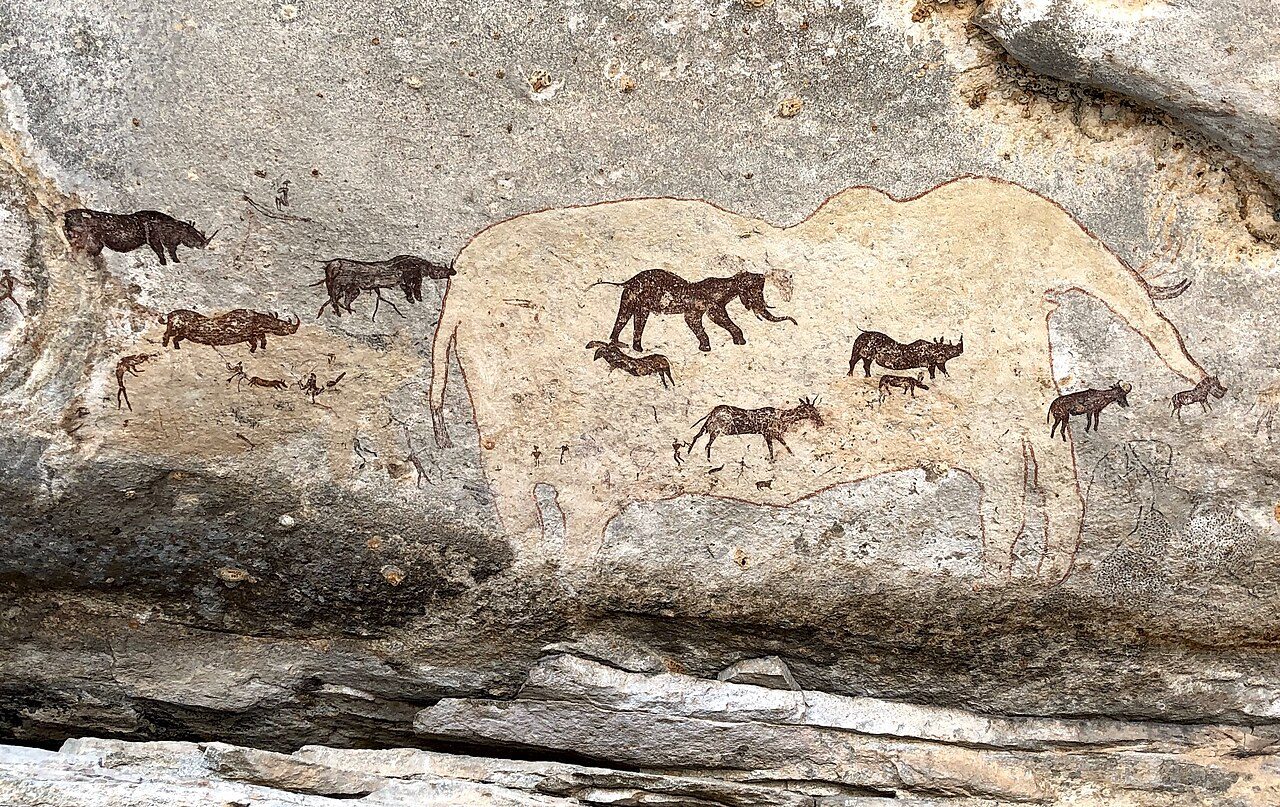
cave paintings and petrographs, petroglyphs, which are carved or scratched into the rock surface, sculpted rock reliefs, and geoglyphs, which are formed on the ground. The oldest known rock art dates from the Upper Palaeolithic period, having been found in Europe, Australia, Asia, and Africa. Anthropologists studying these artworks believe that they likely had magico-religious significance. In scholarly texts, a petroglyph is a rock engraving, whereas a petrograph or pictograph is a rock painting. In common usage, the words are sometimes used interchangeably. The archaeological sub-discipline of rock art studies first developed in the late-19th century among Francophone scholars studying the rock art of the Upper Palaeolithic found in the cave systems of parts of Western Europe. Rock art continues to be of importance to indigenous peoples in various parts of the world, who view them as both sacred items and significant components of their cultural heritage. 1
Etymology
The term rock art appears in the published literature as early as the 1940s. It has also been described as "rock carvings", "rock drawings", "rock engravings", "rock inscriptions", "rock paintings", "rock pictures", "rock records", "rock sculptures", cave art, and parietal art. 1
Background
Parietal art is a term for art in caves; this definition usually extended to art in rock shelters under cliff overhangs. Popularly, it is called "cave art", and is a subset of the wider term, rock art. It is mostly on rock walls, but may be on ceilings and floors. A wide variety of techniques have been used in its creation. The term usually is applied only to prehistoric art, but it may be used for art of any date. Sheltered parietal art has had a far better chance of surviving for very long periods, and what now survives may represent only a very small proportion of what was created. Both parietal and cave art refer to cave paintings, drawings, etchings, carvings, and pecked artwork on the interior of caves and rock shelters. Generally, these either are engraved (essentially meaning scratched) or painted, or, they are created using a combination of the two techniques. Parietal art is found very widely throughout the world, and in many places new examples are being discovered. The defining characteristic of rock art is that it is placed on natural rock surfaces; in this way, it is distinct from artworks placed on constructed walls or free-standing sculpture. As such, rock art is a form of landscape art, and includes designs that have been placed on boulder and cliff faces, cave walls, and ceilings, and on the ground surface. Rock art is a global phenomenon, being found in many different regions of the world. There are various forms of rock art. Some archaeologists also consider pits and grooves in the rock known as cupules, or cups or rings, as a form of rock art. Although there are exceptions, the majority of rock art whose creation was recorded by ethnographers had been produced during rituals. 1
Paintings
In most climates, only paintings in sheltered sites, in particular caves, have survived for any length of time. Therefore, these are usually called "cave paintings", although many do survive in "rock-shelters" or cliff-faces under an overhang. In prehistoric times, these were often popular places for various human purposes, providing some shelter from the weather, as well as light. There may have been many more paintings in more exposed sites, that are now lost. Pictographs are paintings or drawings that have been placed onto the rock face. Such artworks have typically been made with mineral earths and other natural compounds found across much of the world. The predominantly used colours are red, black and white. Red paint is usually attained through the use of ground ochre, while black paint is typically composed of charcoal, or sometimes from minerals such as manganese. White paint is usually created from natural chalk, kaolinite clay or diatomaceous earth. Once the pigments had been obtained, they would be ground and mixed with a liquid, such as water, blood, urine, or egg yolk, and then applied to the stone as paint using a brush, fingers, or a stamp. Alternately, the pigment could have been applied on dry, such as with a stick of charcoal. In some societies, the paint itself has symbolic and religious meaning; for instance, among hunter-gatherer groups in California, paint was only allowed to be traded by the group shamans, while in other parts of North America, the word for "paint" was the same as the word for "supernatural spirit". One common form of pictograph, found in many, although not all rock-art producing cultures, is the hand print. There are three forms of this; the first involves covering the hand in wet paint and then applying it to the rock. 1
Petroglyphs
Petroglyphs are engravings or carvings into rock which is left in situ. They can be created with a range of scratching, engraving or carving techniques, often with the use of a hard hammerstone, which is battered against the stone surface. In certain societies, the choice of hammerstone itself has religious significance. In other instances, the rock art is pecked out through indirect percussion, as a second rock is used like a chisel between the hammerstone and the panel. A third, rarer form of engraving rock art was through incision, or scratching, into the surface of the stone with a lithic flake or metal blade. The motifs produced using this technique are fine-lined and often difficult to see. 1
Rock reliefs
Normally found in literate cultures, a rock relief or rock-cut relief is a relief sculpture carved on solid or "living rock" such as a cliff, rather than a detached piece of stone. They are a category of rock art, and sometimes found in conjunction with rock-cut architecture. However, they tend to be omitted in most works on rock art, which concentrate on engravings and paintings by prehistoric peoples. A few such works exploit the natural contours of the rock and use them to define an image, but they do not amount to man-made reliefs. Rock reliefs have been made in many cultures, and were especially important in the art of the Ancient Near East. Rock reliefs are generally fairly large, as they need to be to make an impact in the open air. 1
The text above is adapted from the Wikipedia article “Rock art”, available under the Creative Commons Attribution-ShareAlike 4.0 licence. 1
rock art is human-made markings on natural stone, according to the structured record cited below. This entry was generated automatically from that record and has not yet been reviewed by a person familiar with the tradition. 2
The source record links this tradition to 29 external registers, which can be verified through the citation. 2