The tradition & historical record
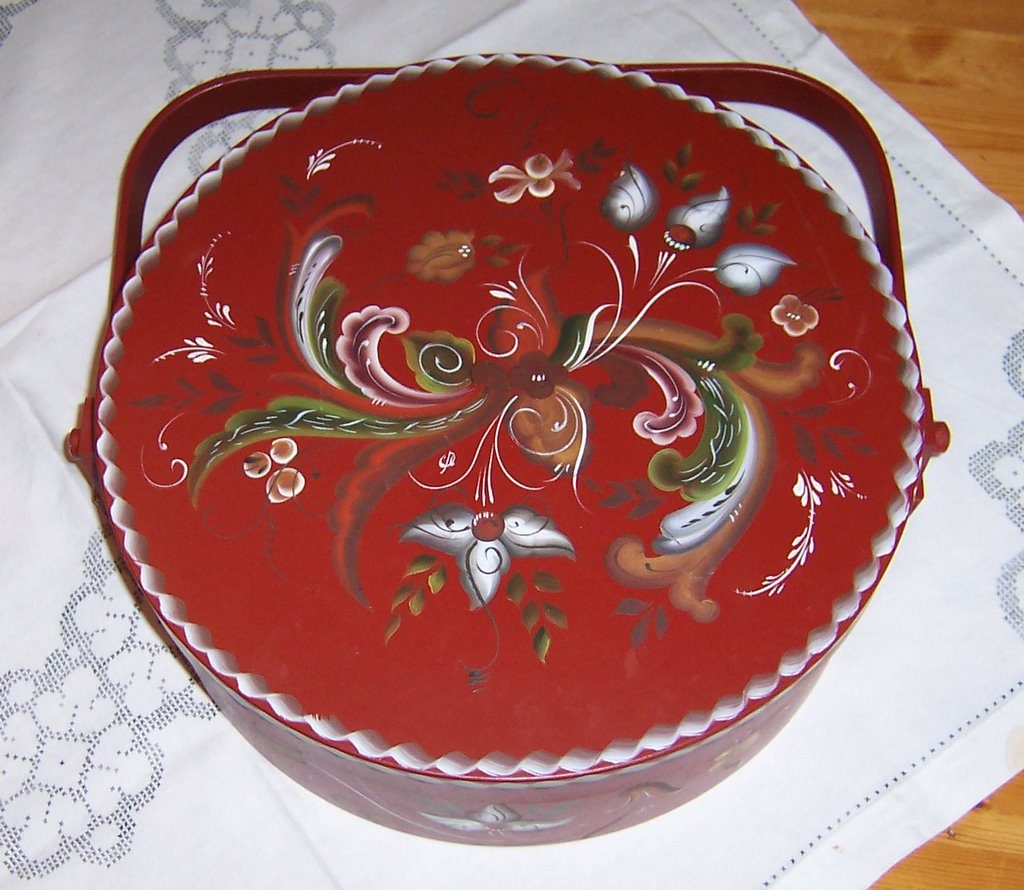
6 min read · 2 sourcesRose-painting, rosemaling, rosemåling or rosmålning is a Scandinavian decorative folk painting that flourished from the 1700s to the mid-1800s, particularly in Norway. In Sweden, rose-painting began to be called dalmålning, c. 1901, for the region Dalecarlia where it had been most popular, and kurbits, in the 1920s, for a characteristic trait, but in Norway the old name still predominates beside terms for local variants. Rose-painting was used to decorate church walls and ceilings. It then spread to wooden items commonly used in daily life, such as ale bowls, stools, chairs, cupboards, boxes, and trunks. Using stylized ornamentation made up of fantasy flowers, scrollwork, fine line work, flowing patterns and sometimes geometric elements give rose-painting its unique feel. Some paintings may include landscapes and architectural elements. Rose-painting also utilizes other decorative painting techniques such as glazing, spattering, marbleizing, manipulating the paint with the fingers or other objects. Regional styles of rose-painting developed, and some varied only slightly from others, while others may be noticeably distinct. 1
Etymology and terminology
The term derives from ros, applied decoration or embellishment, decorative, decorated [rosut, rosute, rosete, rosa] and å male, to paint. The first element can also be interpreted as a reference to the rose flower, but the floral elements are often so stylized that no specific flower is identifiable, and are absent in some designs. In Sweden the style was traditionally called rosmålning, with cupboard decorations said to be utkrusat i rosmålning or krusmålning. In the 20th century the terms dalamålning or dalmålning and kurbitsmålning came into common use. Dalamålning refers to Dalarna, with which the style is particularly associated; the term appeared around 1901. Kurbits originally derived from the Latin Cucurbita, and refers to a long-bodied gourd. The poet Erik Axel Karlfeldt, who wrote about the painted wall hangings of Dalarna, popularized the term in the 1920s, particularly in his 1927 poem "Kurbitsmålning". 1
History in Norway
In Norway, rose-painting, or rosemaling, originated in the 1700s in the lowland and rural areas of eastern Norway, particularly in the Hallingdal and Telemark regions, but also the Valdres, Numedal, Setesdal, Gudbrandsdalen, and in other valleys in Vest-Agder, Hordaland, Sogn og Fjordane, and Rogaland. Rural artists, influenced by Baroque and Rococo styles of the upper classes, encountered through craftsman's guilds, applied the new ideas to their traditional art styles. Rose-painting was originally used to decorate the walls and ceilings of churches and homes of wealthy families. As the 18th century progressed, more and more individuals became artists, allowing for more development of the fledgling art form. Some historians suggest that this was possible due to an increased desire for art, as the style of rural Norwegian homes had changed, with the introduction of chimneys, which vent smoke out of the house, meaning walls could now be painted without becoming smoke damaged. While at first only the rich were able to afford rose-painting decorations, by the mid-18th century, more and more people were able to afford rose-painting in their own homes. Free from the restrictions of guilds, rural artists were free to develop their own styles of this folk art, influenced by various trade routes through their regions, resulting in different regional styles of rose-painting. The three main regional styles are Telemark, Hallingdal and Rogaland, named after the regions in which each originated. Early painters traveled, spreading their style where they went, which accounts for some of the commonalities between regions. Not only did artist paint walls and doorways, they often painted home goods, such as beds, food containers, and trunks. 1
History in Sweden
In Sweden, it is a style of painting featuring light brush strokes and depictions of gourds, leaves, and flowers, used especially in the decoration of furniture and wall hangings, and was adopted by both artists and artisans in rural Sweden, reaching its greatest popularity in the latter half of the 18th century. While rose painting was popular among the entire nation, lots of times the houses of more wealthy individuals had more rose paintings as they were able to afford more decorations. In addition, the major popularity of rose painting in Sweden occurred before the industrialization period. After industrialization, it did not disappear due to the fact that the art created during this period was recognized as a major part of Sweden's folk culture and heritage. 1
The tradition of painted wall hangings in this style was fully developed around 1820. The paintings were done by itinerant painters, most from Dalarna, whose signatures can be found in many localities. The artists learned it as a trade or handicraft from one another, and copied each other's works; some pieces have been found copied more than 140 times. Artists also used stamps to create small details in patterns. Those from the Rättvik school of art were more likely to add spontaneous leaves and flowers, breaking up the symmetry of their pieces. Many of the paintings also included a zig-zag pattern at the bottom of the painting, called ullvibården after the village of Ullvi. Scenes were based on Bible illustrations, with people and buildings rendered in the then current styles. The gourds reference a Biblical legend about Jonah sitting beneath a gourd; the gourd symbolizes vegetal fertility. 1
History in America
Norwegian immigrants brought the art of rosemaling to the United States. Immigration from Norway to America first began in the 1830s. It is not surprising this specific form of folk art was brought to America by Norwegian immigrants since it was not just used for decoration and aesthetic purposes in Norway, but also for self-definition. Rosemaling was a way for Norwegian-Americans to keep a hold of some of their heritage. During this time period of immigration, immigrants did just that, and they maintained a strong ethnic identity both privately and publicly. They might have specific traditions within their homes, participate in ethnic festivals, and more. Rose paintings were often displayed in these festivals. In addition, lots of immigrants traveling from Norway to the Midwest regions of America would actually create rose paintings in churches on their travel to make some money. These rose paintings done by travelers helped expand the variation of styles among rose paintings. The art form experienced a revival in the 20th century as Norwegian-Americans became interested in the rosemaling-decorated possessions of their ancestors. Rosemaling artists whose work was recognized by newspapers and magazines allowed the art form to be further recognized and grow. One prominent rosemaling artist Per Lysne, who was born in Norway and emigrated to Wisconsin, was trained in the craft. Lysne is often considered the father of rosemaling in the U.S. 1
Styles
There are many different styles of rose… 1
The text above is adapted from the Wikipedia article “Rose-painting”, available under the Creative Commons Attribution-ShareAlike 4.0 licence. 1
rosemaling is Norwegian decorative folk art, according to the structured record cited below. This entry was generated automatically from that record and has not yet been reviewed by a person familiar with the tradition. 2
The source record links this tradition to 6 external registers, which can be verified through the citation. 2