The tradition & historical record
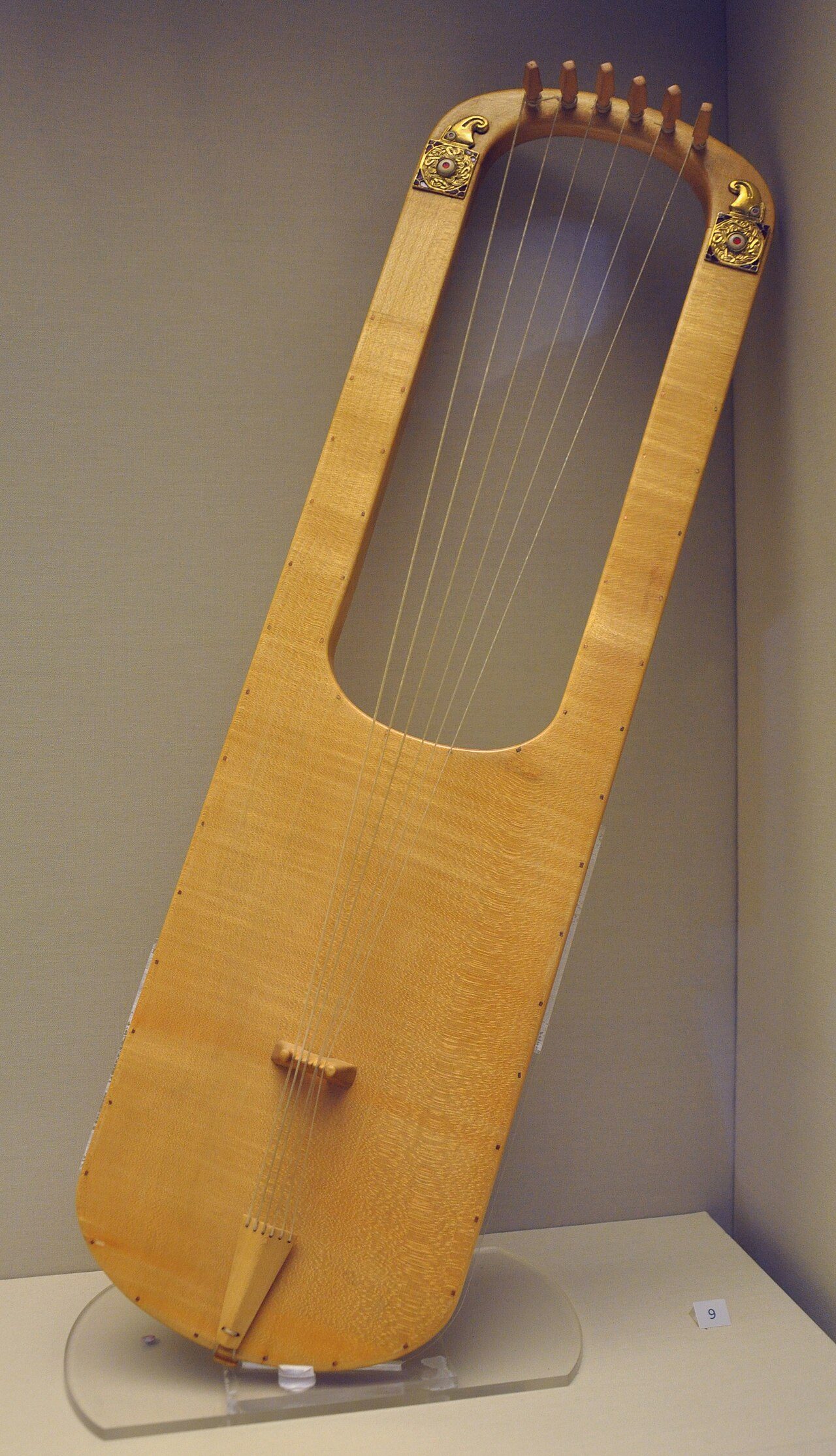
6 min read · 2 sourcesSee Rotte (psaltery) for the medieval psaltery, or Rote for the fiddle Rotte or rotta is a historical name for the Germanic lyre, used in northwestern Europe in the early medieval period (circa 450 A.D.) into the 13th century. Differing from the lyres of the Mediterranean antiquity, Germanic lyres are characterised by a long, shallow and broadly rectangular shape, with a hollow soundbox curving at the base, and two hollow arms connected across the top by an integrated crossbar or ‘yoke’. From northwestern Europe—particularly from England and Germany—an ever-growing number of wooden lyres have been excavated from warrior graves of the first millennium A.D. The plucked variants declined in the medieval era (spreading less often in manuscripts in the 13th century), while bowed variants have survived into modern times. Non-Greek or Roman lyres were used in pre-Christian Europe as early as the 6th century B.C. by the Hallstatt culture, by Celtic peoples as early as the 1st century B.C., and separately by Germanic peoples. They were played in Anglo-Saxon England, and more widely, in Germanic regions of northwestern Europe. Their existence was recorded in the Scandinavian and Old-English story Beowulf, set in pre-Christian times (5th-6th century A.D.) and written or retold by a Christian scribe about 975 A.D. The Germanic lyre has been thought to be a descendant of the ancient lyre which originated in western Asia. 1
Anglo-Saxon lyre
In England, the lyre was called hearpe in Old English. They likely did not use rotta for the lyre. Hearpe lyres were played by the Germanic tribes (Anglo-Saxons) who arrived in England from the continent. Lyres can be seen in English artwork into the 11th century, eventually displaced by the medieval harp. On the continent, lyres continued to be illustrated in manuscripts into the 13th century. The remains of surviving instruments (largely decayed into fragments) have been discovered in graves. Two instruments have given more information about the instrument's characteristic shape. The Grave at Sutton Hoo contained enough of an instrument to create speculation about just what these instruments were; at first it was thought to be a harp. The grave at Prittlewell was thoroughly decayed, but archaeologists were able to use scans of undisturbed soil to reveal the instrument. Apart from archaeological finds, another source of information about hearpes comes from historic images. The Vespasian Psalter, an early 8th-century Anglo-Saxon illustrated book originating from Southumbria (Northern Mercia), shows King David playing the lyre with his court musicians. The theme was commonly repeated across the Christian world, usually with David playing a harp. The image from the Vespasian Psalter gives some insight into how the lyre was played, notably the left hand being used to block strings showing he was using a type of play known as strum and block. This same method of lyre playing appears on many Ancient Greek illustrations of lyre playing. The Durham Cassiodorus contains an image of King David playing the Anglo-Saxon lyre. 1
Norse lyre
In Old Norse, harpa could be used for multiple instruments, including the lyre and the later harp, as can be seen in carved artwork. The oldest image of the Norse lyre comes from Gotland in Sweden, where a rock carving dating from the 6th century has been interpreted as an image of a lyre. In the Poetic Edda, the harpa is mentioned in several different poems. 1
A Norse story about Gunnar that was widely known was source material for Icelandic poetry. In the story, Gunnar lay dying, thrown into a pit of snakes. He had given his sister in marriage to Atli, and wanted Atli's sister Oddrun for his own wife. Atli refused, but Oddrun and Gunnar slept together anyway. Atli had Gunnar killed in the snakepit, and (pleading to his sister Gunnar or his lover Oddrun for help) Gunnar played his harpa with his toes (his hands were tied). The harpa is used this way in the Dráp Niflunga, Oddrúnargrátr, and Atlakviða. 1
It is also mentioned in the Völuspá. 1
Celtic lyre
In Ireland, patriotism has claimed the Celtic harp as an Irish symbol, in spite of scholarship which acknowledges the cruit to originally have been a form of lyre. This disconnect was commented on as early as 1910. Looking broadly at both Ireland and Scotland early images of stringed instruments may be seen in carved reliefs on stone crosses and in a manuscript illustration. The earliest images of European harps are found in Scotland, in Pictish relief carvings. Irish relief artwork shows lyres (or quadrangular stringed-instruments) with soundboards and bridges. Telling the difference between a harp and a lyre in these images may be problematic because they are badly eroded. Should they show a bridge, they may be clearly labeled lyre. Three styles of lyre are seen on the stone crosses: round topped instruments, instruments with one straight and one curved arm, and asymmetrical (or oblique) instruments. In Irish, the instruments were called cruit or crot and timpán. The cruit initially seems to have referred to a lyre. Later in the 8th-10th century A.D., when triangular (or "trilateral") harps appeared, the word cruit would apply to them as well. Once the name for a lyre, cruit would come to apply to smaller harps, while larger harps would be called cláirseach. The timpán was "probably" a lyre with a willow body and three metal strings, played using "a long fingernail or plectrum" by musicians of lesser status than the professional cruitire (bards). It became a bowed instrument, the crwth, "after the early 11th century" or by the 12th century. Used to accompany "Fenian epics and praise poetry." Over time, researchers have interpreted artwork differently; an example is the instrument on the Monasterboice South Cross, which has been called both harp and lyre. 1
Science may not be settled, Celtic versus German lyres
According to linguist Hugo Steger in his 1971 book Philologia Musica, one needs to be careful not to assume that the Germanic rotte lyres are the same as the Irish instruments. His linguistics observations are used by the current Old High German Dictionary (the Althochdeutsches Wörterbuch) to make sense of rotta, rotte and whether these are related to crwth. M. Bruce-Mitford, who wrote the section for the rotte in the New Grove Dictionary of Musical Instruments in 1984, assumed that "the Celtic ‘crwth’, ‘cruit’, and ‘crot’, English ‘rote’ and ‘crowd’, French ‘rote’ and German ‘rotte’ are obviously related etymologically." Steger used linguistics to arrive at a different conclusion. His estimation is that one set of words came from a Germanic language (probably Old Frankish), and that at a later time, crwth entered French from Irish. He estimated that the instruments each language referred to may not be the same, nor the German and Irish words. He wrote that confusion has resulted from writers assuming that words which looked similar must be related; these writers had examined the words in the past without the benefit of modern linguistics knowledge. 1
Naming the lyre
There isn't a firm consensus… 1
The text above is adapted from the Wikipedia article “Rotte (lyre)”, available under the Creative Commons Attribution-ShareAlike 4.0 licence. 1
Rotte is plucked string instrument widely used in north-western Europe from pre-Christian to medieval times, according to the structured record cited below. This entry was generated automatically from that record and has not yet been reviewed by a person familiar with the tradition. 2
The source record links this tradition to 3 external registers, which can be verified through the citation. 2