The tradition & historical record
4 min read · 2 sourcesThe rudra veena (Sanskrit: रुद्र वीणा) (also spelled rudraveena or rudra vīnā), also called the bīn in North India, is a large plucked string instrument used in Hindustani music, especially dhrupad. It is one of the major types of veena played in Indian classical music, notable for its deep bass resonance. Oral tradition ascribes the instrument to Shiva, an important deity within Hinduism. The rudra veena is seen in temple architecture predating the Mughals. It is also mentioned in court records as early as the reign of Zain-ul Abidin (1418–1470), and attained particular importance among Mughal court musicians. Before independence, rudra veena players, as dhrupad practitioners, were supported by the princely states; after independence and the political integration of India, this traditional patronage system ended. With the end of this traditional support, dhrupad's popularity in India declined, as did the popularity of the rudra veena. However, in recent years, the rudra veena has seen a resurgence in popularity, driven at least partly by interest among non-Indian musicians. 1
Names and etymology
The name "rudra veena" comes from Rudra, an epithet of Shiva; rudra vina means "the veena of Shiva" (compare Saraswati veena). The North Indian vernacular name "bīn" (sometimes written "bīṇ") is derived from the preexisting root "veena," the term generally used today to refer to a number of South Asian stringed instruments. While the origins of "veena" are obscure, one possible derivation is from a pre-Aryan root meaning "bamboo" (possibly Dravidian, as in the Tamil veṟam, "cane," or South Indian bamboo flute, the venu), a reference to early stick or tube zithers—as seen in the modern bīn, whose central dandi tube is still sometimes made from bamboo. 1
Form and construction
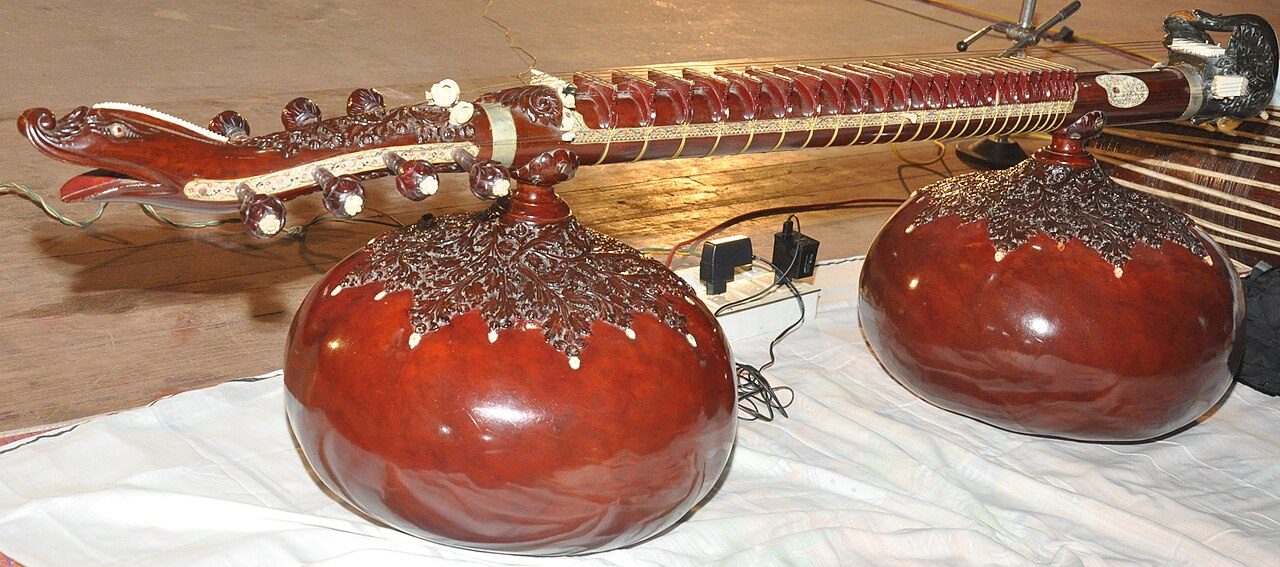
The rudra veena is classified either as a stick zither or tube zither in the Hornbostel–Sachs classification system. The veena's body (dandi) is a tube of bamboo or teak between 137 and 158 cm (54 and 62 in) long, attached to two large tumba resonators made from calabash gourds. The tumbas on a rudra veena are around 34 to 37 cm (13 to 15 in) in diameter; while veena players once attached tumbas to the dandi with leather thongs, modern instruments use brass screw tubes to attach the tumbas. Traditionally, the bottom end of the dandi, where the strings attach below the bridge (jawari), is finished with a peacock carving. This peacock carving is hollow, to enhance the resonance of the instrument. This hollow opens into the tube of the dandi, and is covered directly by the main jawari. The other end of the instrument, holding most or all of the pegs, is finished with a carved makara. Like the peacock at the other end and the dandi tube connecting them, the makara pegbox is also hollow. 1
The rudra veena has twenty-one to twenty-four moveable frets (parda) on top of the dandi. These frets are made of thin plates of brass with flat tops but curved wooden bases to match the shape of the dandi, each about two to four centimeters (0.75–1.5 inches) high. While these frets were once attached to the instrument with wax, contemporary veena players use waxed flax ties to attach the frets. This allows for players to adjust the frets to the individual microtones (shruti) of a raga. 1
History
Its origin is undated; however the instrument is known to be ancient enough and is linked to Shiva. The rudra veena declined in popularity in part due to the introduction in the early 19th century of the surbahar, which allowed sitarists to more easily present the alap sections of slow dhrupad-style ragas. In the 20th century, Zia Mohiuddin Dagar modified and redesigned the rudra veena to use bigger gourds, a thicker tube (dandi), thicker steel playing strings (0.45–0.47 mm) and closed javari that. This produced a soft and deep sound when plucked without the use of any plectrum (mizrab). The instrument was further modified as the shruti veena by Lalmani Misra to establish Bharat's Shadja Gram and obtain the 22 shrutis. 1
The text above is adapted from the Wikipedia article “Rudra veena”, available under the Creative Commons Attribution-ShareAlike 4.0 licence. 1
rudra veena is North Indian zither, type of veena, according to the structured record cited below. This entry was generated automatically from that record and has not yet been reviewed by a person familiar with the tradition. 2
The source record links this tradition to 5 external registers, which can be verified through the citation. 2