The tradition & historical record
6 min read · 2 sourcesRussian icons represent a form of religious art that developed in Eastern Orthodox Christianity after Kievan Rus' adopted the faith from the Eastern Roman (Byzantine) Empire in AD 988. Initially following Byzantine artistic standards, these icons were integral to religious practices and cultural traditions in Russia. Over time, Russian iconography evolved, incorporating local styles and elements that expanded its visual and symbolic vocabulary. The personal, innovative and creative traditions of Western European religious art were largely lacking in Russia before the 17th century, when Russian icon painting became strongly influenced by religious paintings and engravings from both Protestant and Catholic Europe. In the mid-17th-century changes in liturgy and practice instituted by Patriarch Nikon resulted in a split in the Russian Orthodox Church. The traditionalists, the persecuted "Old Ritualists" or "Old Believers", continued the traditional stylization of icons, while the State Church modified its practice. From that time icons began to be painted not only in the traditional stylized and non-realistic mode, but also in a mixture of Russian stylization and Western European realism, and in a Western European manner very much like that of Catholic religious art of the time. 1
History
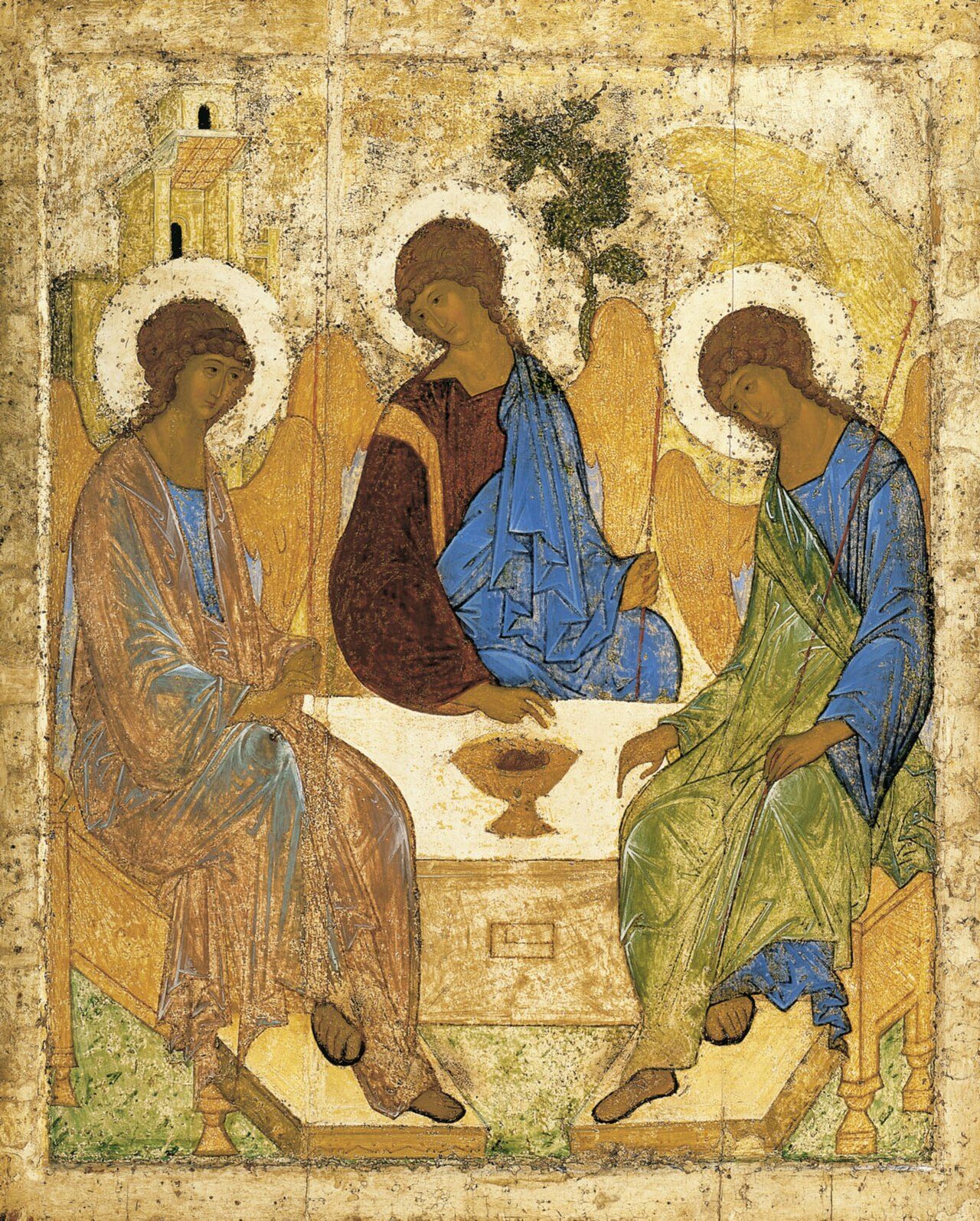
Some of the most venerated but whole icons considered to be products of miraculous thaumaturge are those known by the name of the town associated with them, such as the Vladimir, the Smolensk, the Kazan and the Częstochowa images, all of the Virgin Mary, usually referred to by Orthodox Christians as the Theotokos, the Birth-Giver of God. The preeminent Russian icon painter was Andrei Rublev (1360 – early 15th century), who was "glorified" (officially recognized as a saint) by the Moscow Patriarchate in 1988. His most famous work is The Old Testament Trinity. 1
Russians often commissioned icons for private use, adding figures of specific saints for whom they or members of their family were named gathered around the icon's central figure. Icons were frequently clad in metal covers (the oklad оклад, or more traditionally, riza риза, meaning "robe") of gilt or silvered metal of ornate workmanship, which were sometimes enameled, filigreed, or set with artificial, semiprecious or even precious stones and pearls. Pairs of icons of Jesus and Mary were given as wedding presents to newly married couples. There are far more varieties of icons of the Virgin Mary in Russian icon painting and religious use than of any other figure; Marian icons are commonly copies of images considered to be miraculous, of which there are hundreds: "The icons of Mary were always deemed miraculous, those of her son rarely so". Icons of Mary most often depict her with the child Jesus in her arms; some, however, omit the child. 1
Painting techniques and collecting
Most Russian icons are painted using egg tempera on specially prepared wooden panels, or on cloth glued onto wooden panels. Gold leaf is frequently used for halos and background areas; however, in some icons, silver leaf, sometimes tinted with shellac to look like gold, is used instead, and some icons have no gilding at all. Russian icons may also incorporate elaborate tin, bronze or silver exterior facades that are usually highly embellished and often multi-dimensional. These facades are called rizas or oklads. A regular aspect of icon painting is to varnish over the image with drying oil, either immediately after the paint is dry, or later on. The majority of hand-painted Russian icons exhibit some degree of surface varnish, although many do not. Panels that utilize what are known as "back slats"—cross members that are dovetailed into the back of the boards that make up the panel to prevent warping during the drying process and to ensure structural integrity over time—are usually older than 1880/1890. Subsequent to 1880/1890, advances in materials negated the need for these cross members, thus, are seen either on icons painted after this time period when the intent of the artist was to deceive by creating an "older looking" icon, or on icons which are rendered according to traditional means as a way of honoring the old processes. Back slats are sometimes necessary on newer icons of large size for the same reasons (warping and stability) as existed pre-1900. 1
Age, authenticity, and forgeries
Since the 1990s, numerous late 19th- and early 20th-century icons have been artificially aged, then presented to unwitting buyers or collectors as being older than they really are. Often these "semi-forgeries" are perpetrated by master-level Russian icon painters, highly skilled in their ability to not only paint extraordinary works of art, but to "create age" on the finished icon. While the resulting work may indeed be considered fine art, its deceptive characterization negates its value as an icon beyond its decorative qualities. Another problem area in the field of icon collecting is the "recomposing" of legitimately old icons with newly painted then falsely aged images that exhibit a higher degree of artistry. For example, a primitive or "folk art" icon from the 17th century might be repainted by a modern master painter, and the resulting image falsely aged to match its panel. The intention here would be to produce an icon that could pass as a masterwork from its time, while in reality, it would only be a modern work on a 17th-century panel. With the rise in the value of authentic icons in recent decades, such practices have expanded to lower-quality 19th-century folk icons, which are repainted by contemporary artists and then artificially aged in order fetch a higher selling price. 1
Legalities
Pursuant to Russian law, it is presently illegal to export any Russian icon that is over one hundred years in age. Any and all icons being exported from Russia must be accompanied by a certificate from the Ministry of Culture of the Russian Federation, attesting to the age of the icon. While Russian law regarding the exportation of icons is quite clear, examples of Russian icons over 100 years of age are regularly introduced into the open market by way of smuggling into the neighboring Baltic countries, or as a result of corrupt Ministry of Culture officials who are willing to certify an otherwise unexportable icon as being "100 years old" in order to facilitate its transfer. Since the collapse of the Soviet Union, many Russian icons have been repatriated via direct purchase by Russian museums, private Russian collectors, or as was the case of Pope John Paul II giving an 18th-century copy of the famous Our Lady of Kazan icon to the Russian Orthodox Church, returned to Russia in good faith. 1
Books
Nouwen, Henri J. M. (Henri Josef Machiel) (1987), Behold the beauty of the Lord : praying with icons, Ave Maria Press, ISBN 978-0-87793-356-4 Henri J. M. Nouwen, from Ave Maria Press I. K. I︠A︡zykova; Grenier, Paul (2010), Hidden and triumphant the underground struggle to save Russian iconography, Brewster, Mass Paraclete Press, ISBN 978-1-55725-564-8 1
The text above is adapted from the Wikipedia article “Russian icons”, available under the Creative Commons Attribution-ShareAlike 4.0 licence. 1
Russian icons is Russian religious art, according to the structured record cited below. This entry was generated automatically from that record and has not yet been reviewed by a person familiar with the tradition. 2
The source record links this tradition to 1 external register, which can be verified through the citation. 2