The tradition & historical record
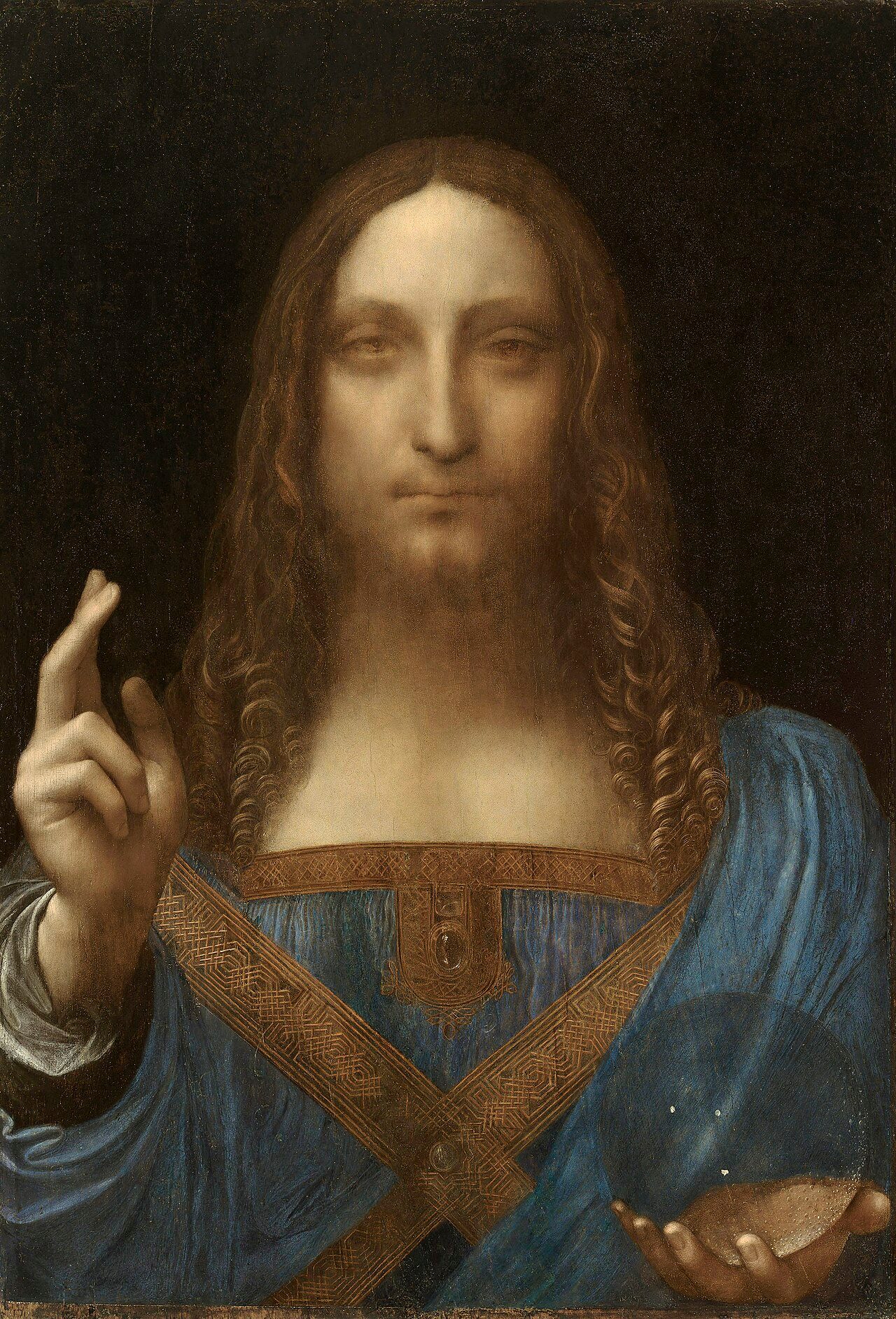
6 min read · 2 sourcesSalvator Mundi (Latin for 'Savior of the World') is a painting attributed in whole or part to the Italian High Renaissance artist Leonardo da Vinci, dated c. 1499–1510. Long thought to be a copy of a lost original veiled with overpainting, it was rediscovered, restored, and included in an exhibition of Leonardo's work at the National Gallery, London, in 2011–2012. Christie's, which sold the work in 2017, stated that most leading scholars consider it an original work by Leonardo, but this attribution has been disputed by some leading specialists who propose that he only contributed certain elements; others believe that the extensive restoration prevents a definitive attribution. The painting depicts Jesus Christ in anachronistic blue Renaissance attire, making a gesture of blessing with his right hand, while holding a transparent, non-refracting crystal orb in his left, signalling his role as Salvator Mundi and representing the celestial sphere of the heavens. Approximately thirty copies and variations of the work by pupils and followers of Leonardo have been identified; two are considered to have been produced during Leonardo's lifetime. Two preparatory chalk and ink drawings of the drapery by Leonardo are held in the British Royal Collection. The painting was sold at auction for US$450.3 million on 15 November 2017 by Christie's in New York to Prince Badr bin Abdullah Al Saud, setting a new record for the most expensive painting ever sold at public auction. 1
Sixteenth century
Art historians have suggested several possibilities for when the work was executed and who the patron may have been. Christie's stated that the painting was probably commissioned around 1500, shortly after King Louis XII of France conquered the Duchy of Milan and took control of Genoa in the Second Italian War; Leonardo himself moved from Milan to Florence in 1500. The art historian Luke Syson agrees, dating the painting to c. 1499, though Martin Kemp and Frank Zöllner date the work to c. 1504–1510 and c. 1507 or later, respectively. Based on their similarity in style and materials to the studies for The Virgin and Child with Saint Anne, Carlo Pedretti dates the drapery studies in the Royal Collection, and thus the painting, to 1510–1515. Because of the specificity of the subject, Leonardo's Salvator Mundi was most likely commissioned by a specific patron rather than produced on speculation. Isabella d'Este, Marchioness of Mantua, is cited as a possible patron as in 1504 she had wished to commission from Leonardo a "youthful Christ of around twelve years, of that age that he had when he disputed in the Temple", though Salvator Mundi shows a more mature Christ. Carlo Pedretti notes that Isabella d'Este was a guest of Leonardo's patron Giuliano de' Medici in 1514 and so may have convinced the artist to complete the commission at that time. Frank Zöllner has discussed Leo X as a possible patron because the Salvator’s garments show some striking resemblances with Aimo’s marble statue of Leo X in Rome. Martin Kemp does not draw conclusions, but likewise discusses the possibility of Isabella d'Este as patron – though he also considers the Hungarian king Matthias Corvinus, Charles VIII of France, and others. 1
Origins
The Salvator Mundi as an image type predates Leonardo. Thus, Martin Kemp argues that on the one hand Leonardo was constrained in his composition by the expected iconography of the Salvator Mundi, but on the other hand, he was able to use the image as a vehicle for spiritual communication between the spectator and the likeness of Christ. The composition has its sources in Byzantine art, the imagery of which further developed in northern Europe before finding its place in the Italian states. Snow-Smith relates the development of the Salvator Mundi to Byzantine iconography and narratives of images of Christ "not made by human hands". Such acheiropoeta would include the Mandylion of Edessa, the Keramidion, and the Veil of Veronica. Although the Salvator Mundi has its origins in the acheiropoeta, Snow-Smith discusses, the Salvator Mundi emerged in the fifteenth century through such intermediate subjects as Christ as Pantocrator, Christ in Majesty, and the Last Judgment, which like the acheiropoeta betray their Byzantine origins through their frontal depictions of Christ. The frontality of Christ is shared by other images of Christ and God the Father in the fifteenth and sixteenth centuries, including in 'portrait' images of Christ, which feature only Christ at half-length and without the orb or blessing gesture, as well as in images of 'Christ Blessing' which does not show Christ holding an orb. Images of Christ holding a sphere became widely popular following Charlemagne's adoption of the globus cruciger and the scepter. The earliest true Salvator Mundi images are found in northern Europe. 1
Copies
The original painting by Leonardo was thought to have been destroyed or lost around 1603. There are at least thirty copies and variations of the painting executed by Leonardo's pupils and followers, as counted by Robert Simon. The large number of these paintings is an important part of the pedigree of Leonardo's painting and emphasizes that there must have been an original by Leonardo from which they were copied. The most significant and widely discussed among these is the painting formerly in the de Ganay collection, as this one shares most closely the same composition and demonstrates the highest technical skill of Leonardo's pupils. This is so much the case that Joanne Snow-Smith proposed it to be the original painting in 1978. The many other copies found in Naples, Detroit, Warsaw, Zürich and other public and private collections contain various attributions to members of Leonardo's pupils and followers. Some versions differ significantly from the original. Two examples can be found in the form of a 'portrait' such as in Salaí's 1511 painting, as well as in a painting sold at Sotheby's on 5 December 2018, both of which use Leonardo's Salvator Mundi as their model but which do not employ the iconography of the blessing hand or globe. Other artists use the same model but for other subjects, as is the case with Leonardo's Spanish follower Fernando Yáñez de la Almedina and the Eucharistic Christ now at the Museo del Prado. Leonardo's studio and his followers likewise produced at least four Salvator Mundi panels depicting a youthful Christ who is less frontal in his pose and who holds a terrestrial globe. 1
Seventeenth to nineteenth centuries
This painting seems to have been at James Hamilton's Chelsea Manor in London from 1638 to 1641. After participating in the English Civil War, Hamilton was executed on 9 March 1649 and some of his possessions were taken to the Netherlands to be sold. The Bohemian artist Wenceslaus Hollar could have made his engraved copy, dated 1650, in Antwerp at that time. It was also recorded in Henrietta Maria's possession in 1649, the same year her husband Charles I was executed, on 30 January. 1
Rediscovery and restoration
In 2005, the estate of Baton Rouge businessman Basil Clovi… 1
The text above is adapted from the Wikipedia article “Salvator Mundi (painting)”, available under the Creative Commons Attribution-ShareAlike 4.0 licence. 1
Salvator Mundi is painting attributed to Leonardo da Vinci, according to the structured record cited below. This entry was generated automatically from that record and has not yet been reviewed by a person familiar with the tradition. 2
The source record links this tradition to 11 external registers, which can be verified through the citation. 2