The tradition & historical record
7 min read · 2 sourcesThe Sarasvatī vīṇa (also spelled Saraswati veena) (Telugu: సరస్వతి వీణ, Kannada: ಸರಸ್ವತಿ ವೀಣೆ, Tamil: சரஸ்வதி வீணை, Malayalam: സരസ്വതി വീണ) is an ancient Indian plucked veena. It is named after the Hindu goddess Saraswati, who is usually depicted holding or playing the instrument. Also known as raghunatha veena, it is used mostly in Carnatic Indian classical music. There are several variations of the veena, which in its South Indian form is a member of the lute family. One who plays the veena is referred to as a vaiṇika. The Saraswati veena is one of 4 major types of veena today. The others include chitra veena, vichitra veena and rudra veena. Out of these the rudra and vichitra veenas are used more often in Hindustani music, while the Saraswati veena and the chitra veena are used more frequently in the Carnatic music of South India. They can be used to play either traditional music or contemporary music. 1
History
The veena has a recorded history that dates back to approximately 1700 BCE. In ancient times, the tone vibrating from the hunter's bow string when he shot an arrow was known as the Vil Yazh. The Jya ghosha (musical sound of the bow string) is referred to in the ancient Atharvaveda. Eventually, the archer's bow paved the way for the musical bow. Twisted bark, strands of grass and grass root, vegetable fibre and animal gut were used to create the first strings. Over the veena's evolution and modifications, more particular names were used to help distinguish the instruments that followed. The word veena in India was a term originally used to generally denote "stringed instrument", and included many variations that would be either plucked, bowed or struck for sound. The veena instruments developed much like a tree, branching out into instruments as diverse as the harp-like Akasa (a veena that was tied up in the tops of trees for the strings to vibrate from the currents of wind) and the Audumbari veena (played as an accompaniment by the wives of Vedic priests as they chanted during ceremonial Yajnas). Veenas ranged from one string to one hundred and were composed of many different materials like eagle bone, bamboo, wood, and coconut shells. The yazh was an ancient harp-like instrument that was also considered a veena. But with the developments of the fretted veena instruments, the yazh quickly faded away, as the fretted veena allowed for the easy performance of ragas and the myriad subtle nuances and pitch oscillations in the gamakas prevalent in the Indian musical system. As is seen in many Hindu temple sculptures and paintings, the early veenas were played vertically. 1
Construction
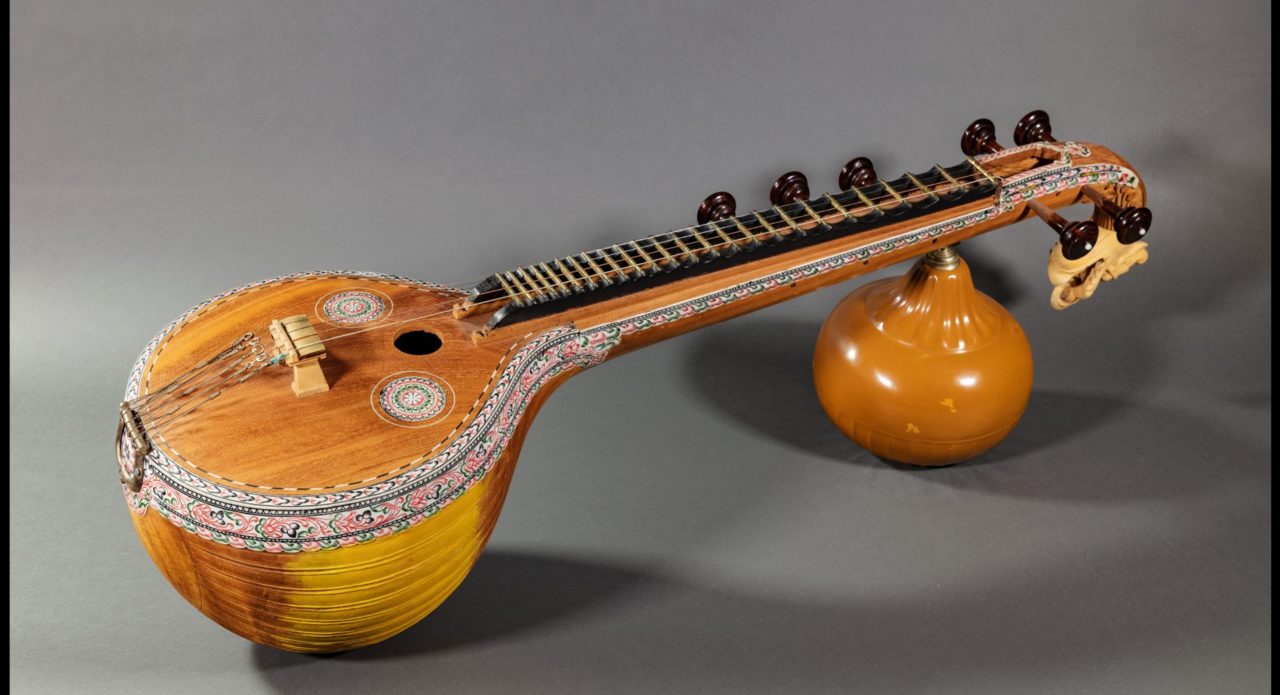
About four feet in length, its design consists of a large resonator (kudam) carved and hollowed out of a log (usually of jackfruit wood), a tapering hollow neck (dandi) topped with 24 brass or bell-metal frets set in scalloped black wax on wooden tracks, and a tuning box culminating in a downward curve and an ornamental dragon's head (yali). If the veena is built from a single piece of wood it is called (Ekanda) veena. A small table-like wooden bridge (kudurai)—about 2 x 2½ x 2 inches—is topped by a convex brass plate glued in place with resin. Two rosettes, formerly of ivory, now of plastic or horn, are on the top board (palakai) of the resonator. Four main playing strings tuned to the tonic and the fifth in two octaves (for example, B flat-E flat below bass clef - B flat- E flat in bass clef) stretch from fine tuning connectors attached to the end of the resonator across the bridge and above the fretboard to four large-headed pegs in the tuning box. Three subsidiary drone strings tuned to the tonic, fifth, and upper tonic (E flat - B flat- E flat in the tuning given above) cross a curving side bridge leaning against the main bridge, and stretch on the player's side of the neck to three pegs matching those of the main playing strings. All seven strings today are of steel. 1
Playing technique
The veena is played by sitting cross-legged with the instrument held tilted slightly away from the player. The small gourd on the left rests on the player's left thigh, the left arm passing beneath the neck with the hand curving up and around so that the fingers rest upon the frets. The palm of the right hand rests on the edge of the top plank so that the fingers (usually index and middle) can pluck the strings. The drone strings are played with the little finger. The veena's large resonator is placed on the floor, beyond the right thigh. Like the sitar, the left hand technique involves playing on the frets, controlled pushing on the strings to achieve higher tones and glissandi through increased tension, and finger flicks, all reflecting the characteristics of various ragas and their ornamentation (gamaka). Modern innovations include one or two circular sound holes (like that of the lute), substitution of machine heads for wooden pegs for easier tuning, and the widespread use of transducers for amplification in performance. 1
Religious associations within Hinduism
The Hindu goddess of learning and the arts, Saraswati, is often depicted playing a veena. The god Shiva is also depicted playing or holding a vina in his form called "Vinadhara," which means "bearer of the vina." The sage Narada is known as a veena maestro, and refers to 19 different kinds of Veena in Sangita Makarandha. Ravana, the antagonist of the epic Ramayana, is described as a versatile veena player. Scholars hold that as Saraswati is the goddess of learning, the most evolved string instrument in a given age was placed in her hands by contemporary artistes. 1
References in ancient texts and literature
The Ramayana, the Puranas and Bharata Muni's Natya Shastra all contain references to the veena, as well as the Sutra and the Aranyaka. The Vedic sage Yajnavalkya speaks of the greatness of the veena in the following verse: "One who is skilled in Veena play, one who is an expert in the varieties of srutis (quarter tones) and one who is proficient in tala (rhythm) attain salvation without effort." Many references to the veena are made in old Sanskrit and Tamil literature, such as Lalita Sahasranama, Adi Shankara's Soundarya Lahari, poet Kalidasa's epic Sanskrit poem Kumarasambhava and Shyamala Dandakam, and Tamil Thevarams and the Thiruvasagam to name a few. Examples include "veena venu mridanga vAdhya rasikAm" in Meenakshi Pancharathnam, "mAsil veeNaiyum mAlai madhiyamum" Thevaram by Appar. Veena or the Hindu goddesses playing the veena i.e. Saraswathi and Shakti have also been referred to as kachchapi (in the Lalitha Sahasranama for example) or vipanchi (in the Soundarya Lahari) in Sanskrit texts. Musical compositions like Tyagaraja's Mokshamugaladha contain philosophies about the spiritual aspects of the veena. Each physical portion of the veena is said to be the seat in which subtle aspects of various gods and goddesses reside in Hinduism. The instrument's neck is Shiva; the strings constitute his consort, Parvati. The bridge is Lakshmi, while the secondary gourd is Brahma, and the dragon head is Vishnu. Upon the “table” (or the resonating body) is Saraswati. 1
The text above is adapted from the Wikipedia article “Saraswati veena”, available under the Creative Commons Attribution-ShareAlike 4.0 licence. 1
Saraswati vina is plucked string instrument, according to the structured record cited below. This entry was generated automatically from that record and has not yet been reviewed by a person familiar with the tradition. 2
The source record links this tradition to 3 external registers, which can be verified through the citation. 2