The tradition & historical record
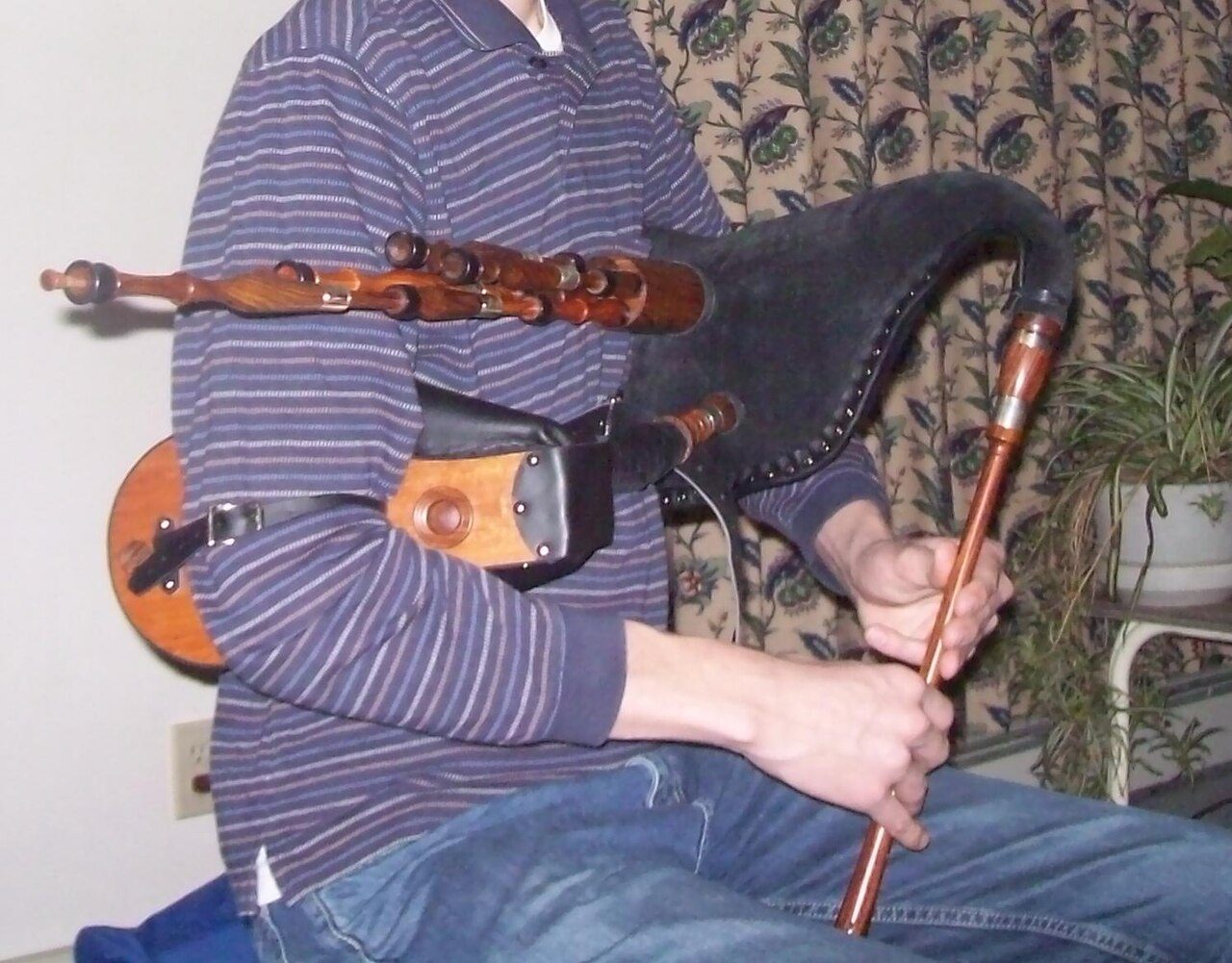
4 min read · 2 sourcesThe Scottish smallpipe is a bellows-blown bagpipe re-developed by Colin Ross and many others, adapted from an earlier design of the instrument. There are surviving bellows-blown examples of similar historical instruments as well as the mouth-blown Montgomery smallpipes, dated 1757, which are held in the National Museum of Scotland. Some instruments are being built as direct copies of historical examples, but few modern instruments are directly modelled on older examples; the modern instrument is typically larger and lower-pitched. The innovations leading to the modern instrument, in particular the design of the reeds, were largely taken from the Northumbrian smallpipes. Although there is evidence of small pipes dating back to 15th century, in its current form it is perhaps the youngest bagpipe with widespread popularity, having only existed in this form since the early 1980s. 1
Characteristics
Scottish smallpipes are distinguished from the Northumbrian smallpipes by the open ended chanter, and usually by the lack of keys. This means that the sound of the chanter is continuous, rather than staccato, and that its range is only nine notes, rather than the octave and a sixth range of the later 18th/early 19th century Northumbrian pipes. The instrument has a cylindrically bored chanter, most commonly pitched in A; pipes in D, C, B flat, and G are also common. Being cylindrically bored, the chanter sounds an octave lower than a conical-bored chanter of the same size, such as that of the Border pipes.The basic scale of the Scottish smallpipe is identical to the Mixolydian scale of the Highland and Border bagpipes: the 7th (leading) note on the scale is flattened, meaning in the case of an A chanter, the low and high G notes are natural, rather than sharp (as they would be in the scale of A major.) Scottish smallpipes are most commonly tuned to be played with the same fingering system as Highland bagpipes (sometimes called 'half-covered'), however they can also be tuned to accept a 'covered' fingering system (very similar to that of the 'closed' system used for Northumbrian smallpipes), where only one finger is lifted from the chanter to play each note, the only difference to the Northumbrian system being that the tonic tonehole on the chanter is left uncovered (except when playing the low leading note.) Scottish smallpipes are normally bellows-blown like the Northumbrian smallpipes and Border pipes. 1
History
Originally one of the first documented bagpipes in Scotland, along with the Border pipes, smallpipes were popular in the Lowland areas of Scotland as far north as Aberdeen. Evidence shows them to have existed since the 15th century (Highland pipes can only be documented from the 15th century in a form definably separate from Irish "warpipes"), when they were used for dancing and entertainment in court and castle, later they became popular amongst burgh pipers, and town minstrels until the early 19th Century, when the demise of the town pipers led to their disappearing from the record. Being bellows-blown this made them suitable for playing for long periods. Bellows-blown smallpipes are believed to have entered Scotland via England, and the continent of Europe, examples are preserved in many drawings, carvings, and paintings from 15th century onwards, and in Europe from the 12th century onwards. There is some discussion of the historical Scottish smallpipes in Collinson's history of the bagpipes. More reliable research and information can be obtained in Hugh Cheape's "Bagpipes: A National Collection." Since there was a break in the continuous playing tradition of the smallpipes, and Border pipes, no absolute, definitive playing style can be ascribed to them. 1
The text above is adapted from the Wikipedia article “Scottish smallpipes”, available under the Creative Commons Attribution-ShareAlike 4.0 licence. 1
Scottish smallpipes is type of bellows-blown bagpipe, according to the structured record cited below. This entry was generated automatically from that record and has not yet been reviewed by a person familiar with the tradition. 2
The source record links this tradition to 3 external registers, which can be verified through the citation. 2