The tradition & historical record
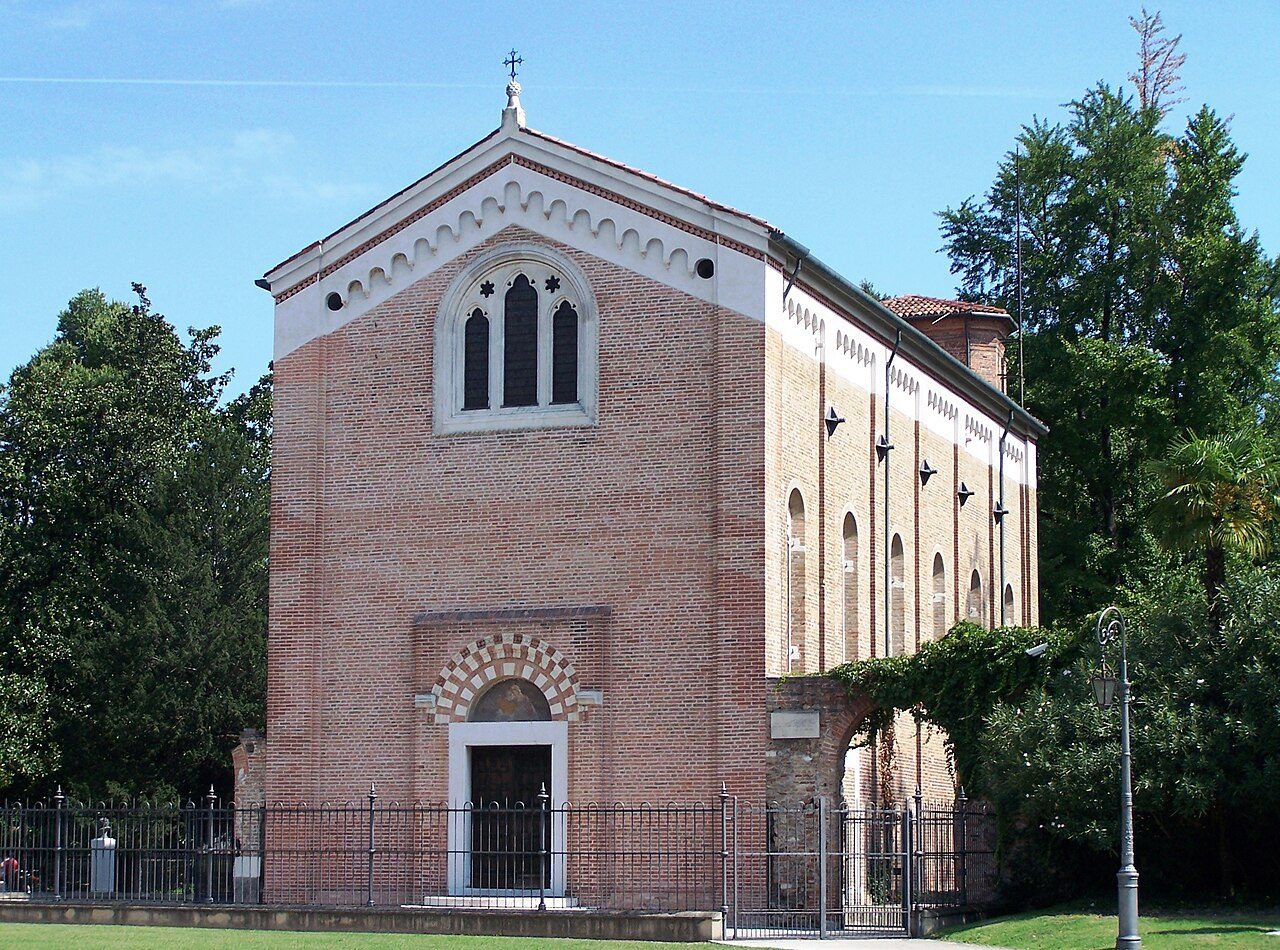
6 min read · 2 sourcesThe Scrovegni Chapel (Italian: Cappella degli Scrovegni [kapˈpɛlla deʎʎi skroˈveɲɲi]), also known as the Arena Chapel, is a small church, adjacent to the Augustinian monastery, the Monastero degli Eremitani in Padua, region of Veneto, Italy. The chapel and monastery are now part of the complex of the Musei Civici di Padova. The chapel contains a fresco cycle by Giotto, completed around 1305 and an important masterpiece of Western art. In 2021, the chapel was declared part of the UNESCO World Heritage Site of 14th-century fresco cycles composed of 8 historical buildings in Padua city centre. The Scrovegni Chapel contains the most important frescoes that marked the beginning of a revolution in mural painting and influenced fresco technique, style, and content for a whole century. 1
Description
Giotto and his team covered all the internal surfaces of the chapel with frescoes, including the walls and the ceiling. The nave is 20.88 metres (68.5 ft) long, 8.41 metres (27.6 ft) wide, and 12.65 metres (41.5 ft) high. The apse area is composed of a square area (4.49 meters deep and 4.31 meters wide) and a pentagonal area (2.57 meters deep). The largest element is extensive cycles showing the Life of Christ and the Life of the Virgin. The wall at the rear of the church, through which the chapel is entered, has a large Last Judgement. There are also panels in grisaille (monochrome) showing the Vices and Virtues. The church was dedicated to Santa Maria della Carità at the Feast of the Annunciation, 1303, and consecrated in 1305. Much of Giotto's fresco cycle focuses on the life of the Virgin Mary and celebrates her role in human salvation. A motet by Marchetto da Padova appears to have been composed for the dedication on 25 March 1305. The chapel is also known as the Arena Chapel because it was built on land purchased by Enrico Scrovegni that abutted the site of a Roman arena. The space was where an open-air procession and sacred representation of the Annunciation to the Virgin had been played out for a generation before the chapel was built. 1
Building and decoration
The Arena Chapel was commissioned to Giotto by the affluent Paduan banker, Enrico Scrovegni. In the early 1300s Enrico purchased from Manfredo Dalesmanini the area on which the Roman arena had stood. Here he had his luxurious palace built, as well as a chapel annexed to it. The chapel's project was twofold: to serve as the family's private oratory and as a funerary monument for himself and his wife. Enrico commissioned Giotto, the famous Florentine painter, to decorate his chapel. Giotto had previously worked for the Franciscan friars in Assisi and Rimini, and had been in Padua for some time, working for the Basilica of Saint Anthony in the Sala del Capitolo and in the Blessings's Chapel. A number of 14th-century sources (Riccobaldo Ferrarese, Francesco da Barberino, 1312–1313) testify to Giotto's presence at the Arena Chapel's site. The fresco cycle can be dated with a good approximation to a series of documentary testimonies: the purchase of the land took place on 6 February 1300; the bishop of Padua, Ottobono dei Razzi, authorised the building some time prior to 1302 (the date of his transferral to the Patriarcato of Aquileia); the chapel was first consecrated on 25 March 1303, the feast day of the Annunciation; on 1 March 1304 Pope Benedict XI granted an indulgence to whoever visited the chapel; one year later on 25 March 1305 the chapel received its definitive consecration. Giotto's work thus falls in the period from 25 March 1303 to 25 March 1305. 1
Giotto, who was born around 1267, was 36–38 years old when he worked at Enrico Scrovegni's chapel. He had a team of about 40 collaborators, and they calculated that 625 work days (giornate) were necessary to paint the chapel. 1
Modern period
The chapel was originally connected with the Scrovegni palace, which was built on what remained of the foundations of the elliptical ancient Roman arena. The palace was demolished in 1827 in order to sell the precious materials it contained and to erect two condominiums in its place. The chapel was purchased by the Municipality of the City of Padua in 1881, a year after the City Council's deliberation of 10 May 1880 leading to a decision to demolish the condominiums and restore the chapel. In June 2001, following a preparation study lasting over 20 years, the Istituto Centrale per il Restauro (Central Institute for Restoration) of the Ministry for Cultural Activities, in collaboration with Padua's Town Hall in its capacity of owner of the Arena Chapel, started a full-scale restoration of Giotto's frescoes under the late Giuseppe Basile's technical direction. In 2000 the consolidation and restoration of the external surfaces had been completed and the adjacent "Corpo Tecnologico Attrezzato" (CTA) had been installed. In this "equipped technological chamber" visitors wait for fifteen minutes to allow their body humidity to be lowered and any accompanying smog dust to be filtered out. In March 2002 the chapel was reopened to the public in its original splendor. A few problems remain unsolved, such as flooding in the crypt under the nave due to the presence of an underlying aquifer, and the negative effect on the building's stability of the cement inserts that replaced the original wooden ones in the 1960s. 1
Scholarly debates
Giuliano Pisani's studies argued that a number of commonly held beliefs concerning the chapel are groundless, among them, the notion that Dante inspired Giotto. However, a posthumous portrait of Dante was included in the Paradise section of the frescoes. Another claim was that the theological program followed by Giotto is based on St Thomas Aquinas, whereas Pisani claims it to be wholly Augustinian. Pisani also argued against the conjecture that the Frati Gaudenti fraternity, of which Enrico Scrovegni was a member, influenced the content of Giotto's fresco cycle. He also argued against the belief that Enrico Scrovegni required that the iconography program have no emphasis placed on the sin of usury. Giuliano Pisani pointed out that Dante's condemnation of Scrovegni's father, Reginaldo, as a usurer in Canto 17 of the Inferno dates to a few years after Giotto's completion of the chapel, so it cannot be regarded as a motive behind any theological anxieties on the part of Enrico Scrovegni. Pisani's arguments have not yet been widely embraced by the scholarly community, and that debates persist regarding the impetus for the chapel's creation and the reasons behind its design. According to Pisani, Giotto painted the chapel's inner surface following a comprehensive iconographic and decorative project devised by the Augustinian theologian, Friar Alberto da Padova. 1
The depiction of the sacred stories, and the message of the vault
Giotto frescoed the chapel's whole surface, including the walls and the ceiling. The fresco cycle is organized along four tiers, each of which contains episodes from the stories of the various protagonists of the Sacred History. Each tier is divided into frames, each forming a scene. 1
The text above is adapted from the Wikipedia article “Scrovegni Chapel”, available under the Creative Commons Attribution-ShareAlike 4.0 licence. 1
Scrovegni Chapel is chapel in Padua, Italy, according to the structured record cited below. This entry was generated automatically from that record and has not yet been reviewed by a person familiar with the tradition. 2
The source record links this tradition to 19 external registers, which can be verified through the citation. 2