The tradition & historical record
5 min read · 2 sourcesSerbian art refers to the visual arts of the Serbs and their nation-state Serbia. The medieval heritage includes Byzantine art, preserved in architecture, frescos and icons of the many Serbian Orthodox monasteries. In the early modern period, Serbian visual arts began to be influenced by Western art, culminating in the Habsburg monarchy in the late 18th century. The beginning of modern Serbian art is placed in the 19th century. Many Serbian monuments and works of art have been lost forever due to various wars and peacetime marginalizations. 1
Prehistory
Artifacts from Europe's oldest known civilizations have been discovered in Serbia. Archaeological Sites of Exceptional Importance (Serbia) are numerous and have the highest level of state protection under the Law on Cultural Heritage. Prehistoric sites in Serbia include Lepenski Vir. 1
Roman period
Geographically the region of modern-day Serbia was always part of the Roman Empire whether it was ruled from Rome or from Byzantium. The Roman ruins are found throughout Southeastern Europe. 1
Medieval Serbian art
Little is known of the lives of the painters, craftsmen (engravers, goldsmiths, woodcarvers), builder/architects of medieval Serbia, of their studies, their schools, and their commissions. However, progress in learning of those topics is gradually being made. But in the course of centuries experience in painting frescoes, miniatures, icons and the iconostasis, there undoubtedly arose arts and crafts workshops where a younger generation of painters and skilled craftsmen could learn the techniques of the masters. Church architecture developed under the patronage of the medieval Serbian state. The most distinctive piece of medieval Serbian architecture was the Studenica monastery founded by Stefan Nemanja, the founder of the Nemanjić dynasty in 1166. This monastery also featured significant works of art including its Byzantine style fresco paintings. Its church also features extensive sculptures based on Psalms and the Dormition of the Theotokos. UNESCO added this monastery to its list of World Cultural Heritage sites in 1986. It was the model for other monasteries at Mileševa, Sopoćani and the Visoki Dečani. The influence of Byzantine art became more influential after the capture of Constantinople in 1204 in the Fourth Crusade when many Greek artists fled to Serbia. Their influence can be seen at the Church of the Ascension at Mileševa as well as in the wall paintings at the Church of the Holy Apostles at Peć and at the Sopoćani Monastery. Icons and frescoes also formed a significant part of church art. At that time in Raška, Stefan Vladislav who founded at Mileševa a monastery and a church where three of his court painters -- Demetrius, George and Theodore -- worked on wall painting free from the strict canon law tradition. 1
Fresco paintings
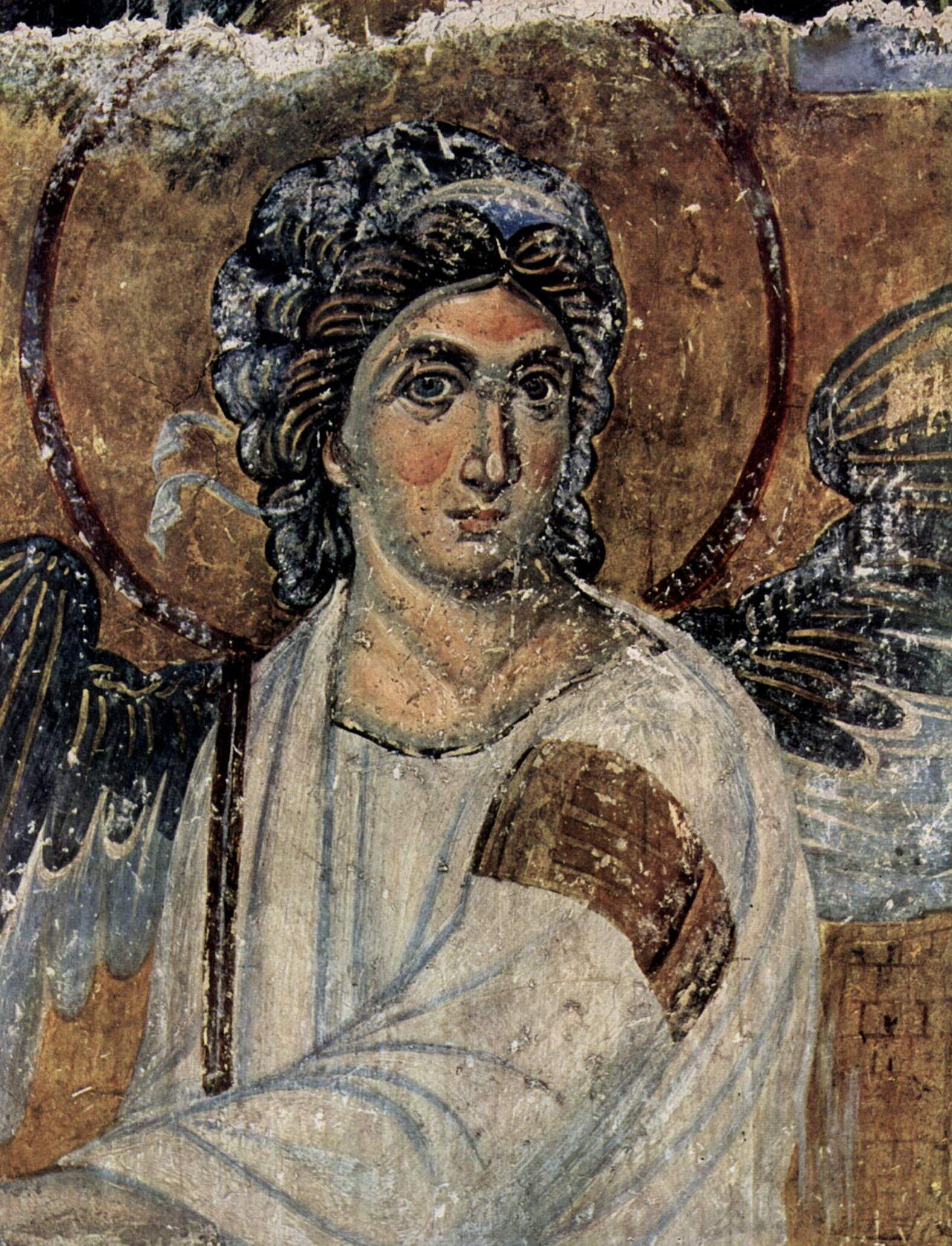
Orthodox fresco painting represents the peak of Serbian medieval art. Its birth went in line with the creation and development of medieval Serbian state, but unlike Serbian state it didn't cease to exist during the Ottoman occupation. While Serbian architecture has seen mixed influences of both Byzantine and medieval Italian states, fresco and icon painting remained deeply rooted in solely eastern byzantine tradition. Frescos were being painted under the patronage of Serbian rulers, as the highest form of religious decorative form. Following the political expansion and military growth, the 13th and 14th century are marked as the period when the biggest amount of newly built or existing sanctuaries have been decorated, mostly by unknown artists. Studenica monastery has been built in 1196 under the patronage of Stefan Nemanja, the founder of Nemanjić dynasty, and ever since it enjoyed the care of Stefan's descendants as the archi-model. Its most representative fresco, The Crucifixion, was made twelve years later, in 1208, on the blue background brought into contrast with golden-yellow of Christ's bare crucified body. In the second half of 13th century an unknown artist painted monumental The Dormition of the Virgin in Sopoćani monastery, which remained the supreme achievement of byzantine painting tradition. However, the most famous Serbian medieval fresco is the Myrrhbearers (or the "White Angel") from the Mileševa monastery, painted in 1235, on the southern wall of the church. It depicts Archangel Gabriel sitting on Christ's grave. The identity of its author is unknown. In the 16th century, the White Angel was over-painted with another fresco, and so was hidden until the 20th century when the fresco was restored. 1
16th and 17th centuries
The Ottoman conquest of Serbia during the 15th century had a negative impact on the visual arts. The Serbs became part of the Rum Millet (Christian community), and were regarded as a lower class (rayah). The Serbian nobility was not integrated into the Ottoman state system, and the Ottoman government abolished the church. As the nobility and church were the main sources of patronage for architects and artists, the early modern period is considered an artistically less productive period in Serbian art. Despite the general trend, notable monuments were built. There was some resumption of artistic endeavor after the restoration of the Serbian Patriarchate in 1557. Zograf Longin (1530-1600) and Georgije Mitrofanović were the leading painters of the late 16th and early 17th century, along with Zograf Jovan, Andrija Raičević, Zograf Radul, Sava Krabulević, Kozma Damjanović, Zograf Dimitrije, Strahinja of Budimlje, Kyr Georgije and Kyr Kozma. Mitrofanović's work on the church at the Morača Monastery is considered one of his best. Among the icon painters working in the Byzantine tradition in Slavonia were Nikola Klisur (mid-17th century) and Ostoja Mrkojević in the late 17th century. 1
The text above is adapted from the Wikipedia article “Serbian art”, available under the Creative Commons Attribution-ShareAlike 4.0 licence. 1
Serbian art is recorded in open cultural data. The structured record cited below does not describe the practice, and this entry has not yet been reviewed by a person familiar with the tradition. 2
The source record links this tradition to 9 external registers, which can be verified through the citation. 2