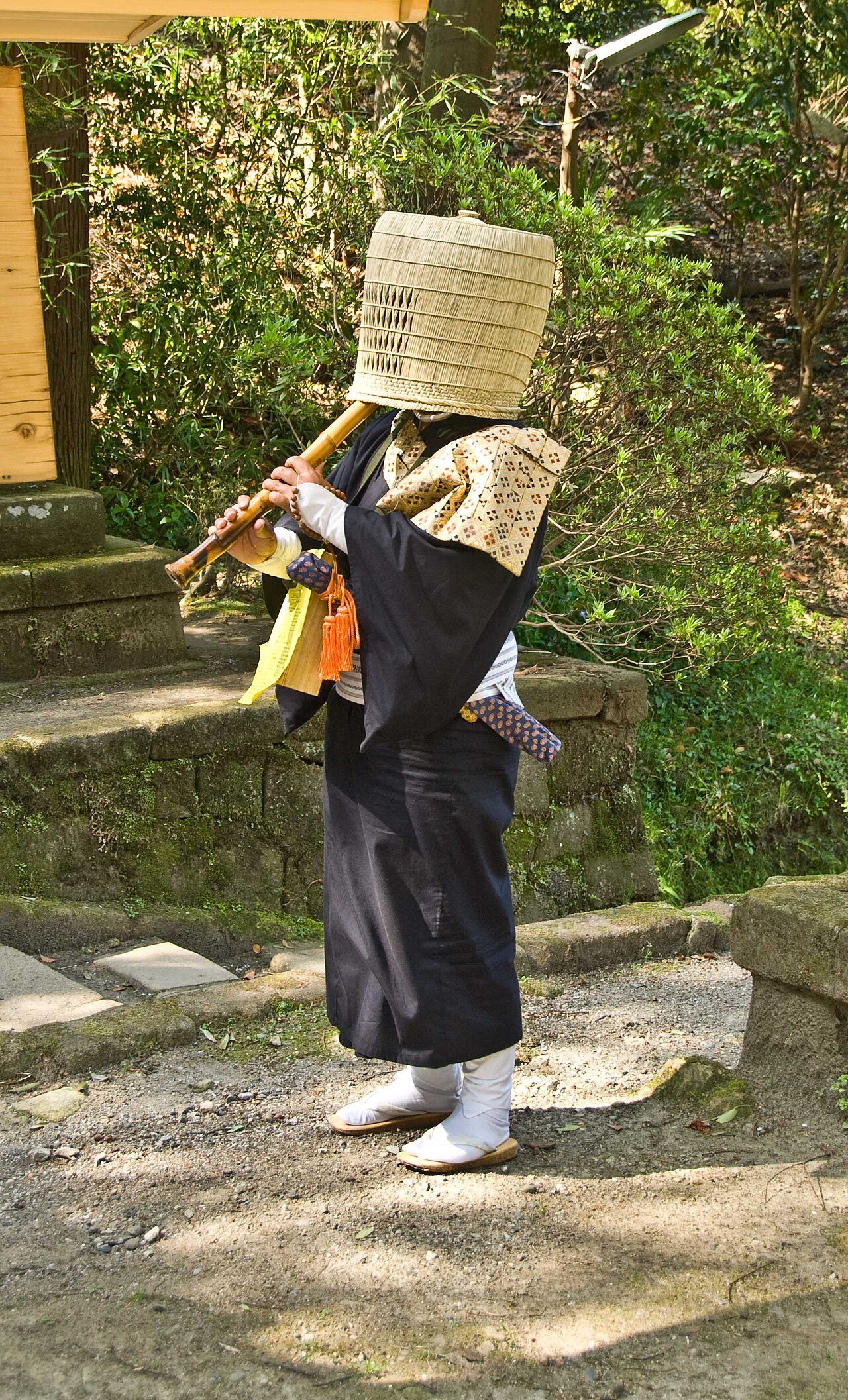
The tradition & historical record
6 min read · 2 sourcesA shakuhachi (Japanese: 尺八; pronounced [ɕakɯhat͡ɕi]) is a Japanese longitudinal, end-blown flute that is made of bamboo. The bamboo end-blown flute now known as the shakuhachi was developed in Japan in the 16th century and is called the fuke shakuhachi (普化尺八). A bamboo flute known as the kodai shakuhachi (古代尺八, ancient shakuhachi) or gagaku shakuhachi (雅楽尺八) was derived from the Chinese xiao in the Nara period and died out in the 10th century. After a long blank period, the hitoyogiri shakuhachi (一節切尺八) appeared in the 15th century, and then in the 16th century, the fuke shakuhachi was developed in Japan. The fuke shakuhachi flourished in the 18th century during the Edo period, and eventually the hitoyogiri shakuhachi also died out. The fuke shakuhachi developed in Japan is longer and thicker than the kodai shakuhachi and has one finger hole less. It is longer and thicker than hitoyogiri shakuhachi and is superior in volume, range, scale and tone quality. Today, since the shakuhachi generally refers only to fuke shakuhachi, the theory that the shakuhachi is an instrument unique to Japan is widely accepted. The shakuhachi is traditionally made of bamboo, but versions now exist in ABS, ebonite, anodized aluminum, and hardwoods. It was used by the monks of the Fuke Zen of Zen Buddhism in the practice of suizen (blowing meditation). The instrument is tuned to the minor pentatonic scale. 1
Etymology
The name shakuhachi means "1.8 shaku", referring to its size. It is a compound of two words: 1
shaku (尺) is an archaic unit of length equal to 30.3 centimetres (0.99 ft) and subdivided in ten subunits. hachi (八) means "eight", here eight sun, or tenths, of a shaku. Thus, the compound word shaku-hachi means "one shaku eight sun" (54.54 cm (21.47 in)), the standard length of a shakuhachi. Other shakuhachi vary in length from about 1.1 shaku up to 3.6 shaku. Although the sizes differ, all are still referred to generically as shakuhachi. 1
Overview
Shakuhachi are usually made from the root end of madake (Phyllostachys bambusoides) bamboo culm and are extremely versatile instruments. Professional players can produce virtually any pitch they wish from the instrument, and play a wide repertoire of original Zen music, ensemble music with koto, biwa, and shamisen, folk music, jazz, and other modern pieces. Much of the shakuhachi's subtlety (and player's skill) lies in its rich tone colouring, and the ability for its variation. Different fingerings, embouchures and amounts of meri/kari can produce notes of the same pitch, but with subtle or dramatic differences in the tone colouring. Holes can be covered partially and pitch varied subtly or substantially by changing the blowing angle. The Honkyoku pieces rely heavily on this aspect of the instrument to enhance their subtlety and depth. Unlike a recorder, where the player blows into a duct—a narrow airway over a block which is called a "fipple"—and thus has limited pitch control, the shakuhachi player blows as one would blow across the top of an empty bottle (though the shakuhachi has a sharp edge to blow against called utaguchi) and therefore has substantial pitch control. The term utaguchi (歌口) literally translates as "to the mouth that sings", referring to the upper and main hole of the flute where the mouthpiece or blowing edge is created by a natural diagonal cut in the bamboo. The history of the shakuhachi shows a variety of designs of inlaid mouthpieces that vary between certain traditional Japanese schools of shakuhachi. Thus, the Kinko Ryu, Myoan and Tozan Ryu, differ in different features in their line of mouthpiece design, coinciding in them the total non-use in their inlay of the semi-circumference formed by the natural cut of the mouthpiece in the bamboo. 1
History
The shakuhachi is derived from the Chinese bamboo-flute. The bamboo-flute first came to Japan from China during the 7th or 8th century. This style of bamboo flute, also called kodai shakuhachi (古代尺八, ancient shakuhachi) or gagaku shakuhachi (雅楽尺八), was used for playing gagaku, but died out in the 10th century. Eight kodai shakuhachi remain in the Shōsō-in Treasure Repository. There are no records of musical scores related to the kodai shakuhachi, so details such as its playing method and scale are unknown. The average length was 40 cm (16 in), the diameter of the finger holes was 2 cm (0.79 in), and there were 6 finger holes – 5 at the front, 1 at the back. In the 15th century, the hitoyogiri shakuhachi (一節切尺八) appeared. It is characterized by a single bamboo joint in the middle of the tube. Although it flourished in the 17th century, it gradually fell into disuse due to the development and popularity of the superior fuke shakuhachi, and was no longer used by the 19th century. The average length was 33.6 cm (13.2 in), the outer diameter was 3 cm (1.2 in), and there were 5 finger holes – 4 at the front, 1 at the back. The flute now known as the shakuhachi was developed in Japan in the 16th century and is called the fuke shakuhachi (普化尺八). This style of shakuhachi is longer and thicker than the older shakuhachi, and its volume, range, scale, and tone are superior to those of the older shakuhachi. 1
Acoustics
The shakuhachi creates a harmonic spectrum that contains the fundamental frequency together with even and odd harmonics and some blowing noise. Five tone holes enable musicians to play the notes D-F-G-A-C-D. Cross (or fork) fingerings, half-covering tone holes, and meri/kari blowing cause pitch sharpening, referred to as intonation anomaly. Especially the second and third harmonic exhibit the well-known shakuhachi timbre. Even though the geometry of the shakuhachi is relatively simple, the sound radiation of the shakuhachi is rather complicated. Sound radiating from several holes and the natural asymmetry of bamboo create an individual spectrum in each direction. This spectrum depends on frequency and playing technique. 1
Notable players
The International Shakuhachi Society maintains a directory of notable professional, amateur, and teaching shakuhachi players. 1
The text above is adapted from the Wikipedia article “Shakuhachi”, available under the Creative Commons Attribution-ShareAlike 4.0 licence. 1
shakuhachi is Japanese end-blown flute, according to the structured record cited below. This entry was generated automatically from that record and has not yet been reviewed by a person familiar with the tradition. 2
The source record links this tradition to 26 external registers, which can be verified through the citation. 2