The tradition & historical record
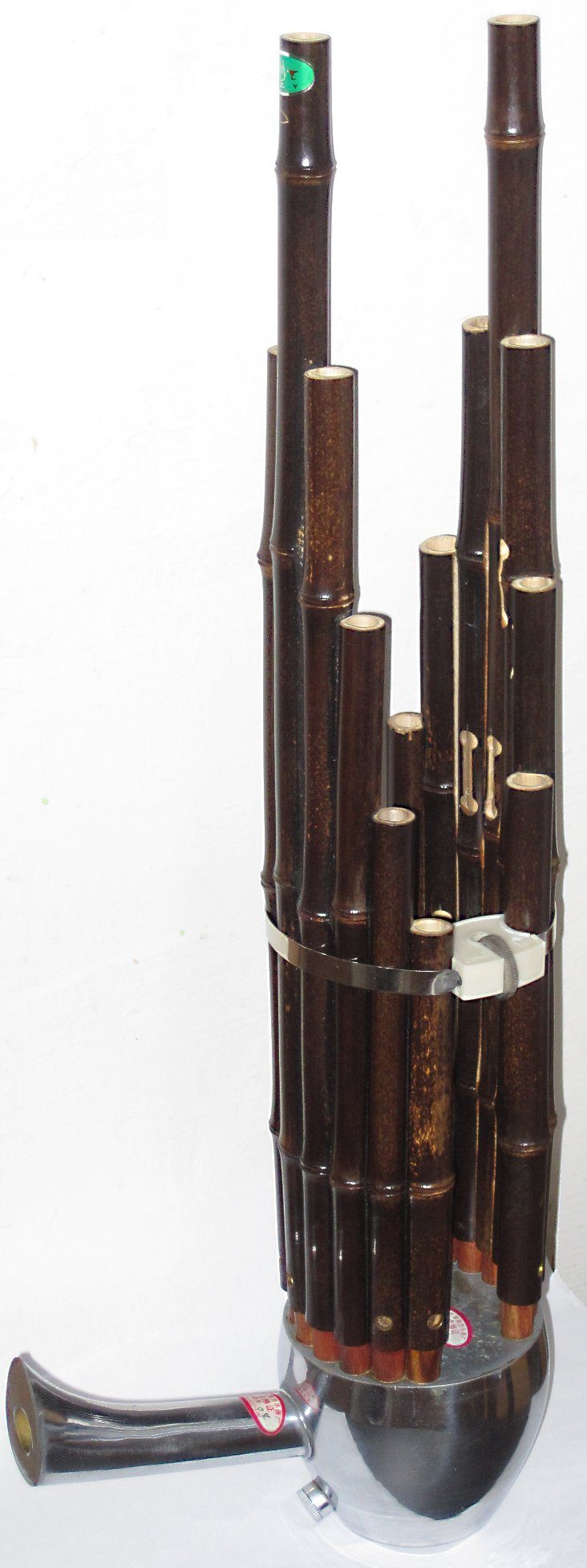
6 min read · 2 sourcesThe sheng (Chinese: 笙) is a Chinese mouth-blown polyphonic free reed instrument consisting of vertical pipes. It is one of the oldest Chinese instruments, with images depicting its kind dating back to 1100 BCE, and there are original instruments from the Han dynasty that are preserved in museums today. Traditionally, the sheng has been used as an accompaniment instrument for solo suona or dizi performances. It is one of the main instruments in kunqu and some other forms of Chinese opera. Traditional small ensembles also make use of the sheng, such as the wind and percussion ensembles in northern China. In the modern large Chinese orchestra, it is used for both melody and accompaniment. The sheng has been used in the works of a few non-Chinese composers, including Unsuk Chin, Jukka Tiensuu, Lou Harrison, Tim Risher, Daníel Bjarnason, Guus Janssen and Christopher Adler. Some believe that Johann Wilde and Pere Amiot traveled to China and brought the first sheng to Europe in 1740 and 1777 respectively, although there is evidence that free reed musical instruments similar to the sheng were known in Europe a century earlier. 1
History
Chinese free-reed wind instruments named sheng and yu were first mentioned in bone oracle writings dating from the 14th to the 12th centuries BCE, and were identified in later texts as types of sheng. The first appearance of the word sheng is in some of the poems of Shijing (Book of Odes), dating back c. 7th century BCE. Ancient instruments with gourd wind chambers, varying numbers of pipes, with bamboo or metal reeds have been discovered in archaeological finds at the tomb of the Marquis Yi of Zeng (c. 433 BCE) in present-day Hubei province, and the Han tombs at Mawangdui (c. 2nd century BCE) in Hunan province. In the 8th century, three yu and three sheng were sent to the Japanese court and these have been preserved in the Shōsōin imperial repository in Nara. All the instruments had 17 pipes with a long curving mouthpiece and are very similar to the traditional sheng in use today. However, variants with different numbers of pipes, and chromatic instruments have been documented over the centuries. 1
Modern changes
The kinds of sheng currently used are the products of changes made since the early 20th century that enhanced its sound and volume as well as increasing its range. Early changes were made by Zheng Jinwen (鄭覲文, 1872–1935) who increased the number of pipes to 32, expanding its range and allowing it to play harmony and chords. The air chamber and size of the pipes were also enlarged, changing the tone color of the instrument. Later various changes were also introduced by players such as Weng Zhenfa (翁鎮發) and particularly Hu Tianquan (胡天泉), with different variants of the instrument produced. 1
Acoustics and performance
The sheng's reeds vibrate at a fixed frequency unlike single reeds, double reeds, and pointed free reeds which vibrate at the pitch according to the length of the attached air column. Covering the hole(s) on a traditional sheng's pipe(s) would cause the entire length of the pipe(s) to resonate with the reeds' frequency. If the hole is open, the resonant frequency would not match, and hence no sound is produced. The sheng is sounded by either exhaling or inhaling into the mouthpiece, and players can produce a relatively continuous sound without pause by quickly switching between the two, similarly to playing a harmonica. The traditional performance style is to sound two or three notes at the same time by adding a fifth and/or octave above the main melody note. When a higher note is not available, a lower note a fourth below the main melody note can be played instead. 1
Types
Sheng varieties can be classified into traditional sheng (Chinese: 传统笙; pinyin: chuántǒng shēng) and keyed sheng (键笙; jiàn shēng) (sometimes also known as "improved sheng" (改良笙; Gǎiliáng shēng)). Keyed shengs were only developed in the 20th century, from roughly 1950 onwards. With more and more hybrid models being introduced, the difference between the two types of sheng are increasingly blurred. However, sheng instruments are generally categorized into either type based on the kind of fingering system that they adopt. This includes (on traditional sheng) certain notes (namely the leading note, submediant, dominant, followed by tonic) present as a group on the left posterior side. Due to fourth and fifth harmonies being common in traditional sheng repertoire, the fingerings on traditional sheng are optimized for such. As a result, fingerings for traditional sheng tend to look jumbled up, and can vary regionally. Keyed sheng, on the other hand, have sequenced fingerings that allow for easy key changes. On a traditional sheng, there are holes on the finger pipes which can be covered by the player's fingers to sound that particular note. On a keyed sheng, the holes are opened and closed by means of keys or levers. The greater number of pipes combined with the size of the larger instruments makes it impractical to operate newer instruments without keys. 1
Traditional sheng
The traditional sheng (传统笙; chuántǒng shēng) used in, for example, northern Chinese ritual music, kunqu and Jiangnan sizhu ensembles generally have 17 pipes but with only 13 or 14 sounding pipes. Its scale is mainly diatonic, for example the 17-pipe (4 of which are silent decorative pipes) sheng used in Jiangnan sizhu is tuned: 1
With the development of guoyue music in mid-20th century China, the sheng underwent changes to increase its range and volume. The guoyue sheng had all its 17 pipes fitted with reeds, then the number of pipes increased to 21, and metal tubes were attached to the bamboo pipes to amplify its sound. The other change was the development of the keyed sheng. 1
Nowadays, traditional sheng are usually only used for solo repertoire, due their not being fully chromatic (and also the fact that certain techniques – like glissandi – can only be achieved on a traditional sheng). For an orchestra setting, keyed sheng tend to be preferred for being fully chromatic. Many modern traditional sheng do come with some keys for ease of fingering; there are also fully chromatic traditional sheng. These are still known by the blanket term "traditional sheng" due to them retaining the typical traditional sheng-like fingering. Also, traditional sheng are usually held in the player's hands when playing, and a 37-reed fully chromatic traditional sheng tends to be too heavy to be held for long performances. 1
The text above is adapted from the Wikipedia article “Sheng (instrument)”, available under the Creative Commons Attribution-ShareAlike 4.0 licence. 1
sheng is Chinese mouth-blown free reed instrument, according to the structured record cited below. This entry was generated automatically from that record and has not yet been reviewed by a person familiar with the tradition. 2
The source record links this tradition to 18 external registers, which can be verified through the citation. 2