The tradition & historical record
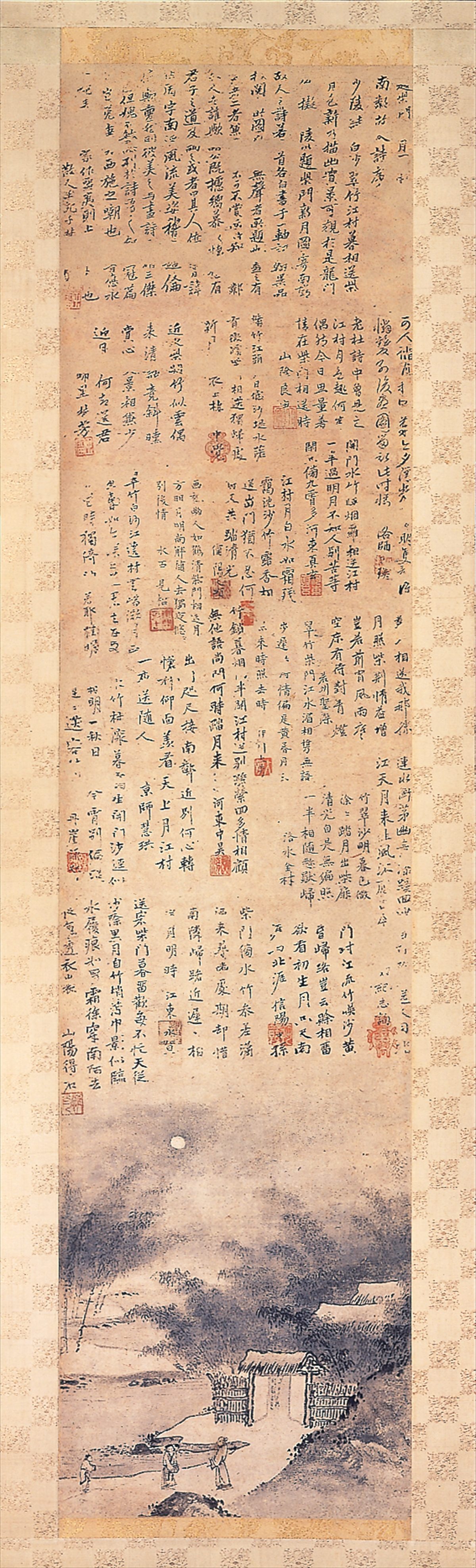
6 min read · 2 sourcesShigajiku (Japanese: 詩画軸, "poem-and-painting scrolls"), are a form of Japanese ink wash painting. These hanging scrolls depict poetic inscriptions at the top of the scroll and a painted image, usually a landscape scene, below. Buddhist monks of the gozan 五山 or Five Mountain monasteries of the early Muromachi Period (1336-1573) first introduced the poem-and-painting scrolls. Shigajiku is a modern category given to the visual and literary culture of the Muromachi Period rooted in the Zen tradition. The most common visual aesthetic for shigajiku is a monochrome water and ink style of painting, suibokuga 水墨画, with only occasional traces of color throughout the scroll. 1
History
The first poem-and-painting scrolls came to Japan with the return of the first Zen monks who had been studying in China. The most important cultural precedent to shigajiku was the Chinese version of the poem/scroll, the shijiku 詩軸. This continental version served as a model for the future poem-and-painting scrolls produced by the Japanese Five Mountains monks. Yet, shigajiku are distinct from their Chinese predecessors because of the distinctive hanging scroll format and the number of inscriptions on the scrolls themselves. The creation of shigajiku is closely tied to the secular and religious lives of the Five Mountains monks. The formation of tatuchū, or sub-temples, provides the basis for the social relationships through which the shigajiku would be created and circulated. The tatuchū created a new social unit among Japanese Zen monks and gave rise to the shikai or poetry meetings. These communities and meetings provide an important social base for the monks of the Five Mountain monasteries. Clerics intermingled with each other and exchanged scrolls with other monks during such gatherings. These monks would then compose and write poems on each other's scrolls, thus accounting for some scrolls having between four and thirty inscriptions. The first surviving shigajiku, Newly Risen Moon over a Brushwood Gate, was produced in the Five Mountains Zen monasteries during 1400. Of the eighteen inscriptions, six are connected to Nanzen-ji, the temple and literary epicenter for Zen monks during the early 15th century. This connection highlights the importance of the social relationships of the clerics and the spiritual value of the painting. 1
Genre Categories of Shigajiku
The subjects of poem-and-painting scrolls vary to include subjects such as: portrait scrolls, chinsō; scrolls on Daoist and Buddhist subjects, dōshaku senki; and landscape scrolls, sansui. Most shigajiku are the last category landscape of which there are many different representations. The different themes of the landscape genre will be focused on here as they appear most frequently in shigajiku. 1
Themes within the landscape genre
Zen kōan – riddles posed by a Zen master designed to teach/enlighten pupils Sōbetsuzu – farewell pictures Kaiyūzu – commemorative paintings Shiizu – painting themes taken from poetry (usually Chinese poetry) Shosaizu – a scholar's study in mountain setting The most common theme of landscape is the image of a secluded scholar's study in a mountain setting or shosaizu. Monks of the tatuchū communities popularized the idea of creating idealizing, memorializing, and pining images of the scholar's study to escape the confines of a private subtemple. These poem-and painting scrolls depict idealized retreats into nature with open skies, vast waters, and hazy mountain views – a perfect setting for the intellectual pleasures of retired monks living out their secluded lives. These scholar's studies were seen as blissful escapes from busy city life where peace was difficult to find. Key features include rocks, cliffs, flowing water, a bridge, a mountain path, an elderly scholar climbing, vast expanses of water and sky with mountains soaring in the distance. To say these scholar's study poem-and-painting scrolls were only escapist would be incorrect. A scholar's study shigajiku aids in evoking an idealized landscape to help the monk bring about a sense of peaceful serenity through which they would write, meditate, reflect, etc. Painters manipulated their surroundings and were forced to use their imagination or memory to create these landscapes that were so far removed from their own setting of a bustling Japanese city. Often looking to the deep mountains valleys one would find in China – these tiny idealists landscapes became a monks’ flight from reality via Chinese inspiration. 1
Paintings
The painting of landscape shigajiku encompasses different themes, but almost always includes an idealized landscape representing some imaginary corner of nature. This made it a preferred artform for monks. Ancient crooked pine trees clinging tenaciously to a sheer cliff, hills in the distance, vast expanse of water and sky, this secluded corner of nature were some of the most common tropes of shigajiku. Historically there were two ways to create the painting of the shigajiku: the “old style” and the “new style.” The “old style” is believed to have derived from the painting traditions of the Northern Sung painters, specifically Guo Xi (1020-1090), where the aesthetic concentrated around balanced and centered compositions. The “new style” is believed to be largely derived from the Southern Sung, specifically Xia Gui (1195–1224), with the central focus of the composition moved into a corner of the scroll to create a dynamic and asymmetrical image. Both of these painting styles originated in China and became the way in which Japanese Zen monks desired to paint their shigajiku. Reading in a Bamboo Grove encompasses the most common tropes of the shigajiku, the imposing mountains, with sheer cliffs, trees precariously perched near edges, and hints of a vast open horizon. This scholar's study shigajiku is done in the “new style,” and when compared with a composition by Xia Gui, the characteristics of the “new style” become clearer. The positioning of the mountain scene in the corner and the poetic inscriptions above and opposite the image dramatically accentuates the asymmetrical nature of the scroll. 1
Inscriptions
Five Mountains monks used the shikai or poetry gatherings to discuss, create, and inscribe their poetry onto the scrolls of their fellow monks. The poetic inscription extends no further than 2/3 of the scroll leaving the bottom 1/3 for the painted image. This structuring has led some scholars to argue that the poetry is valued more than painting. The Zen priests inscribing shigajiku were not as concerned with who painted the picture as they were with how successful the painting was in transporting the viewer into an idealistic natural setting. The poetic inscriptions vary in subject matter, referring to the natural poetry of the early century, celebrated works of Chinese poetry, or messages to other monks of greeting, farewell, congratulation, etc. 1
The text above is adapted from the Wikipedia article “Shigajiku”, available under the Creative Commons Attribution-ShareAlike 4.0 licence. 1
shigajiku is form of Japanese ink wash painting, according to the structured record cited below. This entry was generated automatically from that record and has not yet been reviewed by a person familiar with the tradition. 2
The source record links this tradition to 2 external registers, which can be verified through the citation. 2