The tradition & historical record
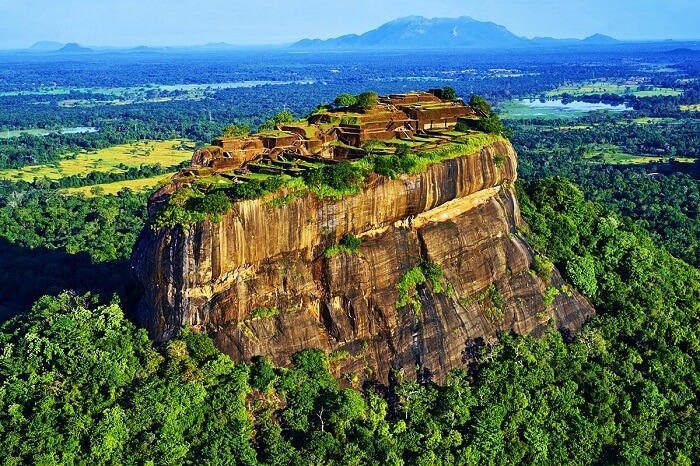
6 min read · 2 sourcesSigiriya or Sinhagiri (Lion Rock Sinhala: සීගිරිය, Tamil: சிகிரியா/சிங்ககிரி, ) is an ancient rock fortress located in the northern Matale District near the town of Dambulla in the Central Province, Sri Lanka. It is a site of historical and archaeological significance that is dominated by a massive column of granite approximately 180 m (590 ft) high. According to the ancient Sri Lankan chronicle the Cūḷavaṃsa, this area was a large forest, then after storms and landslides it became a hill and was selected by King Kashyapa (CE 477–495) for his new capital. He built his palace on top of this rock and decorated its sides with colourful frescoes. On a small plateau about halfway up the side of this rock he built a gateway in the form of an enormous lion. The name of this place is derived from this structure; Sinhagiri, the Lion Rock. The capital and the royal palace were abandoned after the king's death. It was used as a Buddhist monastery until the 14th century. Sigiriya today is a UNESCO listed World Heritage Site. It is one of the best preserved examples of ancient urban planning. 1
Geology
Sigiriya rock rises abruptly from the low-lying plains that extend from the central mountain range of Sri Lanka. It is an inselberg, a hardened granite outcrop deriving from a solidified magma plug of a former volcano. Pidurangala Rock, 1 km to the north, has a similar origin. 1
History
It is likely that the area around Sigiriya was inhabited since prehistoric times. There is clear evidence from Brahmi inscriptions on the western side of Sigiriya that the many rock shelters and caves in the vicinity were occupied by Buddhist monks and ascetics from as early as the 1st or 2nd century BCE. The earliest evidence of human habitation at Sigiriya is the Aligala rock shelter to the east of Sigiriya rock, indicating that the area was occupied circa 3000 BCE during the Mesolithic Period. 1
Buddhist monastic settlements were established during the 3rd century BCE in the western and northern slopes of the boulder-strewn hills surrounding the Sigiriya rock. Several rock shelters or caves were created during this period. These shelters were made under large boulders, with carved drip ledges around the cave mouths. Rock inscriptions are carved near the drip ledges on many of the shelters, recording the donation of the shelters to the Buddhist monastic order as residences. These were made in the period between the 3rd century BCE and the 1st century CE. The Cūḷavaṃsa describes that in 477 CE, Kashyapa I, the son of King Dhatusena by a non-royal consort, seized the throne in a coup assisted by Migara, the King's nephew and army commander. He murdered his father by walling him up alive and then usurped the throne which rightfully belonged to his half-brother Moggallana who, fearing for his life, fled to South India, but vowed revenge. Expecting the inevitable return of Moggallana, Kashyapa moved the capital and his residence from the traditional capital of Anuradhapura to the more secure summit of Sigiriya. During King Kashyapa's reign (477–495 CE), Sigiriya was developed into a complex city and fortress. 1
Archaeological remains and features
In 1831 Major Jonathan Forbes of the 78th (Highlanders) Regiment of Foot of the British Army, while returning on horseback from a trip to Pollonnuruwa, encountered the "brushwood-covered summit of the rock of Sigiri". Sigiriya came to the attention of antiquarians and, later, archaeologists. Archaeological work at Sigiriya began on a small scale in the 1890s. H.C.P. Bell was the first archaeologist to conduct extensive research on Sigiriya. The Cultural Triangle Project, launched by the Government of Sri Lanka, focused its attention on Sigiriya in 1982. Archaeological work began on the entire city for the first time under this project. There was a sculpted lion's head above the legs and paws flanking the entrance, but the head collapsed years ago. Sigiriya consists of an ancient citadel built by King Kashyapa during the 5th century. The Sigiriya site contains the ruins of an upper palace located on the flat top of the rock, a mid-level terrace that includes the Lion Gate and the mirror wall with its frescoes, the lower palaces clings to the slopes below the rocks. The moats, walls and gardens of the palace extended for a few hundred metres from the base of the rock. The site was both a palace and a fortress. The upper palace on the top of the rock includes cisterns cut into the rock. 1
Site plan
Sigiriya is considered to be one of the most important urban planning sites of the first millennium, and the site plan is considered very elaborate and imaginative. The plan combined concepts of symmetry and asymmetry to intentionally interlock the man-made geometrical and natural forms of the surroundings. On the west side of the rock lies a park for the royals, laid out on a symmetrical plan; the park contains water-retaining structures, including sophisticated surface/subsurface hydraulic systems, some of which are working today. The south contains a man-made reservoir; these were extensively used from the previous capital of the dry zone of Sri Lanka. Five gates were placed at entrances. The more elaborate western gate is thought to have been reserved for the royals. 1
Frescoes
John Still in 1907 wrote, "The whole face of the hill appears to have been a gigantic picture gallery... the largest picture in the world perhaps". The paintings would have covered most of the western face of the rock, an area 140 m (460 ft) long and 40 m (130 ft) high. There are references in the graffiti to 500 ladies in these paintings. However, most have been lost forever. More frescoes, different from those on the rock face, can be seen elsewhere, for example on the ceiling of the location called the "Cobra Hood Cave". 1
Although the frescoes are classified as in the Anuradhapura period, the painting style is considered unique; the line and style of application of the paintings differing from Anuradhapura paintings. The lines are painted in a form which enhances the sense of volume of the figures. The paint has been applied in sweeping strokes, using more pressure on one side, giving the effect of a deeper colour tone towards the edge. Other paintings of the Anuradhapura period contain similar approaches to painting, but do not have the sketchy lines of the Sigiriya style, having a distinct artists' boundary line. The true identity of the ladies in these paintings still has not been confirmed. There are various ideas about their identity. Some believe that they are the ladies of the kings while others think that they are women taking part in religious observances. These pictures have a close resemblance to paintings seen in the Ajanta Caves in India. 1
The text above is adapted from the Wikipedia article “Sigiriya”, available under the Creative Commons Attribution-ShareAlike 4.0 licence. 1
Sigiriya is ancient rock fortress near Dambulla, Sri Lanka., according to the structured record cited below. This entry was generated automatically from that record and has not yet been reviewed by a person familiar with the tradition. 2
The source record links this tradition to 20 external registers, which can be verified through the citation. 2