The tradition & historical record
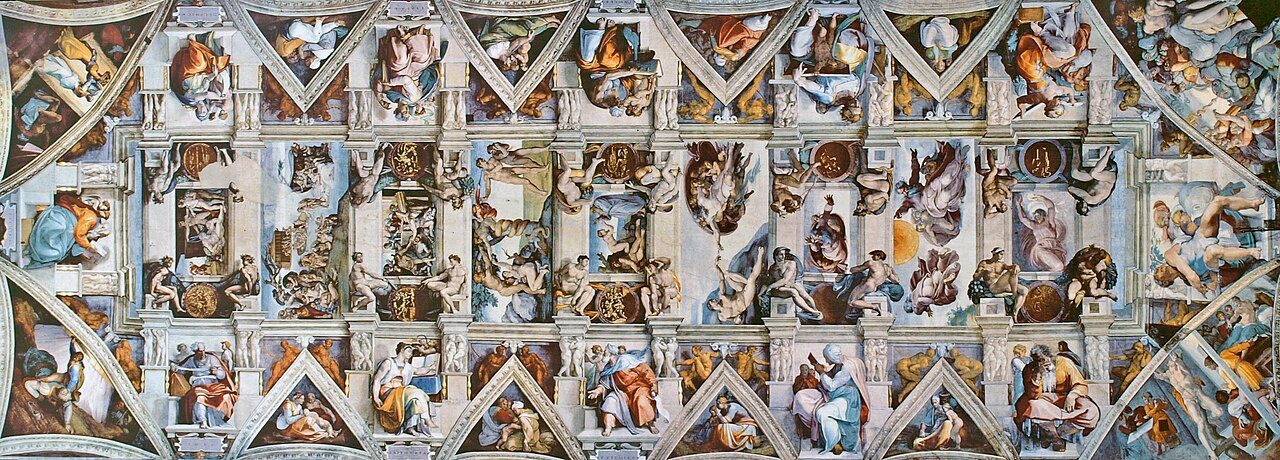
7 min read · 2 sourcesThe Sistine Chapel ceiling (Italian: Soffitto della Cappella Sistina), painted in fresco by Michelangelo between 1508 and 1512, is a cornerstone work of High Renaissance art. The Sistine Chapel is the large papal chapel built within the Vatican between 1477 and 1480 by Pope Sixtus IV, for whom the chapel is named. The ceiling was painted at the commission of Pope Julius II. The ceiling's various painted elements form part of a larger scheme of decoration within the chapel. Prior to Michelangelo's contribution, the walls were painted by several leading artists of the late 15th century including Sandro Botticelli, Domenico Ghirlandaio, and Pietro Perugino. After the ceiling was painted, Raphael created a set of large tapestries (1515–1516) to cover the lower portion of the wall. Michelangelo returned to the chapel to create The Last Judgment, a large wall fresco situated behind the altar. The chapel's decoration illustrates much of the doctrine of the Catholic Church, serving as the setting for papal conclaves and many other important services. Central to the ceiling decoration are nine scenes from the Book of Genesis, including The Creation of Adam. The complex design includes several sets of figures, some clothed and some nude, allowing Michelangelo to demonstrate his skill in depicting the human figure in a variety of poses. The ceiling was immediately well-received and imitated by other artists, continuing to the present. 1
Context and creation
The walls of the Sistine Chapel had been decorated 20 years before Michelangelo's work on the ceiling. Following this, Raphael designed a set of tapestries (1515–1516) to cover the lowest of three levels; the surviving tapestries are still hung on special occasions. The middle level contains a complex scheme of frescoes illustrating the Life of Christ on the right side and the Life of Moses on the left side. It was carried out by some of the most renowned Renaissance painters: Sandro Botticelli, Domenico Ghirlandaio, Pietro Perugino, Pinturicchio, Luca Signorelli, and Cosimo Rosselli. The upper level of the walls contains the windows, between which are painted pairs of illusionistic niches with representations of the first 32 popes. 1
The original ceiling painting was by Pier Matteo d'Amelia, and had depicted stars over a blue background like the ceiling of the Arena Chapel decorated by Giotto at Padua. For six months in 1504, a diagonal crack in the chapel's vault had made the chapel unusable, and Pope Julius II (Giuliano della Rovere) had the damaged painting removed by Piero Roselli, a friend of Michelangelo. Julius II was a "warrior pope" who in his papacy undertook an aggressive campaign for political control to unite and empower Italy under the leadership of the Catholic Church. He invested in symbolism to display his temporal power, such as his procession, in which he (in the Classical manner) rode a chariot through a triumphal arch after one of his many military victories. Julius II's project to rebuild St. Peter's Basilica would distinguish it as the most potent symbol of the source of papal power; he ultimately demolished and replaced the original basilica with a grander one intended to house his own tomb. 1
Method
Michelangelo probably began working on the plans and sketches for the design from April 1508. The preparatory work on the ceiling was complete in late July the same year and on 4 February 1510, Francesco Albertini recorded that Michelangelo had "decorated the upper, arched part with very beautiful pictures and gold". The main design was largely finished in August 1510, as Michelangelo's texts suggest. From September 1510 until February, June, or September 1511, Michelangelo did no work on the ceiling on account of a dispute over payments for work done; in August 1510 the pope left Rome for the Papal States' campaign to reconquer Bologna and despite two visits there by Michelangelo, resolution only came months after the pope's return to Rome in June 1511. On 14 August 1511, Julius held a papal mass in the chapel and saw the progress of the work so far for the first time. This was the vigil for Assumption Day on 15 August, the Sistine Chapel's patronal feast. The whole design was revealed to visitors on 31 October 1512 with a formal papal mass the following day, the feast of All Saints. Clerical use of the chapel continued throughout, except when the work on the scaffolding necessitated its closure, and disruption to the rites was minimized by beginning the work at the west end, furthest from the liturgical centre around the altar at the east wall. Debate exists on what sequence the parts of the ceiling were painted in and over how the scaffold that allowed the artists to reach the ceiling was arranged. There are two main proposals. 1
The majority theory is that the ceiling's main frescoes were applied and painted in phases, with the scaffolding each time dismantled and moved to another part of the room, beginning at the chapel's west end. 1
Content
Michelangelo's frescoes form the backstory to the 15th-century narrative cycles of the lives of Moses and Jesus Christ by Perugino and Botticelli on the chapel's walls. While the main central scenes depict incidents in the Book of Genesis, the first book of the Bible, much debate exists on the multitudes of figures' exact interpretation. The Sistine Chapel's ceiling is a shallow barrel vault around 35 metres (118 feet) long and around 14 m (46 ft) broad. The chapel's windows cut into the vault's curve, producing a row of lunettes alternating with spandrels. Though Michelangelo claimed he eventually had a free hand in the artistic scheme, this claim was also made by Lorenzo Ghiberti about his monumental bronze doors for the Florence Baptistery, for which it is known Ghiberti was constrained by stipulations on how the Old Testament scenes should appear and was able to decide merely the forms and number of the picture fields. It is likely that Michelangelo was free to choose forms and presentation of the design, but that the subjects and themes themselves were decided by the patron. The central, almost flat field of the ceiling is delineated by a fictive architectural cornice and divided into four large rectangles and five smaller ones by five pairs of painted ribs which cut laterally across the central rectangular field. Michelangelo painted these rectangles, which appear open to the sky, with scenes from the Old Testament. The narrative begins at the chapel's east end, with the first scene above the altar, focus of the Eucharistic ceremonies performed by the clergy. The small rectangular field directly above the altar depicts the Primal Act of Creation. 1
Interpretation
The overt subject matter of the ceiling is the Christian doctrine of humanity's need for salvation as offered by God through Jesus. It is a visual metaphor of humankind's need for a covenant with God. The Old Covenant of the Children of Israel through Moses and the New Covenant through Christ had already been represented around the walls of the chapel. 1
The ceiling as a Renaissance puzzle
Much remains … 1
The text above is adapted from the Wikipedia article “Sistine Chapel ceiling”, available under the Creative Commons Attribution-ShareAlike 4.0 licence. 1
Sistine Chapel ceiling is cycle of frescoes by Michelangelo, according to the structured record cited below. This entry was generated automatically from that record and has not yet been reviewed by a person familiar with the tradition. 2
The source record links this tradition to 4 external registers, which can be verified through the citation. 2