The tradition & historical record
4 min read · 2 sourcesThe Sitabhinji Group of Rock Shelters, also referred to as the Ravanachhaya Mural Rocks, is a 4th to 6th century CE rock-cut monument with a major painted mural and inscriptions near Danguapasi village of Kendujhar (Keonjhar) district of Odisha. Archaeological excavations after the 1950s have unearthed boulder sections with additional inscriptions in Sanskrit and early Odiya, coins and parts of pre-8th-century Hindu temple and artwork from the Bhanja dynasty. The 4th-century Ravanachhaya painted mural is notable for one of the earliest tempera painting (chitra) in India, for its non-religious portrayal of a king's procession, as well as its Sanskrit inscription in the emerging eastern branch of the northern script. The other notable discoveries here include the late-Gupta chaturmukha (four faced) Shiva Linga dated to around the 5th or 6th-century CE. The Sitabhinji Group of Rock Shelters site is managed and protected by the Archaeological Survey of India (N-OR-32). 1
Location
Sitabinji is located on the southeast side of Danguapasi village, about 30 kilometers south of Keonjhar town, and 10 kilometers west of Dhenkikot. It is north of the Sita-nadi (Seta) river, midst farms punctuated by huge boulders and a forested hilly terrain. The site is well marked for visitors and consists of several group of rocks to the west and northwest of the Surpanakha temple. These are not caves, but are open natural and partly rock-cut shelters. The entire area including the temple and different rocks-group are named after the characters or events in the Hindu epic Ramayana (Ravana, Surpanakha, Rama, Sita, Lakshmana, Lava, Kusa, others). One of these rock-shelters has a large multi-colored painted mural called the Ravanachhaya fresco site, while others are smaller and have minor inscriptions and single color painted marks. Ruins can be seen at this site, with major ones excavated at this site – such as the many-face Shiva linga, elephant with a baby, and others – are now at the temple. 1
Description
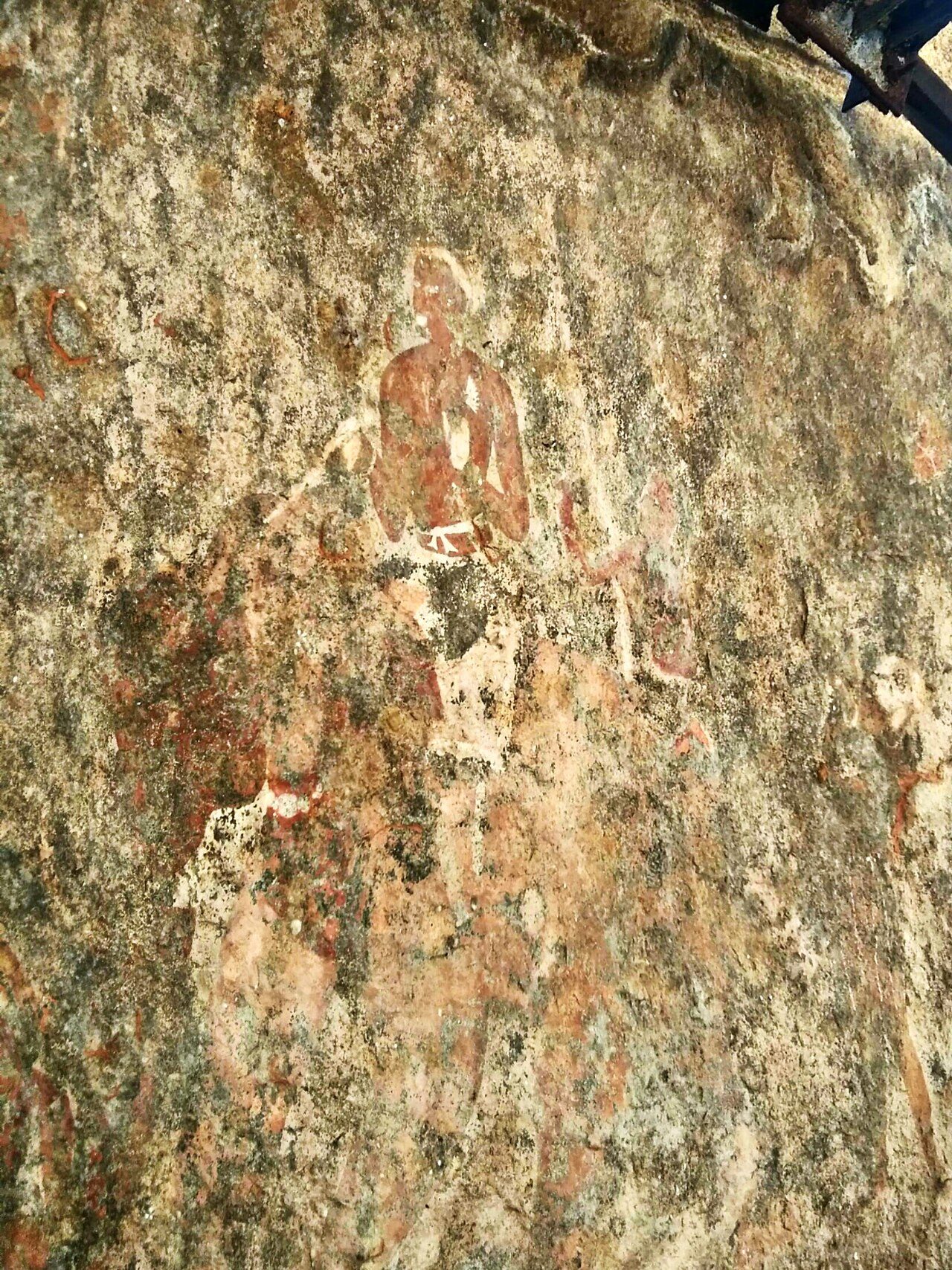
This Ravanachhaya rock-shelter consists of two large boulders stacked one above another, with the shape of a half-umbrella. The under-side of this naturally covered portion of the rock was cut, then smoothened and then inscribed and painted around the 4th-century CE. This smooth cut surface stands 22 feet above the ground and projects about 15 feet. The original painting spanned over 25 feet by 10 feet. There is a natural crack in the lower rock which likely emerged from natural causes and caused a portion of the original mural to be more exposed to the deleterious climate and damage. The other side of the mural remains preserved, though it was covered by tropical insect nests and cocoons at the time of re-discovery by archaeologists in mid 20th-century. The surviving portion of the mural is about 17 feet by 10 feet. The painter(s) chose to write the inscription first and then paint over it, which has helped date the mural. 1
The small inscription on the mural consists of two lines, which is in Sanskrit. The top line reads "Maharaja Sri Disa Bhmaja". Second line is unclear. Above these is the mural that shows a royal procession. A king is riding an elephant, with his left hand holding a flower (water lily), and his right hand holds a goad. His attendant with a chamara and chatri sits to his back at a distance on the same elephant. In front are footmen, four in number. With these footmen is a horse with a cavalier. To the left and somewhat back of the elephant on foot is a woman, likely an attendant. There are traces of apsaras above. The inscription is below the horse. The mural was painted in five colors – white, brown, red, yellow ochre and buff. The thin base has a buff shade. It is also the color of the dress of the footmen, turbans and the caparisons. 1
The text above is adapted from the Wikipedia article “Sitabhinji Group of Rock Shelters”, available under the Creative Commons Attribution-ShareAlike 4.0 licence. 1
Sitabhinji Group of Rock Shelters is 4th-century painting and archaeological site in northeast Odisha, India, according to the structured record cited below. This entry was generated automatically from that record and has not yet been reviewed by a person familiar with the tradition. 2