The tradition & historical record
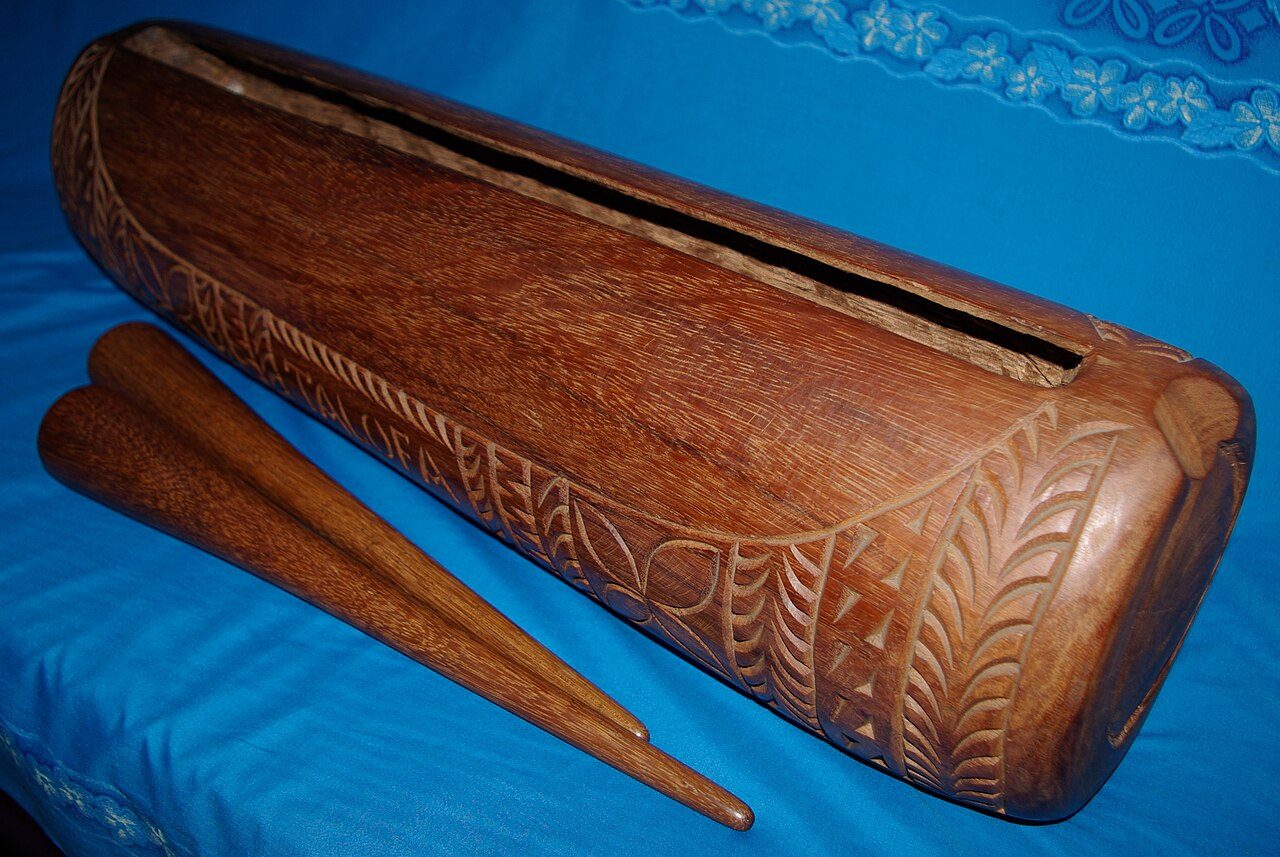
4 min read · 2 sourcesA slit drum, or slit gong, is a hollow percussion instrument, often made out of wood or bamboo. In spite of its often being called a drum, it is not a true drum, because it lacks a drumhead, the membrane (made out of animal skin or plastic) stretched across the top of a true drum. It is classed instead as an idiophone in which the entire instrument vibrates. 1
Description
A slit drum is usually carved or constructed from bamboo or wood, in the form of a mostly closed hollow chamber with one or more slits in it. It is played by striking near the edge of the slit. In some designs, the slit is a single straight line; in others, the slit is used to create one or more "tongues", achieved by cutting three sides of a rectangular (or similar) shape and leaving the fourth side attached. Most slit drums have one slit, though two and three slits (often resembling an "H" and thereby forming two tongues) occur. Tongues of different areas or thicknesses will produce different pitches. Slit drums are used throughout Africa, Southeast Asia, and Oceania. In Africa, such drums are situated in strategic locations for optimal acoustic transmission (e.g., along a river or valley), in order to be used for long-distance communication. The ends of a slit drum are closed so that the shell becomes the resonating chamber for the sound vibrations created when the tongues are struck, usually with a stick or mallet. The resonating chamber increases the volume of the sound produced by the tongue and presents the sound through an open port. If the resonating chamber is the correct size for the pitch being produced by the tongue, which means it has the correct volume of airspace to complete one full sound wave for that particular pitch, the instrument will be more efficient and louder. The people of Vanuatu create a similar instrument out of a large log. In most islands, the drum lies horizontally on the ground. In the central islands, slit drums are erected vertically, and adorned with carvings on the outer surface, representing spirits. While traditional on one island only, this adorned type of drums have become one of the national emblems of Vanuatu as a whole. 1
African
Enók - Manyu Division (Cameroon) Alimba – Zairean (Democratic Republic of the Congo) Ekwe – Igbo (Nigeria, Equatorial Guinea) Ikoro – Igbo (Nigeria, Equatorial Guinea) Krin or Kolokolos – Guinea Lokole – Congo Basin Lukombé – (Democratic Republic of the Congo) Mondo – West Africa Mukoku – Yaka people (Congo) Sudanese slit drum – Sudanese (Sudan) 1
Austroasiatic
Grōg (木鼓, 克罗克, 库洛, 克拉) – Wa (China and Myanmar) 1
Austronesian
Agung a Tamlang — Maguindanaon (Philippines) Atingting kon — Ambrym (Vanuatu) Garamut — Papuan and especially Tolai people (Papua New Guinea) Kagul — Maguindanaon (Philippines) Kalatong — Tagalog (Philippines) Kohkol — Sundanese (Indonesia) Kentongan — Javanese (Indonesia), used to wake people for sahur meals on Ramadan Kulkul — Balinese (Indonesia) Lali — Fijian (Fiji) Pahu — Māori (Aotearoa / New Zealand) Pate — Samoa, Cook Islands, and other parts of Polynesia Tagutok (Philippine) — Maranao (Philippines) Tōʻere — Tahitian (Tahiti), also Tōkere by Tuamotuans, Mangarevans and Cook Islanders 1
Mesoamerican
Huiringua – Mexico Mayohuacán – Taino people (Puerto Rico, Cuba, Dominican Republic, Caribbean) Teponaztli – Mesoamerican 1
The text above is adapted from the Wikipedia article “Slit drum”, available under the Creative Commons Attribution-ShareAlike 4.0 licence. 1
slit drum is hollow idiophone carved from wood or bamboo with one or more longitudinal slits, classed as an idiophone rather than a true drum as it lacks a drumhead; widely used across Africa, Asia, and Oceania for communication and ceremony, according to the structured record cited below. This entry was generated automatically from that record and has not yet been reviewed by a person familiar with the tradition. 2
The source record links this tradition to 19 external registers, which can be verified through the citation. 2