The tradition & historical record
7 min read · 2 sourcesThe snare drum (or side drum) is a percussion instrument that produces a sharp staccato sound when the top head is struck with a drum stick which is held under tension against the lower head. Snare drums are often used in orchestras, concert bands, marching bands, parades, drumlines, drum corps, and more. It is one of the central pieces in a drum set, a collection of percussion instruments designed to be played by a seated drummer and used in many genres of music. Because basic rhythms are very easy to learn to play on a snare drum even for children, the instrument is also suitable for the music education for young children and for a rhythm band. Snare drums are usually played with drum sticks, but other beaters, such as the brush or the rute, can be used to achieve different tones. The snare drum is a versatile and expressive percussion instrument due to its sensitivity and responsiveness. The sensitivity of the snare drum allows it to respond audibly to the softest strokes, even with a wire brush. It can be used for complex rhythmic patterns and engaging solos at moderate volumes. Its high dynamic range allows the player to produce powerful accents with vigorous strokes and a loud metallic click with the rimshot. The snare drum originates from the tabor, a drum first used to accompany the flute. The tabor evolved into more modern versions, such as the kit snare (the type usually included in a drum kit), marching snare, tarol snare, soprano snare, and piccolo snare. 1
Playing
When the top head is struck, the bottom (resonant) head vibrates in tandem, which in turn stimulates the snares and produces a cracking sound. The drum can be played by striking it with a drum stick or any other form of beater, including brushes, rute and hands, all of which produce a softer-sounding vibration from the snare wires. When using a stick, the drummer may strike the head of the drum, the rim (counterhoop), or the shell. The snares can be thrown off (disengaged) with a lever on the strainer so that the drum produces a sound reminiscent of a tom-tom. Rimshots are a technique associated with snare drums in which the head and rim are struck simultaneously with one stick (or in orchestral concert playing, a stick placed on the head and the rim struck by the opposite stick). In contemporary and/or pop and rock music, where the snare drum is used as a part of a drum kit, many of the backbeats and accented notes on the snare drum are played as rimshots, due to the ever-increasing demand for their typical sharp and high-volume sound. A commonly used alternative way to play the snare drum is known as "cross-stick", "rim click", or "side-stick". This is done by holding the tip of the drumstick against the drum head and striking the stick's other end (the butt) against the rim, using the hand to mute the head. This produces a dry high-pitched click, similar to a set of claves, and is especially common in Latin and jazz music. So-called "ghost notes" are very light "filler notes" played in between the backbeats in genres such as funk and rhythm and blues. The iconic drum roll is produced by alternately bouncing the sticks on the drum head, striving for a controlled rebound. 1
Construction
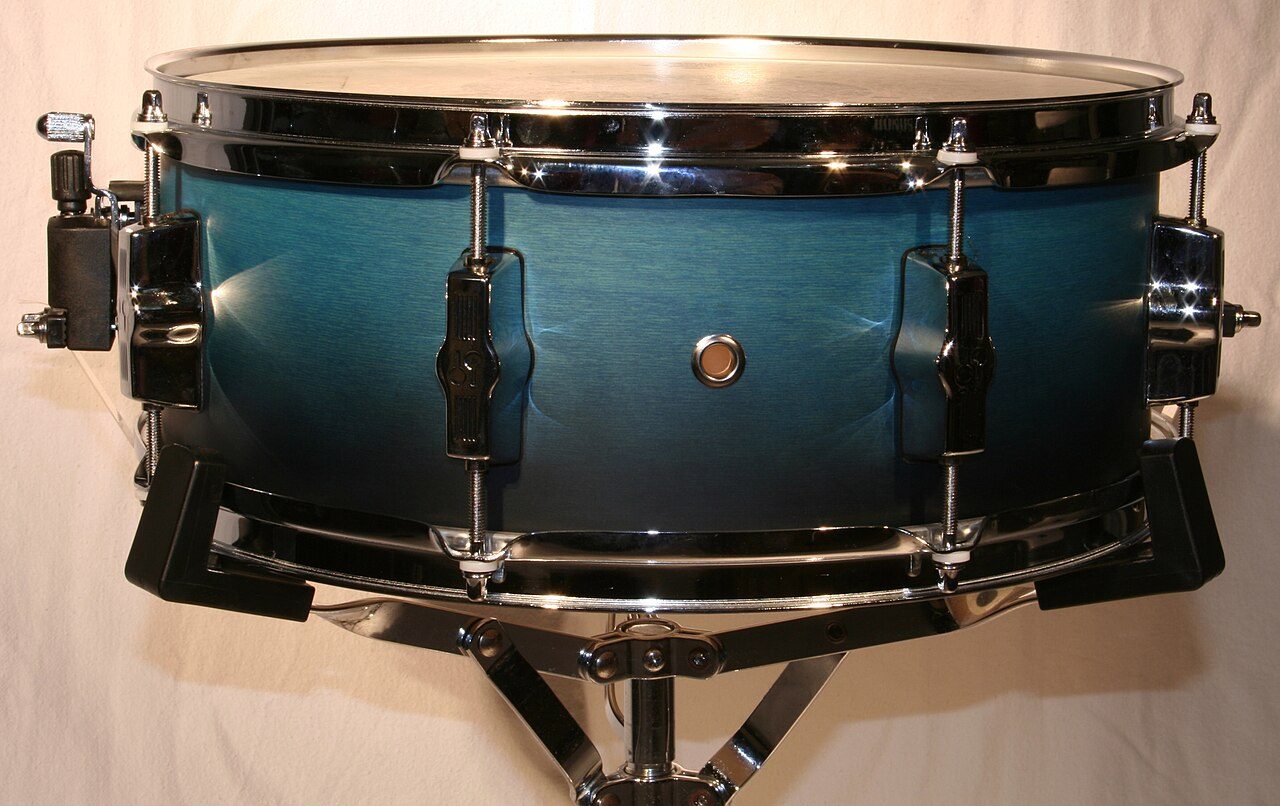
Snare drums may be made from various wood, metal, acrylic, or composite, e.g., fiberglass materials. A typical diameter for snare drums is 14 in (36 cm). Marching snare drums are deeper (taller) in size than snare drums normally used for orchestral or drum kit purposes, often measuring 12 in deep (tall). Orchestral and drum kit snare drum shells are about 6 in (15 cm) deep. Piccolo snare drums are even shallower at about 3 in (7.6 cm) deep. Soprano, popcorn, and firecracker snare drums have diameters as small as 8 in (20 cm) and are often used for higher-pitched special effects. Most wooden snare drum shells are constructed in plies (layers) that are heat- and compression-moulded into a cylinder. Steam-bent shells consist of one ply of wood that is gradually rounded into a cylinder and glued at one seam. Reinforcement rings, so-called "re-rings", are often incorporated on the inside surface of the drum shell to keep it perfectly round. Segment shells are made of multiple stacks of segmented wood rings. The segments are glued together and rounded out by a lathe. Similarly, stave shells are constructed of vertically glued pieces of wood into a cylinder (much like a barrel) that is also rounded out by a lathe. Solid shells are constructed of one solid piece of hollowed wood. The heads or skins used are a batter head (the playing surface on the top of the drum) and a resonant (bottom) head. The resonant head is usually much thinner than the batter head and is not beaten while playing. Rather than calfskin, most modern drums use plastic (Mylar) skins of around 10 mils thickness, sometimes with multiple plies (usually two) of around 7 mils for the batter head. 1
History
The snare drum seems to have descended from a medieval drum called the tabor, which was a drum with a single-gut snare strung across the bottom. It is a little bigger than a medium tom and was first used in war, often played with a fife (pipe); the player would play both the fife and drum (see also Pipe and tabor). Tabors were not always double-headed and not all may have had snares. By the 15th century, the size of the snare drum had increased and had a cylindrical shape. This simple drum with a simple snare became popular with the Swiss mercenary troops who used the fife and drum from the 15th to 16th centuries. The drum was made deeper and carried along the side of the body. Further developments appeared in the 17th century, with the use of screws to hold down the snares, giving a brighter sound than the rattle of a loose snare. During the 18th century, the snare drum underwent changes which improved its characteristic sound. Metal snares appeared in the 20th century. Today the snare drum is used in jazz, pop music, and modern orchestral music. 1
Much of the development of the snare drum and its rudiments is closely tied to the use of the snare drum in the military. In his book, The Art of Snare Drumming, Sanford A. Moeller (of the "Moeller method" of drumming) states, "To acquire a knowledge of the true nature of the [snare] drum, it is absolutely necessary to study military drumming, for it is essentially a military instrument and its true character cannot be brought out with an incorrect method. When a composer wants a martial effect, he instinctively turns to the drums." Before the advent of radio and electronic communications, the snare drum was often used to communicate orders to soldiers. 1
Definitions
Military drum/field drum: a snare drum with a diameter of 14–16 in and 9–16 in deep, with a wood or metal shell and the two heads stretched by tensioning screws. It has a snare-release lever to activate or deactivate a minimum of eight metal, gut, or plastic snares. The term came into use in 1837 with the invention of the tensioning-screw mechanism. 1
Types
There are many types of snare drums, for example: 1
… 1
The text above is adapted from the Wikipedia article “Snare drum”, available under the Creative Commons Attribution-ShareAlike 4.0 licence. 1
snare drum is type of percussion instrument, according to the structured record cited below. This entry was generated automatically from that record and has not yet been reviewed by a person familiar with the tradition. 2
The source record links this tradition to 30 external registers, which can be verified through the citation. 2