The tradition & historical record
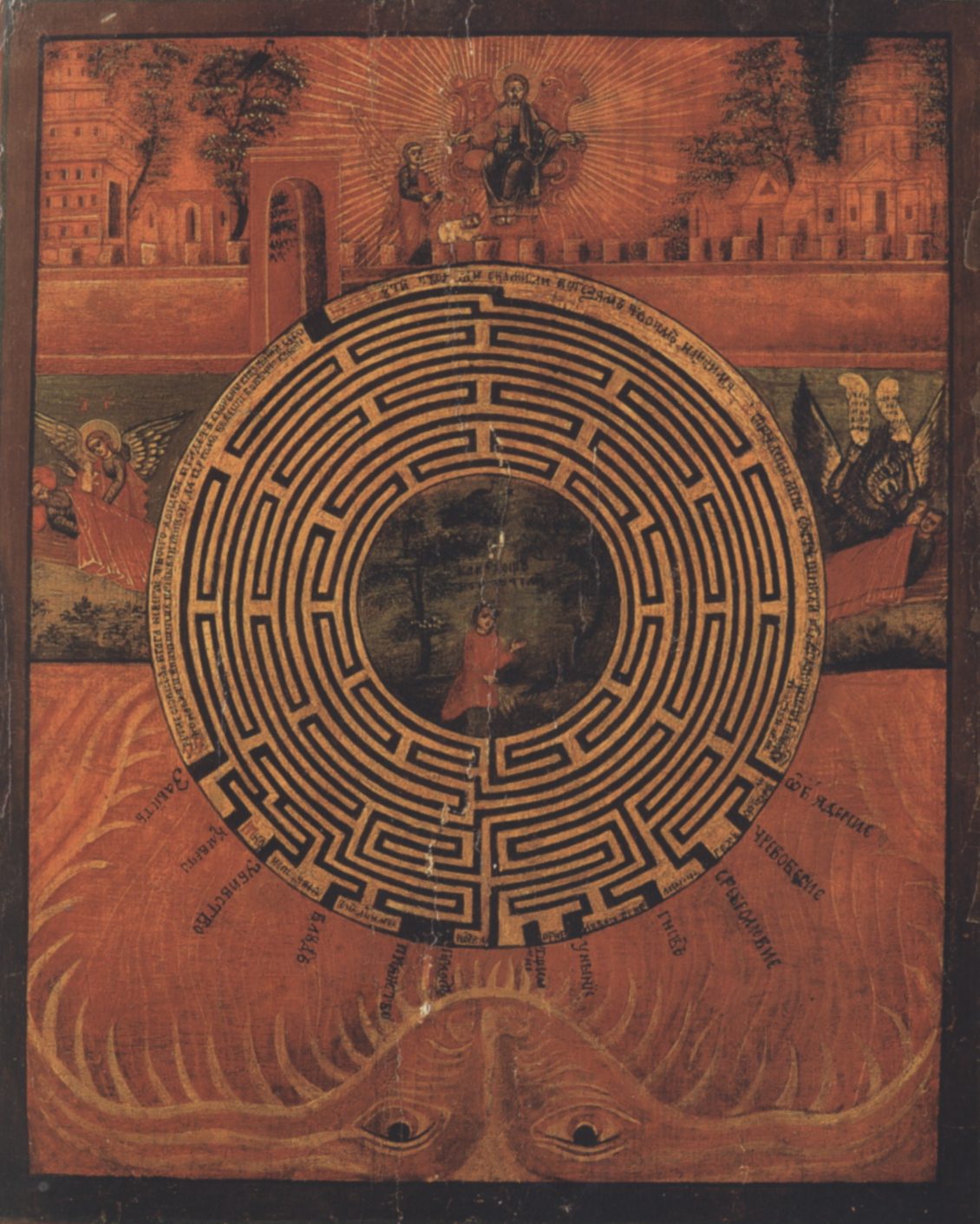
6 min read · 2 sourcesThe spiritual labyrinth (Russian: «Лабиринт духовный») is a rare iconographic type in Russian icon painting, which researchers date to the 18th century (less commonly to the early 19th century). In the middle register of these icons is a labyrinth representation, in the upper part the New Jerusalem, and in the lower part the underworld. Contemporary art historians interpret such icons as a visual representation of the idea that the path to the New Jerusalem passes through the labyrinth of life, which is filled with dead ends and false paths. Such icons were not objects of religious veneration; they served didactic purposes. As of 2023, only two icons of this iconographic type have been identified in the collections of Russian museums and Orthodox churches. One is in the collection of the State Museum of the History of Religion in Saint Petersburg, and the second in that of the New Jerusalem museum in Istra in Moscow Oblast. Researchers have made attempts to determine the origin of "spiritual labyrinth" iconography, advancing hypotheses regarding its underlying literary source, the influence of Western European and Russian engravings, as well as frescoes or floor images in Catholic churches. 1
Icon from the New Jerusalem Museum
The greater part of the icon is occupied by a circular labyrinth. University of Warwick art historian Sergei Zotov considers this icon an expanded version of the iconographic type of the "spiritual labyrinth". The ages of human life in the form of male and female figures are depicted at the center of the icon and the labyrinth, on the steps of a stone pyramid. From infant to decrepit old man, they are arranged on this distinctive staircase. Above each figure the age is written (from 1 to 90 years). There is an hourglass above the figures hovering on wings. It measures the span of human life. The image is accompanied by the inscription: "This time of God with the hours of day and night as if on wings". At the bottom are depicted scenes of birth and death (representing the beginning of human life and its end), and between them stands Death in the form of a skeleton with a crown on its head and a scythe in its hands. According to Zotov, the viewer perceives themselves in the position of a deceased soul and it is from the center that they begin their mental journey through the labyrinth depicted around them. 1
In its movement upward toward the New Jerusalem, the soul can read the inscriptions present on the icon: "As if dwelling on the path in the present life, be with Christ in eternal beauty" and "Brother, do not believe the words of your enemy, until the swift course of this life has passed". At the top there are two exits from the labyrinth. The wayfarer is greeted by the inscription: "Since Christ lovingly calls and diligently opens the gates of paradise". In the upper part of the icon is a depiction of the New Jerusalem itself with twelve gates, as well as pure souls, who are accompanied to the New City by two angels. 1
Icon from the State Museum of the History of Religion
The composition of the icon employs the techniques of reverse perspective. The action unfolds in a single plane. The depicted content is treated in a conventional and flat manner; only the person in the labyrinth in the middle register and Christ on the throne in the upper register are rendered with greater volume. Anastasia Dolgova notes the icon painter's use of techniques from book illustration and engraving. In her opinion, the depiction of the labyrinth is especially close to engraving. The text on the "Spiritual Labyrinth" icon demands concentration and attentive reading, which is also characteristic of engraving and is poorly suited to an icon, in which inscribed texts "traditionally play a subsidiary, auxiliary role or carry sacred meaning, merely supplementing the image and being reproduced in abbreviated form with titlos". 1
Dolgova analyzed the semantic and compositional structure of the icon. The icon is divided along the vertical central axis into two parts opposite in meaning (the death of a young sinner on one side of the axis and an elderly righteous person on the other). There is also an analogous, horizontal division(the fiery Gehenna below and the New Jerusalem above). The composition "is supplemented by text and emotionally reinforced by the color scheme". 1
The "Spiritual Labyrinth" icon has three parts. The upper part depicts the New Jerusalem, the central part — the earthly world, the lower part — the underworld with the fiery Gehenna. At the center of the composition is the labyrinth, in the middle of which, against a relatively realistically rendered landscape background, is placed a person who, according to Dolgova, is kneeling. His red garments stand out against the dark green background of the scene. 1
Icons in the collections of Russian museums
As of 2023, only two icons on the subject of the "spiritual labyrinth" were within the purview of art historians (however, art historian Galina Zelenskaya asserts: "the profound spiritual and didactic content, expressed in vivid imagery, contributed to the appearance of various recensions of the 'Labyrinth' in icon painting and in the Russian popular print — the lubok"). One of them is part of the collection of the Museum of the History of Religion in Saint Petersburg. The second is in the collection of the New Jerusalem museum in Istra in Moscow Oblast. 1
Dolgova asserts that the first of the two icons was painted by a master of the Moscow school of icon painting in the late 18th century, and attributes its execution to the traditional icon-painting technique (tempera on wood). The dimensions of this icon are 54 by 43.9 by 3.1 centimetres (21.3 in × 17.3 in × 1.2 in) (the website of St. Tikhon's Orthodox University provides slightly different information: 54 by 44 centimetres (21 in × 17 in), tempera on wood, second half of the 18th century). Dolgova notes that the provenance of this icon and its location before entering the museum collection are unknown. The icon from the collection of the State Museum of the History of Religion has been exhibited many times and is well known to specialists. 1
The "symbolicо-dogmatic" trend in icon painting
Anastasia Dolgova attributed the iconography of the "spiritual labyrinth" to the "symbolico-dogmatic" trend (Natalya Merzlyutina held the same view). From her perspective, from the mid-16th century onward — Dolgova places the emergence of didactic iconography later: the late 17th and early 18th centuries — the icon begins to illustrate "the texts of prayers, hymnody, and services, striving to depict and explain complex theological concepts in an accessible manner". Such an icon often constitutes an illustration of a theological dogma, yet it is not perceived by believers as a mediator in communication with God. Icons belonging to the "symbolico-dogmatic" trend introduce into iconography a new circle of subjects, often based on the interpretation of theological and "other kinds of literature", and are simultaneously didactic and illustrative in character. A stable iconography of such subjects gradually takes shape. 1
Literary source
Anastasia Dolgova notes the indisputable influence of th… 1
The text above is adapted from the Wikipedia article “Spiritual labyrinth”, available under the Creative Commons Attribution-ShareAlike 4.0 licence. 1
Spiritual labyrinth is rare type of Eastern Orthodox icon, according to the structured record cited below. This entry was generated automatically from that record and has not yet been reviewed by a person familiar with the tradition. 2