The tradition & historical record
3 min read · 2 sourcesSpoons can be played as a makeshift percussion instrument, or more specifically, an idiophone related to the castanets. They are played by hitting one spoon against the other. 1
Techniques
Fire tongs style: A pair of spoons is held tight with concave sides facing out and with index finger between their handles to space them apart. When the pair is struck, the spoons sharply hit each other and then spring back to their original position. The spoons are typically struck against the knee and the palm of the hand. The fingers and other body parts may also be used as striking surfaces to produce different sounds, rhythms, rattles and visual effects. Salad serving style: One spoon between little, ring, and long finger; the other spoon between ring, thumb, and index finger in such a way that they can be rotated with ring finger as the common axis. They can be hit to each other at the convex sides by gathering the fingers (mostly middle and thumb). Castanets style: Two in each hand one spoon held concave-side against the palm held down by the thumb, one between ring and middle fingers with finger tips in the concave side balancing the handle. They can be hit to each other at the convex sides by gripping with the middle and ring fingers. Drumstick style: One spoon held concave-side against the palm, and handle jammed tight under the wrist watch belt, another in between ring and middle fingers of the left hand hitting the latter castanet style, and a third spoon in the right hand hitting both spoons in the left hand. 1
American folk music
In the United States, spoons as instrument are associated with American folk music, minstrelsy, jug bands, and spasm bands. These musical genres make use of other everyday objects as instruments, such as the washboard and the jug. In addition to common tableware, spoons that are joined at the handle are available from musical instrument suppliers. 1
British folk music
As percussion, spoons accompany fiddle playing and other folk sets. An example is seen in Midsomer Murders Series 6, episode 2, where Detective Sergeant Gavin Troy plays the spoons at a house party joining a fiddle player who is entertaining the guests. He uses the first technique. The guests also contribute percussion by hand clapping in time with the music. The song "This Old Man" refers to a related concept, except with sheep bones (hence paddywhack) instead of spoons. 1
Canadian folk music
In Canada, the spoons accompany fiddle playing in Québecois and Acadian music. Also, Newfoundland and the Atlantic provinces popularly play the spoons at family gatherings. Playing the spoons in Western Canada is closely related to the Métis culture. 1
Greek folk music
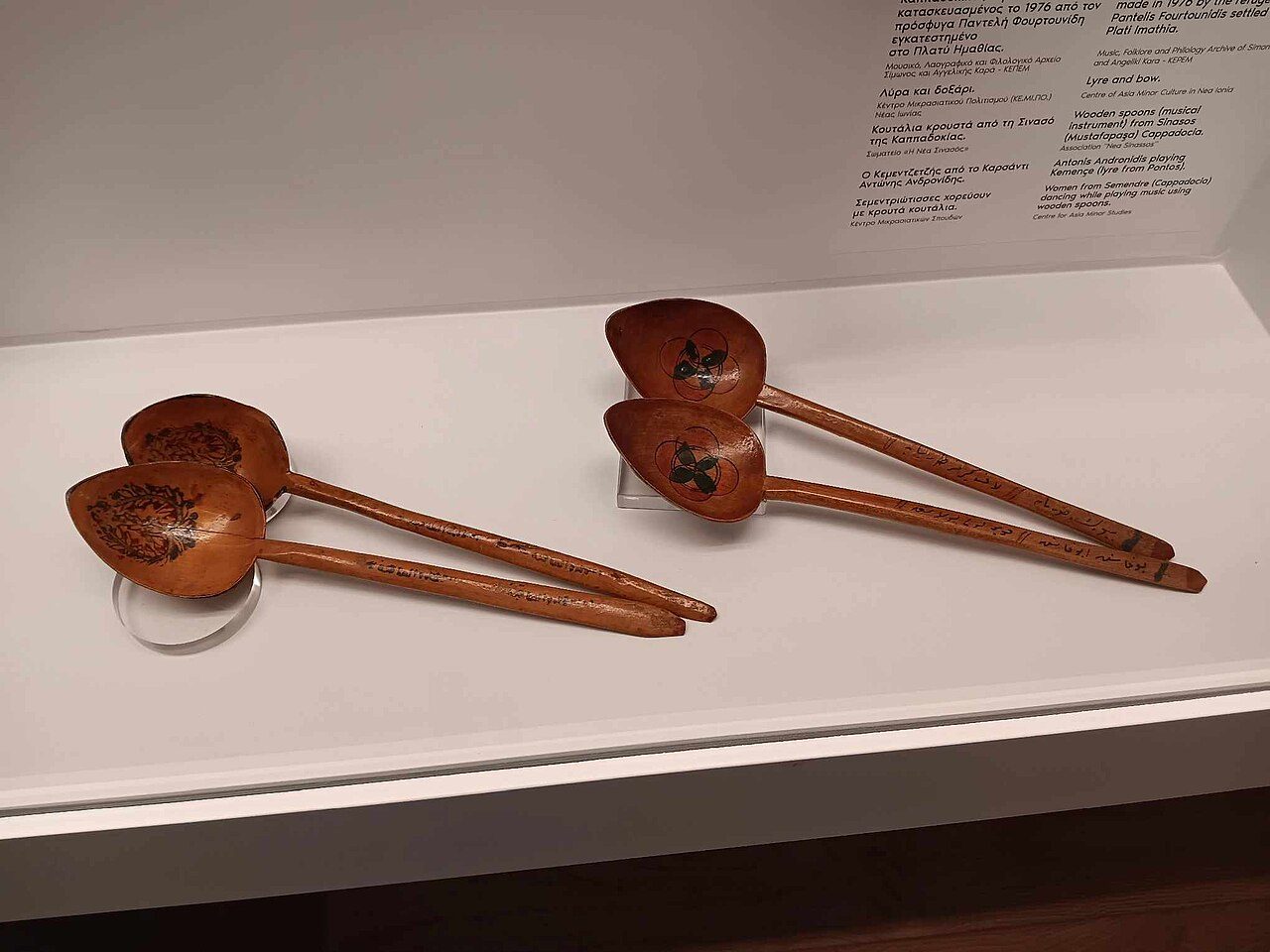
In Greece, spoons as a percussion instrument are known as koutalakia (Greek: κουταλάκια 'little spoons'). Dancers accompany their dancing with rhythms tapped out on the spoons. Many of them are sculpted or painted. The specific tradition is not common in the music of mainland Greece, but used to be popular among Anatolian Greeks. 1
The text above is adapted from the Wikipedia article “Spoons (musical instrument)”, available under the Creative Commons Attribution-ShareAlike 4.0 licence. 1
spoons is percussion instrument, according to the structured record cited below. This entry was generated automatically from that record and has not yet been reviewed by a person familiar with the tradition. 2
The source record links this tradition to 4 external registers, which can be verified through the citation. 2