The tradition & historical record
6 min read · 2 sourcesThe steelpan (also known as a pan or steel drum) is a musical instrument originating in Trinidad and Tobago. Steelpan musicians are called pannists. In 1992, the steelpan was declared Trinidad and Tobago’s national instrument by Prime Minister Patrick Manning. This helped turn the steelpan into a source of national pride and cultural identity, recognized both locally and internationally. The steelpan developed in Trinidad and Tobago during the 1930s and 1940s and evolved from earlier Carnival percussion traditions, including Tamboo bamboo. It became an important part of Trinidad and Tobago Carnival and is now the country's national instrument. In 2023, the United Nations General Assembly declared 11 August as World Steelpan Day. The following year, the Parliament of Trinidad and Tobago officially recognised the steelpan as the country's national instrument. 1
Description
The modern pan is a chromatically pitched percussion instrument made from 200-litre industrial drums. Drum refers to the steel drum containers from which the pans are made; the steel drum is more correctly called a steel pan or pan as it falls into the idiophone family of instruments, and so is not a drum (which is a membranophone). Some steelpans are made to play in the Pythagorean musical cycle of fourths and fifths. A pan is played using a pair of straight sticks tipped with rubber; the size and type of rubber tip varies according to the class of pan being played. Some musicians use four pansticks, holding two in each hand. This grew out of Trinidad and Tobago's early 20th-century Carnival percussion groups known as tamboo bamboo. The pan is the national instrument of Trinidad and Tobago and appears on the country's current coat of arms. 1
Origin
Steelpans developed in the early to mid 1900s, but with roots going back much earlier, including the talking drums of West African cultures which were used for ceremonies and communicating messages at a distance. As a result of the transatlantic slave trade, African slaves were brought to the Americas, including Trinidad. In the 1780s, French colonists arrived in Trinidad and Tobago and brought street festival traditions. In 1785, plantation owners held the first Carnival in Trinidad. Many white plantation owners masqueraded as slaves and marched down the streets mocking African slave dress, singing, and dance customs, including banging on talking drums. Though they were mimicked, enslaved Africans were not allowed to join the festivities. In response, the Africans organized underground Carnivals of their own, taking place in cabins and backyards. Inspired by ancient traditions, Africans incorporated masks, feathers, beads, and drumming. In 1789, Spanish governor of Trinidad José María Chacón issued a directive that all Africans (the majority of the population) would observe Roman Catholic religion and all Christian holy days. The purpose was to further erase West African culture and religious beliefs. However, the enslaved Africans were able to preserve their traditions by camouflaging them within Christian holidays. For example, on Sundays, enslaved people would "put on their best clothes and go to drum dances held in different yards or on the land away from the plantation where they were allowed to grow their own crops...[They] would dance to the music and rhythms of the skin drums and gourd rattles." In 1834, slaves were emancipated in Trinidad and Tobago following the Slavery Abolition Act 1833, but segregation and indentured servitude continued. 1
Evolution and developments
Anthony Williams designed the "fourths and fifths" arrangement of notes, known as the circle of fifths. This has become the standard form of note placement for lead pans. Other important developments include the tuning of harmonic overtones in individual notes, developed simultaneously and independently by Bertie Marshall and Alan Gervais. In the United States, steelpan instruments were marketed as early as 1961. The Caribbean Research Institute CARIRI investigated possibilities to mass-produce raw forms with the use of pressing machines in the 1970s. Much of this project took place in Sweden in collaboration with the Saab Company. Although first results were promising, the project has been abandoned due to lack of finances and support by local pan tuners in Trinidad. Another method of shaping the pan was attempted: by spinning. The pan was spun on a lathe-like device, and a roller on the end of a bar was used to sink the pan. While this did create pre-sunk pans, a problem was that there would often be scratches and grooves in the steel. A Swiss steelpan manufacturer (PANArt) researched the field of fine-grain sheet steel and developed a deep-drawn raw form which was additionally hardened by nitriding. This process, and the new instruments they called pang, were presented at the International Conference of Steel pan and Science in Port-of-Spain in 2000. Electronic steelpans have also been developed. One such version is the E-Pan, invented by Salmon Cupid, who holds utility patents for it. Another is the Percussive Harmonic Instrument (PHI). 1
Construction
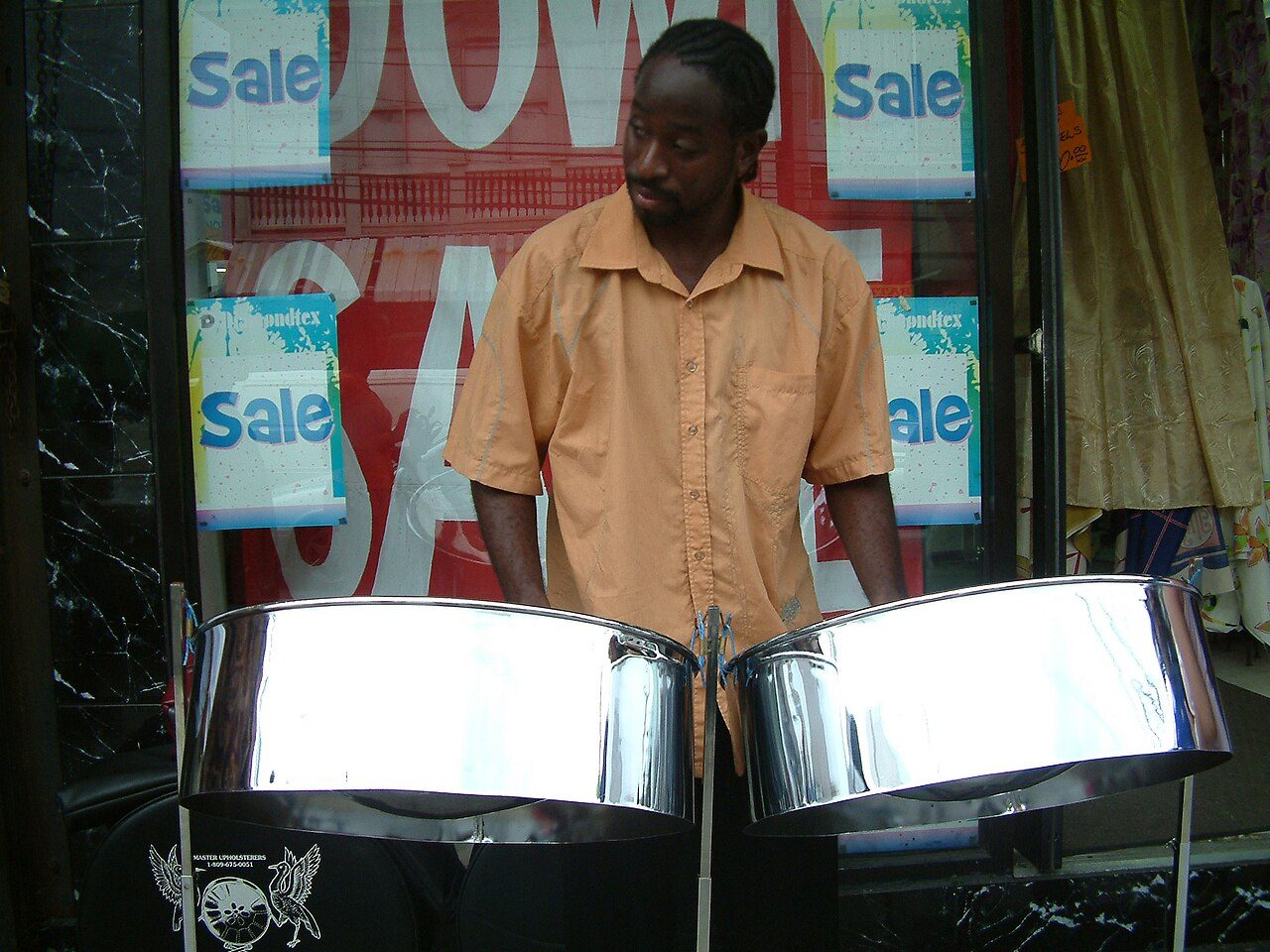
The note's size corresponds to the pitch—the larger the oval, the lower the tone. The size of the instrument varies from one pan to another. It may have almost all of the "skirt" (the cylindrical part of the oil drum) cut off and around 30 soprano-range notes. It may use the entire drum with only three bass notes per pan, in which case one person may play six such pans. The length of the skirt generally corresponds to the tessitura (high or low range) of the drum. The pans are usually either painted or chrome plated. Other processes such as nickel plating, powdercoating, or hardening can also be applied as a finish. Despite being a relatively new member of the percussion family, steelpan tuning techniques have advanced rapidly. Strobe tuners are ideally suited for the task. The need to see the first few overtones further makes a strobe tuner a necessity for steelpan tuning. Steelpan makers have used strobe tuners since it was discovered that, by adjusting the overtones (first (fundamental), second, and third partial), the pan's sound seemed to sparkle in a way that it did not previously. There are several ways in which a steelpan may become out of tune (most commonly this is caused by playing the steelpan with excessive force and incorrect handling) and it is quite common that steelbands arrange to have their instruments tuned once or twice a year. A tuner must have great skill in their work to manage to make the notes sound both good and at the correct pitch. Much of the tuning work is performed using hammers. 1
Classification
In the beginning of the steelband movement, players would play a single pan only, now commonly called around the neck instruments. Later on, some steelpans became chromatic by using multiple pans, particularly for the bass registers, which have fewer notes per pan owing to the larger sizes of the lower note areas. Following are some of the most popular instruments: 1
The text above is adapted from the Wikipedia article “Steelpan”, available under the Creative Commons Attribution-ShareAlike 4.0 licence. 1
steelpan is musical instrument originating from Trinidad and Tobago, according to the structured record cited below. This entry was generated automatically from that record and has not yet been reviewed by a person familiar with the tradition. 2
The source record links this tradition to 22 external registers, which can be verified through the citation. 2