The tradition & historical record
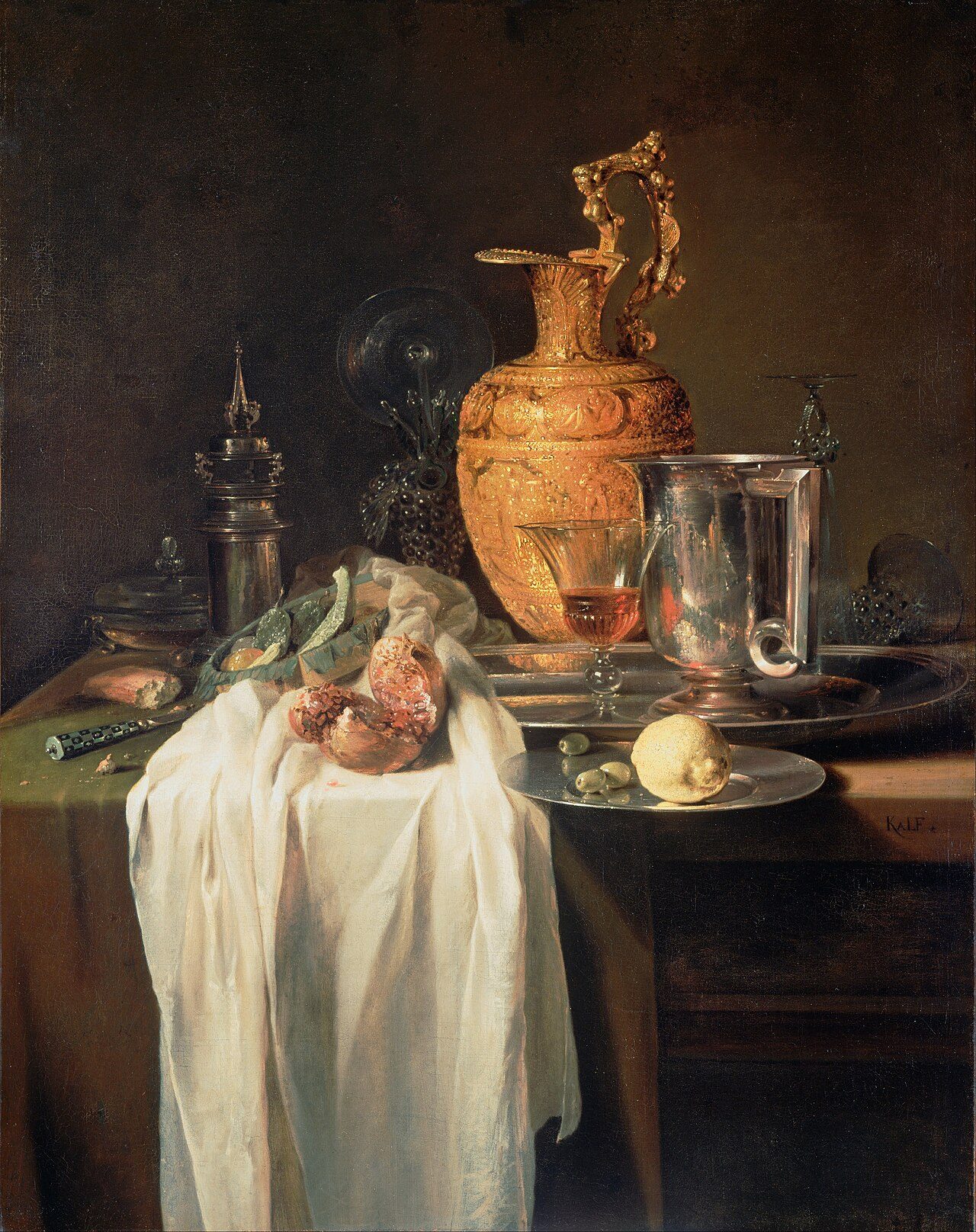
6 min read · 2 sourcesA still life (pl.: still lifes) is a work of art depicting mostly inanimate subject matter, typically commonplace objects which are either natural (food, flowers, dead animals, plants, rocks, shells, etc.) or human-made (drinking glasses, books, vases, jewelry, coins, pipes, etc.). With origins in Ancient Greco-Roman art and the Middle Ages, still-life painting emerged as a distinct genre and professional specialization in Western painting by the late 16th century, and has remained significant since then. One advantage of the still-life artform is that it allows an artist much freedom to experiment with the arrangement of elements within a composition of a painting. Still life, as a particular genre, began with Netherlandish painting of the 16th and 17th centuries, and the English term still life derives from the Dutch word stilleven. Early still-life paintings, particularly before 1700, often contained religious and allegorical symbolism relating to the objects depicted. Later still-life works are produced with a variety of media and technology, such as found objects, photography, computer graphics, as well as video and sound. The term includes the painting of dead animals, especially game. Live ones are considered animal art, although in practice they were often painted from dead models. Because of the use of plants and animals as a subject, the still-life category also shares commonalities with zoological and especially botanical illustration. 1
Antecedents and development
Still-life paintings often adorn the interior of ancient Egyptian tombs. It was believed that food objects and other items depicted there would, in the afterlife, become real and available for use by the deceased. Ancient Greek vase paintings also demonstrate great skill in depicting everyday objects and animals. Peiraikos is mentioned by Pliny the Elder as a panel painter of "low" subjects, such as survive in mosaic versions and provincial wall-paintings at Pompeii: "barbers' shops, cobblers' stalls, asses, eatables and similar subjects". Similar still life, more simply decorative in intent, but with realistic perspective, have also been found in the Roman wall paintings and floor mosaics unearthed at Pompeii, Herculaneum and the Villa Boscoreale, including the later familiar motif of a glass bowl of fruit. Decorative mosaics termed "emblema", found in the homes of rich Romans, demonstrated the range of food enjoyed by the upper classes, and also functioned as signs of hospitality and as celebrations of the seasons and of life. By the 16th century, food and flowers would again appear as symbols of the seasons and of the five senses. Also starting in Roman times is the tradition of the use of the skull in paintings as a symbol of mortality and earthly remains, often with the accompanying phrase Omnia mors aequat (Death makes all equal). These vanitas images have been re-interpreted through the last 400 years of art history, starting with Dutch painters around 1600. The popular appreciation of the realism of still-life painting is related in the ancient Greek legend of Zeuxis and Parrhasius, who are said to have once competed to create the most lifelike objects, history's earliest descriptions of trompe-l'œil painting. 1
Middle Ages and Early Renaissance
By 1300, starting with Giotto and his pupils, still-life painting was revived in the form of fictional niches on religious wall paintings which depicted everyday objects. Through the Middle Ages and the Renaissance, still life in Western art remained primarily an adjunct to Christian religious subjects, and convened religious and allegorical meaning. This was particularly true in the work of Northern European artists, whose fascination with highly detailed optical realism and symbolism led them to lavish great attention on their paintings' overall message. Painters like Jan van Eyck often used still-life elements as part of an iconographic program. In the late Middle Ages, still-life elements, mostly flowers but also animals and sometimes inanimate objects, were painted with increasing realism in the borders of illuminated manuscripts, developing models and technical advances that were used by painters of larger images. There was considerable overlap between the artists making miniatures for manuscripts and those painting panels, especially in Early Netherlandish painting. The Hours of Catherine of Cleves, probably made in Utrecht around 1440, is one of the outstanding examples of this trend, with borders featuring an extraordinary range of objects, including coins and fishing-nets, chosen to complement the text or main image at that particular point. Flemish workshops later in the century took the naturalism of border elements even further. Gothic millefleur tapestries are another example of the general increasing interest in accurate depictions of plants and animals. 1
Sixteenth century
Though most still lifes after 1600 were relatively small paintings, a crucial stage in the development of the genre was the tradition, mostly centred on Antwerp, of the "monumental still life", which were large paintings that included great spreads of still-life material with figures and often animals. This was a development by Pieter Aertsen, whose A Meat Stall with the Holy Family Giving Alms (1551, now Uppsala) introduced the type with a painting that still startles. Another example is "The Butcher Shop" by Aertsen's nephew Joachim Beuckelaer (1568), with its realistic depiction of raw meats dominating the foreground, while a background scene conveys the dangers of drunkenness and lechery. The type of very large kitchen or market scene developed by Pieter Aertsen and his nephew Joachim Beuckelaer typically depicts an abundance of food with a kitchenware still life and burly Flemish kitchen-maids. A small religious scene can often be made out in the distance, or a theme such as the Four Seasons is added to elevate the subject. This sort of large-scale still life continued to develop in Flemish painting after the separation of the North and South, but is rare in Dutch painting, although other works in this tradition anticipate the "merry company" type of genre painting. Gradually, religious content diminished in size and placement in this type of painting, though moral lessons continued as sub-contexts. One of the relatively few Italian works in the style, Annibale Carracci's treatment of the same subject in 1583, Butcher's Shop, begins to remove the moral messages, as did other "kitchen and market" still-life paintings of this period. Vincenzo Campi probably introduced the Antwerp style to Italy in the 1570s. 1
Seventeenth century
Prominent Academicians of the early 17th century, such as Andrea Sacchi, felt that genre and still-life painting did not carry the "gravitas" merited for painting to be considered great. 1
Dutch and Flemish painting
Still life developed as a separate category in the Low Countries in the last quarter of the 16th century. 1
The text above is adapted from the Wikipedia article “Still life”, available under the Creative Commons Attribution-ShareAlike 4.0 licence. 1
still life is art genre mostly showing inanimate objects, according to the structured record cited below. This entry was generated automatically from that record and has not yet been reviewed by a person familiar with the tradition. 2
The source record links this tradition to 46 external registers, which can be verified through the citation. 2