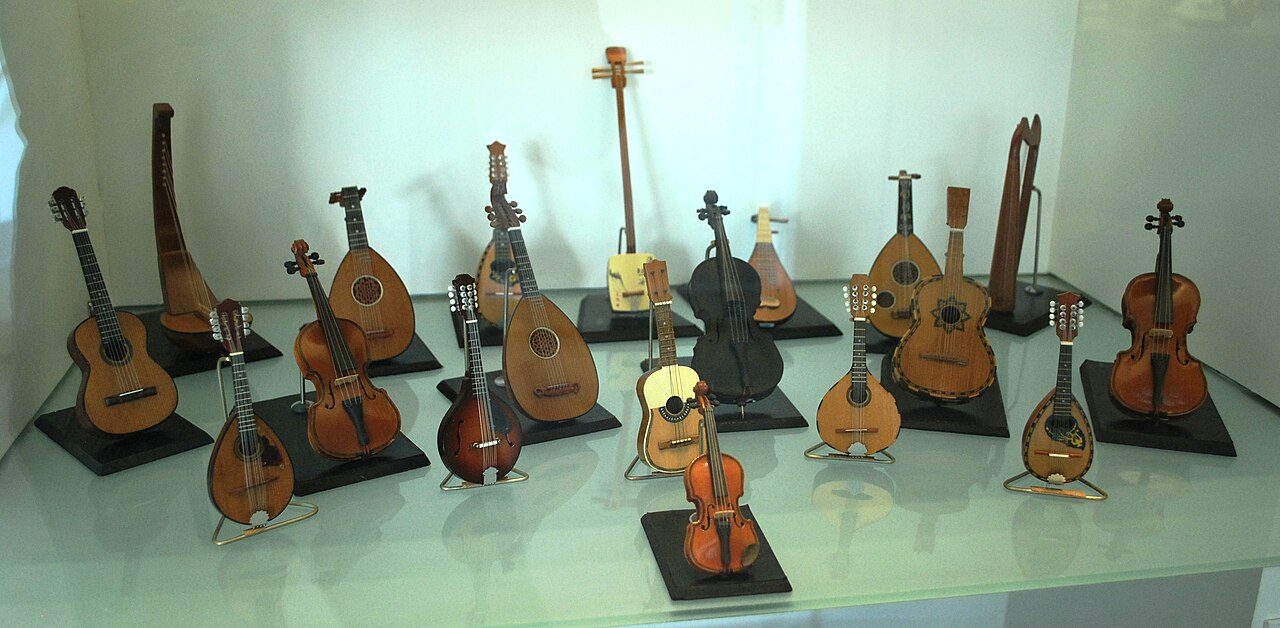
The tradition & historical record
6 min read · 2 sourcesIn musical instrument classification, string instruments, or chordophones, are musical instruments that produce sound from vibrating strings when a performer strums, plucks, strikes or sounds the strings in varying manners. Musicians play some string instruments, like guitars, by plucking the strings with their fingers or a plectrum (pick), and others by hitting the strings with a light wooden hammer or by rubbing the strings with a bow, like violins. In some keyboard instruments, such as the harpsichord, the musician presses a key that plucks the string. Other musical instruments generate sound by striking the string. With bowed instruments, the player pulls a rosined horsehair bow across the strings, causing them to vibrate. With a hurdy-gurdy, the musician cranks a wheel whose rosined edge touches the strings. Bowed instruments include the string section instruments of the orchestra in Western classical music (violin, viola, cello and double bass) and a number of other instruments (e.g., viols and gambas used in early music from the Baroque music era and fiddles used in many types of folk music). All of the bowed string instruments can also be plucked with the fingers, a technique called "pizzicato". 1
Classification
In musicology, string instruments are known as chordophones. It is one of the five main divisions of instruments in the Hornbostel–Sachs scheme of musical instrument classification. Hornbostel–Sachs divides chordophones into two main groups: instruments without a resonator as an integral part of the instrument (which have the classification number 31, also known as 'simple'); and instruments with such a resonator (which have the classification number 32, also known as 'composite'). Most western instruments fall into the second group, but the piano and harpsichord fall into the first. Hornbostel and Sachs's criterion for determining which sub-group an instrument falls into is that if the resonator can be removed without destroying the instrument, then it is classified as 31. The idea that the piano's casing, which acts as a resonator, could be removed without destroying the instrument, may seem odd, but if the action and strings of the piano were taken out of its box, it could still be played. 1
Earliest string instruments
Dating to around c. 13,000 BC, a cave painting in the Trois Frères cave in France depicts what some believe is a musical bow, a hunting bow used as a single-stringed musical instrument. From the musical bow, families of stringed instruments developed; since each string played a single note, adding strings added new notes, creating bow harps, harps and lyres. In turn, this led to being able to play dyads and chords. Another innovation occurred when the bow harp was straightened out and a bridge used to lift the strings off the stick-neck, creating the lute. This picture of musical bow to harp bow is theory and has been contested. In 1965 Franz Jahnel wrote his criticism stating that the early ancestors of plucked instruments are not currently known. He felt that the harp bow was a long cry from the sophistication of the civilizations of western Asia in 4000 BC that took the primitive technology and created "technically and artistically well-made harps, lyres, citharas, and lutes." Archaeological digs have identified some of the earliest stringed instruments in Ancient Mesopotamian sites, like the lyres of Ur, which include artifacts over three thousand years old. The development of lyre instruments required the technology to create a tuning mechanism to tighten and loosen the string tension. Lyres with wooden bodies and strings used for plucking or playing with a bow represent key instruments that point towards later harps and violin-type instruments; moreover, Indian instruments from 500 BC have been discovered with anything from 7 to 21 strings. In Vietnam, a 2,000 year old, singularly stringed instrument made of deer antler was also discovered. 1
Lutes
Musicologists have put forth examples of that 4th-century BC technology, looking at engraved images that have survived. The earliest image showing a lute-like instrument came from Mesopotamia prior to 3000 BC. A cylinder seal from c. 3100 BC or earlier (now in the possession of the British Museum) shows what is thought to be a woman playing a stick lute. From the surviving images, theorists have categorized the Mesopotamian lutes, showing that they developed into a long variety and a short. The line of long lutes may have developed into the tamburs and pandura. The line of short lutes was further developed to the east of Mesopotamia, in Bactria, Gandhara, and Northwest India, and shown in sculpture from the 2nd century BC through the 4th or 5th centuries AD. During the medieval era, instrument development varied in different regions of the world. Middle Eastern rebecs represented breakthroughs in terms of shape and strings, with a half a pear shape using three strings. Early versions of the violin and fiddle, by comparison, emerged in Europe through instruments such as the gittern, a four-stringed precursor to the guitar, and basic lutes. These instruments typically used catgut (animal intestine) and other materials, including silk, for their strings. 1
Renaissance to modern
String instrument design was refined during the Renaissance and into the Baroque period (1600–1750) of musical history. Violins and guitars became more consistent in design and were roughly similar to acoustic guitars of the 2000s. The violins of the Renaissance featured intricate woodwork and stringing, while more elaborate bass instruments such as the bandora were produced alongside quill-plucked citterns, and Spanish body guitars. In the 19th century, string instruments were made more widely available through mass production, with wood string instruments a key part of orchestras – cellos, violas, and upright basses, for example, were now standard instruments for chamber ensembles and smaller orchestras. At the same time, the 19th-century guitar became more typically associated with six-string models, rather than traditional five-string versions. Major changes to string instruments in the 20th century primarily involved innovations in electronic instrument amplification and electronic music – electric violins were available by the 1920s and were an important part of emerging jazz music trends in the United States. The acoustic guitar was widely used in blues and jazz, but as an acoustic instrument, it was not loud enough to be a solo instrument, so these genres mostly used it as an accompaniment rhythm section instrument. In big bands of the 1920s, the acoustic guitar played backing chords, but it was not loud enough to play solos like the saxophone and trumpet. The development of guitar amplifiers, which contained a power amplifier and a loudspeaker in a wooden cabinet, let jazz guitarists play solos and be heard over a big band. The development of the electric guitar provided guitarists with an instrument that was built to connect to guitar amplifiers. 1
Construction
String instruments can be divided into… 1
The text above is adapted from the Wikipedia article “String instrument”, available under the Creative Commons Attribution-ShareAlike 4.0 licence. 1
string instrument is musical instrument that generates tones by one or more strings stretched between two points, according to the structured record cited below. This entry was generated automatically from that record and has not yet been reviewed by a person familiar with the tradition. 2
The source record links this tradition to 45 external registers, which can be verified through the citation. 2