The tradition & historical record
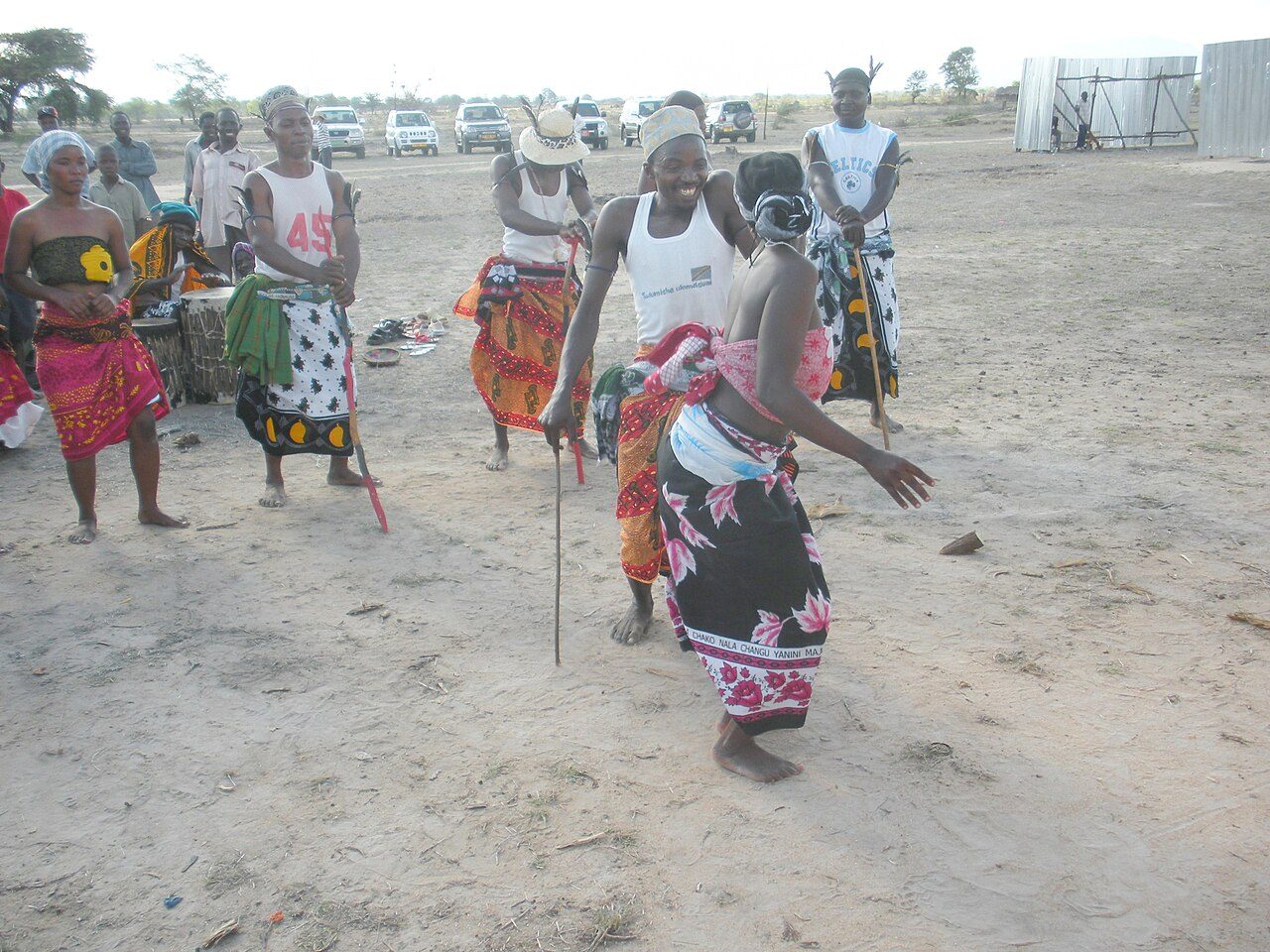
6 min read · 2 sourcesIn many parts of sub-Saharan Africa, the use of music is not limited to entertainment: it serves a purpose to the local community and helps in the conduct of daily routines. Traditional African music supplies appropriate music and dance for work and for religious ceremonies of birth, naming, rites of passage, marriage and funerals. The beats and sounds of the drum are used in communication as well as in cultural expression. African dances are largely participatory: there are traditionally no barriers between dancers and onlookers except with regard to spiritual, religious and initiation dances. Even ritual dances often have a time when spectators participate. Dances help people work, mature, praise or criticize members of the community, celebrate festivals and funerals, compete, recite history, proverbs and poetry and encounter gods. They inculcate social patterns and values. Many dances are performed by only males or females. Dances are often segregated by gender, reinforcing gender roles in children. Community structures such as kinship, age, and status are also often reinforced. To share rhythm is to form a group consciousness, to entrain with one another, to be part of the collective rhythm of life to which all are invited to contribute. 1
Yoruba dancers and drummers, for instance, express communal desires, values, and collective creativity. 1
Regions
Alan P. Merriam divided Africa into seven regions for ethnomusicological purposes, observing current political frontiers (see map), and this article follows this division as far as possible in surveying the music of ethnic groups in Africa. 1
Music of the northern region of Africa (red on the map), including that of the Horn of Africa (dark green on the map), is mostly treated separately under Middle Eastern and North African music traditions. West African music (yellow on the map) includes the music of Senegal and the Gambia, of Guinea and Guinea-Bissau, Sierra Leone and Liberia, of the inland plains of Mali, Niger and Burkina Faso and also the coastal nations of Côte d'Ivoire, Ghana, Togo, Benin, Nigeria, Cameroon, Gabon and the Republic of the Congo as well as the islands of Cape Verde, São Tomé and Príncipe. Central African Music (dark blue on the map) includes the music of Chad, the Central African Republic, the Democratic Republic of the Congo and Zambia. The Eastern region (light green on the map) includes the music of Uganda, Kenya, Rwanda, Burundi, Tanzania, Malawi, Mozambique and Zimbabwe as well as the islands of Madagascar, the Seychelles, Réunion, Mauritius and Comoros. The eastern region has received south Asian and even Austronesian influences via the Indian Ocean. The Southern region (brown on the map) includes the music of South Africa, Lesotho, Eswatini, Botswana, Namibia and Angola. 1
Sahel and Sudan
The music of Sudan (turquoise on the map) indicates the difficulty of dividing music traditions according to state frontiers. The musicology of Sudan involves some 133 language communities. that speak over 400 dialects, Afro-Asian, Nilotic and Niger–Congo. In contrast to traditional Arabic music, most Sudanese music styles are pentatonic, and the simultaneous beats of percussion or singing in polyrhythms are further prominent characteristics of Sudanese music. Sudan takes its name from that of the sub-Saharan savanna which makes, with the Nile, a great cross-roads of the region. South of the Sahara the Sahel forms a bio-geographic zone of transition between the desert and the Sudanian savannas, stretching between the Atlantic Ocean and the Red Sea. The Nilotic peoples prominent in southern Sudan, Uganda, Kenya, and northern Tanzania, include the Luo, Dinka, Nuer and Maasai. Many of these have been included in the Eastern region. 1
The Dinka are a mainly agro-pastoral people inhabiting the Bahr el Ghazal region of the Nile basin, Jonglei and parts of southern Kordufan and Upper Nile regions. They number around 1.5 million, about 10% of the population. of Sudan. The Arabian rebab has found a home among the Nuba peoples. The Senegambian Fula have migrated as far as Sudan at various times, often speaking Arabic as well as their own language. The Hausa people, who speak a language related to Ancient Egyptian and Biblical Hebrew, have moved in the opposite direction. Further west the Berber music of the Tuareg has penetrated to Sub-Saharan countries. 1
Western, central, eastern and southern territories
These remaining four regions are most associated with Sub-Saharan African music: familiar African musical elements such as the use of cross-beat and vocal harmony may be found all over all four regions, as may be some instruments such as the iron bell. This is largely due to the expansion of the Niger–Congo-speaking people that began around 1500 BC: the last phases of expansion were 0–1000 AD. Only a few scattered languages in this great area cannot readily be associated with the Niger–Congo language family. However two significant non-Bantu musical traditions, the Pygmy music of the Congo jungle and that of the bushmen of the Kalahari, do much to define the music of the central region and of the southern region respectively. As a result of the migrations of Niger-Congo peoples (e.g., Bantu expansion), polyrhythmic culture (e.g., dance, music), which is generally associated with being a common trait among modern cultures of Africa Including Nilo-Saharan speakers in Sudan, spread throughout Southern Africa. Due to the Trans-Atlantic slave trade, music of the African diaspora, many of whom descend from Niger-Congo peoples, has had considerable influence upon modern Western forms of popular culture (e.g., dance, music). 1
West Africa
The music of West Africa must be considered under two main headings: in its northernmost and westernmost parts, many of the above-mentioned transnational sub-Saharan ethnic influences are found among the Hausa, the Fulani, the Wolof people, the Mande speakers of Mali, Senegal and Mauritania, the Gur-speaking peoples of Mali, Burkina Faso and the northern halves of Ghana, Togo and Côte d'Ivoire, the Fula found throughout West Africa, and the Senufo speakers of Côte d'Ivoire and Mali. The coastal regions are home to the Niger-Congo speakers; Kwa, Akan, the Gbe languages, spoken in Ghana, Togo, Benin, and Nigeria, the Yoruba and Igbo languages, spoken in Nigeria and the Benue–Congo languages of the east. Inland and coastal languages are only distantly related. While the north, with its griot traditions, makes great use of stringed instruments and xylophones, the south relies much more upon drum sets and communal singing. 1
Northern
Complex societies existed in the region from about 1500 BCE. The Ghana Empire existed from before c. 830 until c. 1235 in what is now south-east Mauritania and western Mali. The Sosso people had their capital at Koumbi Saleh until Sundiata Keita defeated them at the Battle of Kirina (c. 1240) and began the Mali Empire, which spread its influence along the Niger River through numerous vassal kingdoms and provinces. 1
The text above is adapted from the Wikipedia article “Sub-Saharan African music traditions”, available under the Creative Commons Attribution-ShareAlike 4.0 licence. 1
Sub-Saharan African music traditions is Traditional sound-based art forms developed by sub-Saharan African peoples, according to the structured record cited below. This entry was generated automatically from that record and has not yet been reviewed by a person familiar with the tradition. 2
The source record links this tradition to 4 external registers, which can be verified through the citation. 2