The tradition & historical record
4 min read · 2 sourcesThe suling (Sundanese: ᮞᮥᮜᮤᮀ) is a musical instrument of the Sundanese people in Indonesia. It is used in the Degung ensemble. Bamboo ring flute can also be found in Southeast Asia, especially in Brunei, Indonesia, Malaysia, the Philippines and Singapore. 1
Construction
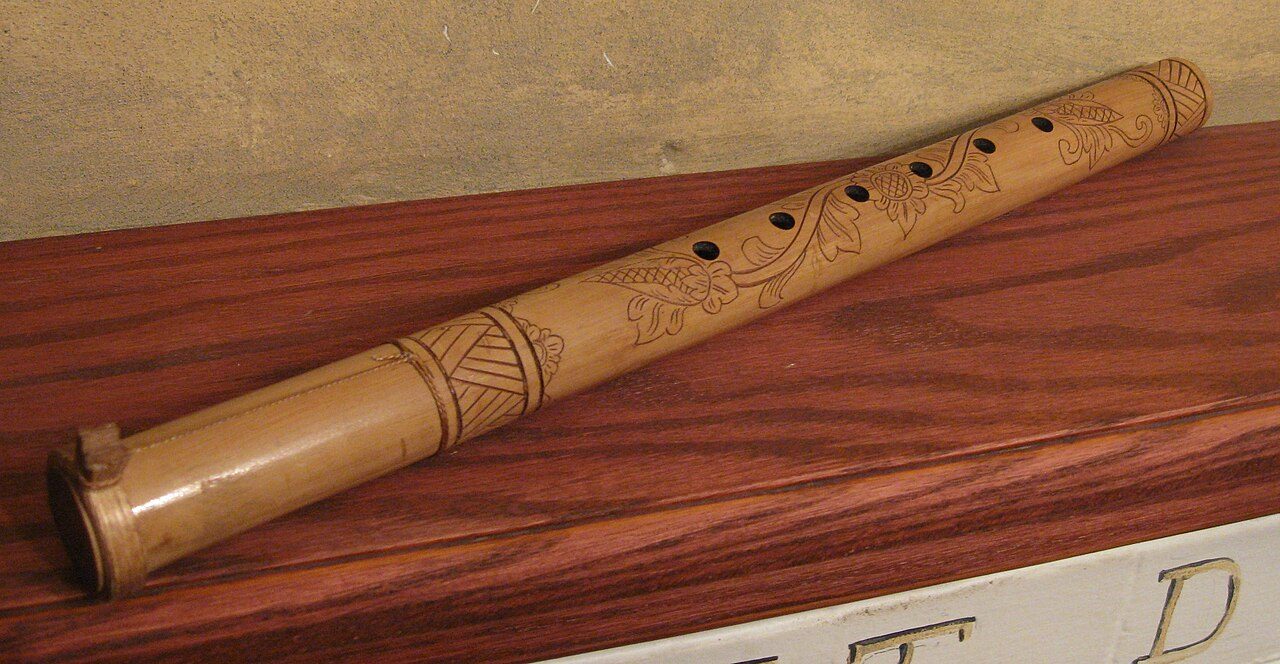
Sulings are made mainly of tamiang bamboo (Schizostachyum blumei, Nees), a long, thin-walled bamboo tube. The mouthpiece of the suling is circled with a thin band made of rattan near a small hole. 1
Playing method
To play the suling, performers blow into a gap between the rattan band and the bamboo tube at one end of the instrument. There are two factors that affect a fine suling's tone: 1
Fingering position. Speed of the airflow blown by the mouth. This factor also should be supported with the position of the mouth around the blowing hole. The fingering position changes the wavelength of sound resonance inside the suling's body. Depending on the distance of nearest hole to the suling's head, different notes can be produced. The airflow speed also can modify the tone's frequency. A note with twice frequency can be produced mostly by blowing the air into suling's head's hole with twice speed. 1
In the music of Bali, the suling is an essential instrument and it appears to be similar to other forms of Javanese suling. The way it is played, however, sets it apart from other forms of Indonesian suling. Namely, it is necessary for the performers to use the technique circular breathing in order to create a highly strung sense of constancy that continues even at moments of dramatic climax by the percussive gamelan instruments. 1
Special effects
Slur is dynamically changing note from one tone position to another position without stopping the airflow. For example, changing from 5 to 4, 4 to 5, 2 to 1 etc. Puruluk (Sundanese term) is an effect produced by a-repeatedly-fast opening-and-closing of suling's hole by one or more fingers. The produced sound is similar to voice of a pigeon. The easiest puruluk can be produced by opening and closing mid-finger as shown by the following picture: 1
In Sundanese technique, there are other known effects such as wiwiw, keleter, lelol, gebos, petit, jengkat, and betrik. 1
Sundanese
In the Sundanese region, a suling is used as 1
one of the main instruments in kacapi suling accompanying instrument in Gamelan Degung, Tembang Sunda 1
Tuning
Sulings can have either 4 holes or 6 holes. The 4-holed sulings are made for single scale usage. The 6-holed Sundanese suling can play at least three different scales. Some custom sulings have 7, 8, and 9 holes as additional holes for playing extended scales such as Mandalungan, the transposed version of Degung. 1
Pelog/Degung: da mi na ti la da [1 2 3 4 5 1], nearly corresponds to do si sol fa mi do [1' 7 5 4 3 1] in the Western diatonic scale. Madenda/Sorog: da mi na ti la da [1 2 3 4 5 1], nearly similar to fa mi do si la fa [4’ 3’ 1’ 7 6 4] in the Western diatonic scale. Madenda conceptually played by changing the 3rd note of Degung [1' 7 5 4 3 1] in diatonic scale to [1' 7 6 4 3 1], and move the Sundanese 1/da to the Western 4/fa position. Saléndro: da mi na ti la da [1 2 3 4 5 1], nearly similar to re do la sol fa re [2’ 1’ 6 5 4 2] in the Western diatonic scale. Saléndro tone are almost five-equally divided tones, called as Saléndro Padantara (equal interval). Unequal division of Saléndro notes called as Saléndro Bédantara (unequal interval). Mandalungan: a rarely used scale, similar to Degung scale, but it is actually a transposed Degung via changing the 4th tone of Madenda [4' 3' 1' 7 6 4] in Western diatonic scale to [4' 3' 1' ♭7 6 4]. Basically sounds the same as Degung, just with a different transposition. This scale needs an extra hole (usually in the back of suling) to play. Wisaya: this scale is the same as Madenda/Sorog, but on different transposition. This scale is only playable with additional hole, usually on the back and top most position. Its notation [1 2 3 4 5 1] corresponds to western [1' 7 5 ♯4 3 1]. 1
The text above is adapted from the Wikipedia article “Suling”, available under the Creative Commons Attribution-ShareAlike 4.0 licence. 1
suling is Indonesian traditional musical instrument, according to the structured record cited below. This entry was generated automatically from that record and has not yet been reviewed by a person familiar with the tradition. 2
The source record links this tradition to 11 external registers, which can be verified through the citation. 2