The tradition & historical record
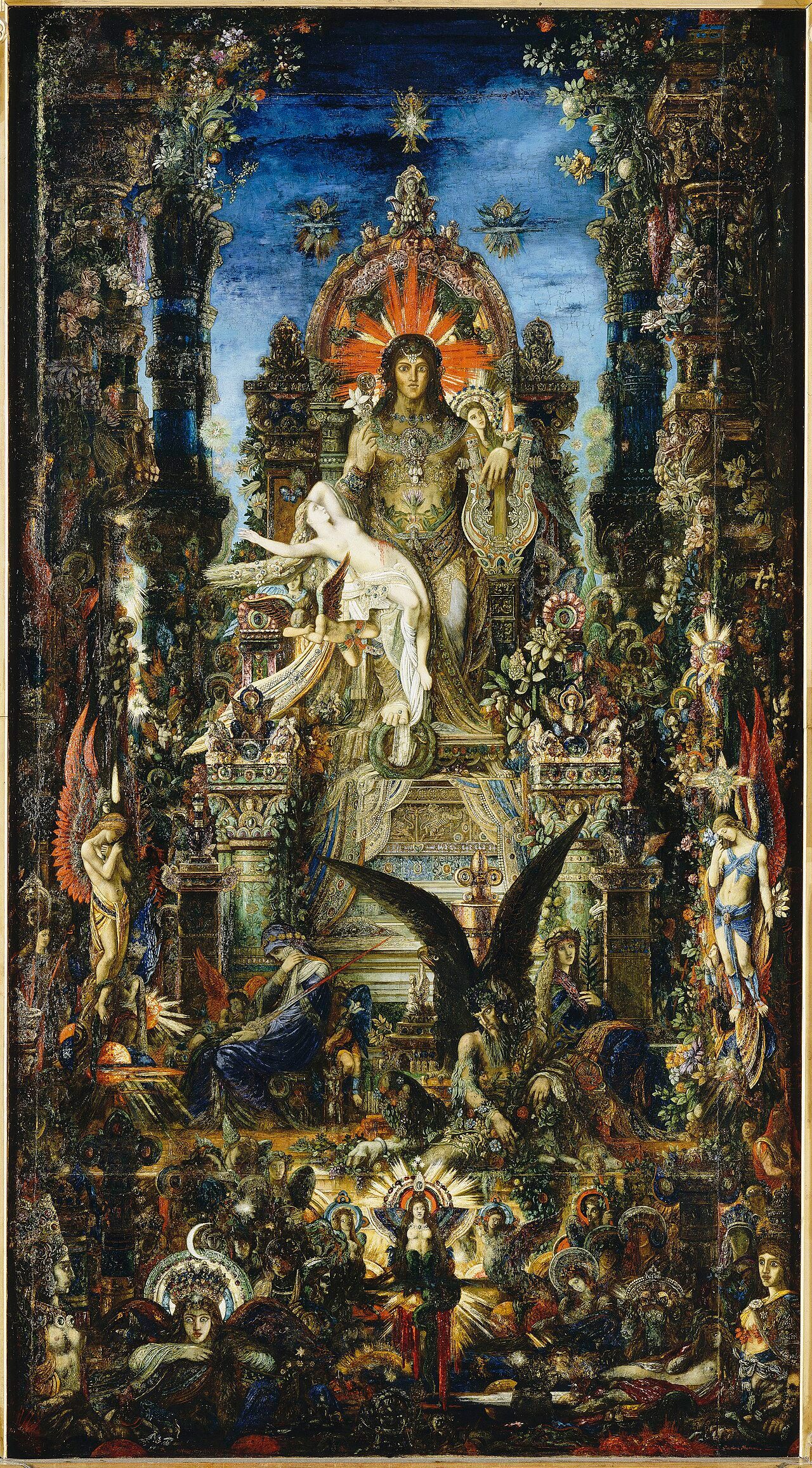
6 min read · 2 sourcesSymbolist painting was one of the main artistic manifestations of symbolism, a cultural movement that emerged at the end of the 19th century in France and developed in several European countries. The beginning of this current was in poetry, especially thanks to the impact of The Flowers of Evil by Charles Baudelaire (1868), which powerfully influenced a generation of young poets including Paul Verlaine, Stéphane Mallarmé and Arthur Rimbaud. The term "symbolism" was coined by Jean Moréas in a literary manifesto published in Le Figaro in 1886. The aesthetic premises of Symbolism moved from poetry to other arts, especially painting, sculpture, music and theater. The chronology of this style is difficult to establish: the peak is between 1885 and 1905, but already in the 1860s there were works pointing to symbolism, while its culmination can be established at the beginning of the First World War. In painting, symbolism was a fantastic and dreamlike style that emerged as a reaction to the naturalism of the Realist painting and Impressionist trends, whose objectivity and detailed description of reality were opposed by the Symbolists' subjectivity and the depiction of the occult and the irrational. Just as in poetry the rhythm of words served to express a transcendent meaning, in painting they sought ways for color and line to express ideas. 1
General characteristics
Symbolism emerged as a reaction to the multiple tendencies linked to realism in the field of culture throughout the 19th century. Factors such as the progress of science since the Renaissance—which in this century led to scientific positivism, the development of industry and commerce that originated with capitalism and the Industrial Revolution, the preference of the bourgeoisie for cultural naturalism, and the emergence of socialism with its tendency toward philosophical materialism, led to a clear preference for artistic realism throughout the century, which was evident in movements such as realist painting and impressionism. In contrast to this, first poets and then artists expressed a new way of understanding life, more subjective and spiritual, a reflection of their existential anguish in a time of loss of both moral and religious values, which is why they entered into the search for a new language and a new category of values that manifest their inner world, their beliefs, their emotions, their fears, their longings. According to Johannes Dobai, "Symbolist art tends to generalize, through images, an individual, or rather unconscious, experience of the world." Symbolism was an eclectic movement, which brought together a number of artists with common concerns and sensibilities. More than a homogeneous style, it was an amalgam of styles grouped by a series of common factors, such as themes, ways of understanding life and art, literary and musical influences, and an opposition to realism and scientific positivism. It was a sometimes contradictory movement, which mixed the desire for modernity and a break with tradition with nostalgia for the past, the ugliness of decadentism with the beauty of aestheticism; serenity with exaltation, reason with madness. 1
Antecedents
Symbolism, understood as a means of expression of the "symbol", that is, of a type of content, whether written, sonorous or plastic, whose purpose is to transcend matter to signify a superior order of intangible elements, has always existed in art as a human manifestation, one of whose qualities has always been spiritual evocation and the search for a language that transcends reality. Thus, the presence of the symbol in art can be perceived as early as prehistoric cave painting and has been a constant, especially in art linked to religious beliefs, from Egyptian art or Aztec art to Christian art, Islamic art, Buddhist art or any of the multiple religions that have arisen throughout history. A symbolic background has been present in most modern artistic movements, such as the Renaissance, Mannerism, Baroque, Rococo or Romanticism. In general, these movements have been opposed to others that placed greater emphasis on the description of reality—a trend generally known as naturalism—such as academicism, Neoclassicism, realism or Impressionism. 1
Some Renaissance artists such as Botticelli and Mantegna exerted a great influence on the Symbolist painters: the former especially in England (Beardsley, Burne-Jones, Ricketts) and the latter in France with Moreau and Redon, and even Picasso. Other Renaissance artists who gave great relevance to the symbolic content of their works were Giorgione, Titian and Albrecht Dürer, who were also admired by the 19th century symbolists. 1
Literary sources
On September 18, 1886, Jean Moréas published in Le Figaro a literary manifesto in which he defined symbolism as "the enemy of teaching, declamation, false sensibility and objective description". According to Moréas, art was the analogical and concrete expression of the Idea, in which sensory and spiritual elements merge. For his part, the critic fr:Charles Morice defined symbolism as the synthesis between the spirit and the senses (La Littérature de tout à l'heure, 1889). A literary antecedent of this movement was the book Against the Grain (À rebours) by Joris-Karl Huysmans (1884), a hymn to aestheticism and eccentricity as a vital attitude, in which he relates the work of certain artists such as Gustave Moreau, Rodolphe Bresdin and Odilon Redon to decadentism. In this novel the protagonist, Jean Floressas des Esseintes, withdraws from the world to live in an environment created by him in which he devotes himself to enjoying literature, music, art, flowers, jewels, perfumes, liquors and all those things that stimulate an idealized existence, removed from the mundane noise. 1
Aestheticism
Symbolism was closely linked to aestheticism, a philosophical-artistic movement which, against the materialism of the industrial era, opposed the exaltation of art and beauty, synthesized in Théophile Gautier's formula of "art for art's sake" (l'art pour l'art'), which was even referred to as "aesthetic religion". This position sought to isolate the artist from society, to seek his own inspiration autonomously and to be driven solely by an individual quest for beauty. Beauty was removed from any moral component, becoming the ultimate goal of the artist, who came to live his own life as a work of art-as can be seen in the figure of the dandy. For aesthetes, art should have no didactic, moral, social or political function, but should respond solely to pleasure and beauty. This movement arose in the United Kingdom, cradle of the Industrial Revolution, where in the first half of the 19th century artistic styles—especially in architecture and decorative arts—of eclectic cut such as historicism developed. Against this, an "Aesthetic Discontent" began to emerge, which provoked a reaction towards more natural and handcrafted forms, as seen in the Arts & Crafts movement, which led to a revaluation of the decorative arts. 1
Decadentism
Decadentism was a fin-de-siecular current perceptibl… 1
The text above is adapted from the Wikipedia article “Symbolist painting”, available under the Creative Commons Attribution-ShareAlike 4.0 licence. 1
symbolist painting is 19th-century cultural movement, according to the structured record cited below. This entry was generated automatically from that record and has not yet been reviewed by a person familiar with the tradition. 2
The source record links this tradition to 1 external register, which can be verified through the citation. 2