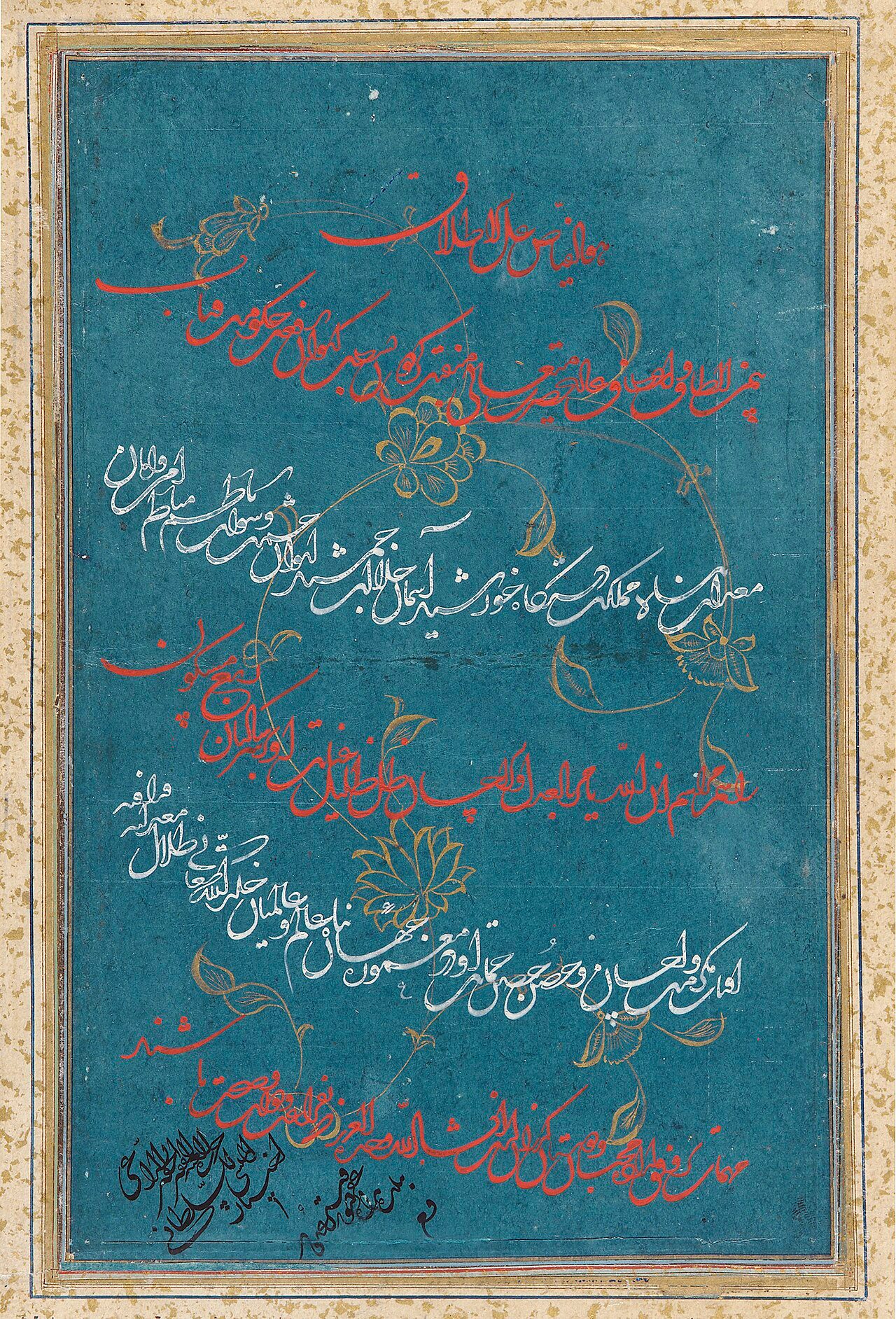
The tradition & historical record
2 min read · 2 sourcesThe taʿlīq (Persian: تعلیق, lit. 'hanging') script is a calligraphic hand in Islamic calligraphy typically used for official documents written in Persian. Literally meaning hanging or suspended script, it emerged in the mid‑13th century CE and was widely used, especially in chanceries of Iranian states, although from the early 16th century onward it lost ground to another hanging script, the increasingly popular nastaliq. Taliq had a long gestation. The Persian style of writing naskh underwent gradual changes from the 11th century onward, and those changes, together with some borrowings from tawqi and riqa', resulted in the emergence of taliq script in the mid‑13th century CE. Taliq shares many peculiarities with these three scripts, "but is more stylized. It revels in curvilinear elements, extraneous loops, extreme contrasts between compression and expansion, and connected letters, all traits that make it difficult for the novice to decipher". In taliq words and detached letters could be joined, which allowed for speedy writing and made it suitable for official correspondence. By the late thirteenth century taliq had achieved a definitive style, sometimes called taliq-i qadim (old taliq) or taliq-i asl (original taliq), "probably driven in part by the burgeoning Ilkhanid bureaucracy’s need to standardize written Persian". (see firman of Sadr al-Din Zanjani, vizier of ilkhan Gaykhatu). 1
The text above is adapted from the Wikipedia article “Taliq script”, available under the Creative Commons Attribution-ShareAlike 4.0 licence. 1
Taʿlīq script is script style in Persian & Arabic calligraphy, according to the structured record cited below. This entry was generated automatically from that record and has not yet been reviewed by a person familiar with the tradition. 2
The source record links this tradition to 4 external registers, which can be verified through the citation. 2