The tradition & historical record
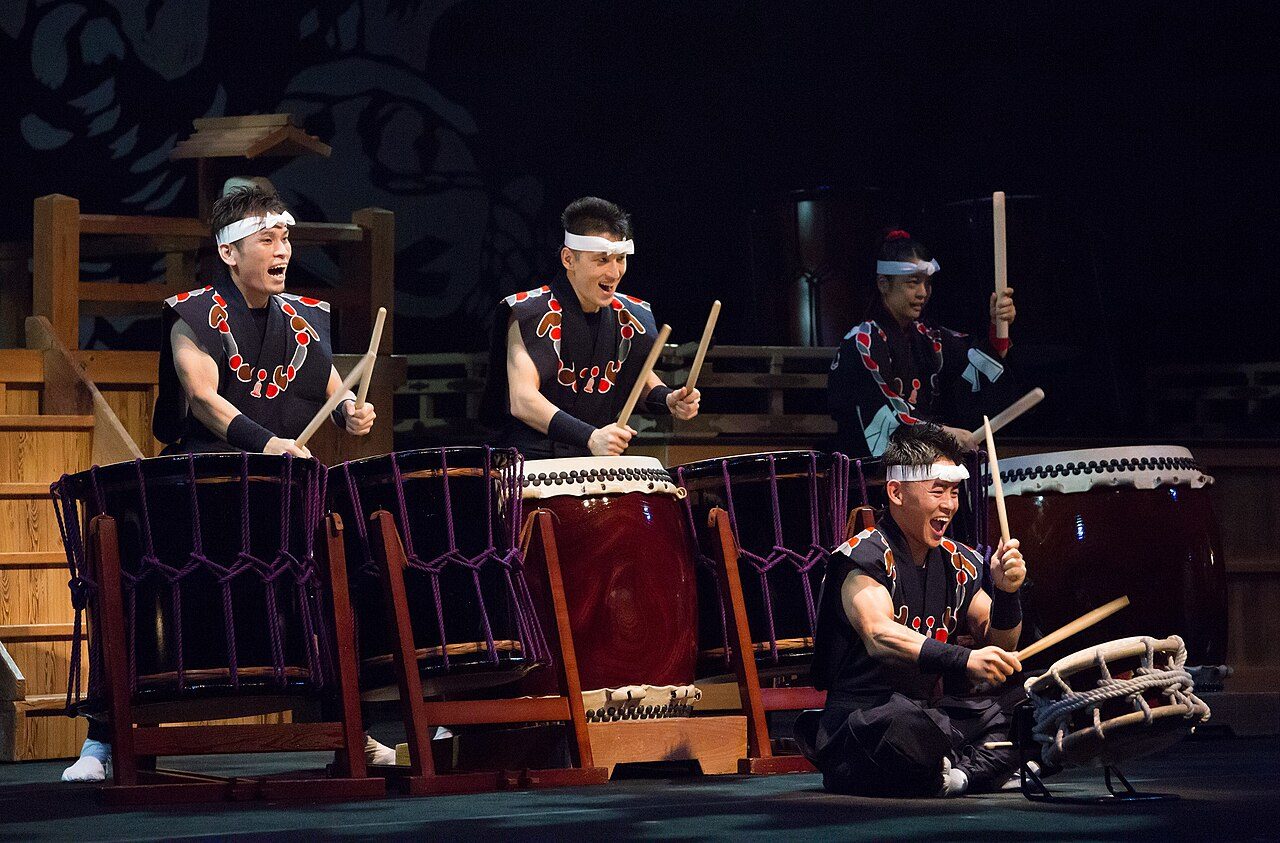
6 min read · 2 sourcesTaiko (太鼓) are a broad range of Japanese percussion instruments. In Japanese, the term taiko refers to any kind of drum, but outside Japan, it is used specifically to refer to any of the various Japanese drums called wadaiko (和太鼓, lit. 'Japanese drums') and to the form of ensemble taiko drumming more specifically called kumi-daiko (組太鼓, lit. 'set of drums'). The process of constructing taiko varies between manufacturers, and the preparation of both the drum body and skin can take several years depending on the method. Taiko have a mythological origin in Japanese folklore, but historical records suggest that taiko were introduced to Japan through Chinese and Korean cultural influence as early as the 6th century CE; pottery from Haniwa figures depicting taiko drums has also been found. Some taiko are similar to instruments originating from India. Archaeological evidence also supports the view that taiko were present in Japan during the 6th century in the Kofun period. Their function has varied throughout history, ranging from communication, military action, theatrical accompaniment, religious ceremonies and concert performances. 1
Origin
The origin of the taiko and its variants is unclear, though there have been many suggestions. Historical accounts, of which the earliest date from 588 CE, note that young Japanese men traveled to Korea to study the kakko, a drum that originated in South China. This study and appropriation of Chinese instruments may have influenced the emergence of taiko. Certain court music styles, especially gigaku and gagaku, arrived in Japan through both China and Korea. In both traditions, dancers were accompanied by several instruments that included drums similar to taiko. Certain percussive patterns and terminology in togaku, an early dance and music style in Japan, in addition to physical features of the kakko, also reflect influence from both China and India on drum use in gagaku performance. Archaeological evidence shows that taiko were used in Japan as early as the 6th century CE, during the latter part of the Kofun period, and were likely used for communication, in festivals, and in other rituals. This evidence was substantiated by the discovery of haniwa statues in the Sawa District of Gunma Prefecture. Two of these figures are depicted playing drums; one of them, wearing skins, is equipped with a barrel-shaped drum hung from his shoulder and uses a stick to play the drum at hip height. This statue is titled "Man Beating the Taiko" and is considered the oldest evidence of taiko performance in Japan. Similarities between the playing style demonstrated by this haniwa and known music traditions in China and Korea further suggest influences from these regions. The Nihon Shoki, the second-oldest book of Japanese classical history, contains a mythological story describing the origin of taiko. 1
Use in warfare
In feudal Japan, taiko were often used to motivate troops, call out orders or announcements, and set a marching pace; marches were usually set to six paces per beat of the drum. During the 16th-century Warring States period, specific drum calls were used to communicate orders for retreating and advancing. Other rhythms and techniques were detailed in period texts. According to the war chronicle Gunji Yoshū, nine sets of five beats would summon an ally to battle, while nine sets of three beats, sped up three or four times, was the call to advance and pursue an enemy. Folklore from the 16th century on the legendary 6th-century Emperor Keitai offers a story that he obtained a large drum from China, which he named Senjin-daiko (線陣太鼓, "front drum"). The Emperor was thought to have used it to both encourage his own army and intimidate his enemies. 1
In traditional settings
Taiko have been incorporated in Japanese theatre for rhythmic needs, general atmosphere, and in certain settings decoration. In the kabuki play The Tale of Shiroishi and the Taihei Chronicles, scenes in the pleasure quarters are accompanied by taiko to create dramatic tension. Noh theatre also features taiko music, where performance consists of highly specific rhythmic patterns. The Konparu (金春流) school of drumming, for example, contains 65 basic patterns in addition to 25 special patterns; these patterns are categorized in several classes. Differences between these patterns include changes in tempo, accent, dynamics, pitch, and function in the theatrical performance. Patterns are also often connected together in progressions. Taiko continue to be used in gagaku, a classical music tradition typically performed at the Tokyo Imperial Palace in addition to local temples and shrines. In gagaku, one component of the art form is traditional dance, which is guided in part by the rhythm set by the taiko. Taiko have played an important role in many local festivals across Japan. They are also used to accompany religious ritual music. In kagura, a category of music and dances stemming from Shinto practices, taiko frequently appear alongside other performers during local festivals. In Buddhist traditions, taiko are used for ritual dances as part of the Bon Festival. Taiko, along with other instruments, are featured atop towers that are adorned with red-and-white cloth and serve to provide rhythms for the dancers who are encircled around the performers. 1
Kumi-daiko
In addition to the instruments, the term taiko also refers to the performance itself, and commonly to one style called kumi-daiko, or ensemble-style playing (as opposed to festival performances, rituals, or theatrical use of the drums). Kumi-daiko was developed by Daihachi Oguchi in 1951. He is considered a master performer and helped transform taiko performance from its roots in traditional settings in festivals and shrines. Oguchi was trained as a jazz musician in Nagano, and at one point, a relative gave him an old piece of written taiko music. Unable to read the traditional and esoteric notation, Oguchi found help to transcribe the piece, and on his own added rhythms and transformed the work to accommodate multiple taiko players on different-sized instruments. Each instrument served a specific purpose that established present-day conventions in kumi-daiko performance. Oguchi's ensemble, Osuwa Daiko, incorporated these alterations and other drums into their performances. They also devised novel pieces that were intended for non-religious performances. Several other groups emerged in Japan through the 1950s and 1960s. Oedo Sukeroku Daiko was formed in Tokyo in 1959 under Seidō Kobayashi, and has been referred to as the first taiko group who toured professionally. Globally, kumi-daiko performance became more visible during the 1964 Summer Olympics in Tokyo, when it was featured during the Festival of Arts event. Kumi-daiko was also developed through the leadership of Den Tagayasu (田耕), who gathered young men who were willing to devote their entire lifestyle to taiko playing and took them to Sado Island for training where Den and his family had settled in 1968. 1
Categorization
Taiko have been developed into a broad… 1
The text above is adapted from the Wikipedia article “Taiko”, available under the Creative Commons Attribution-ShareAlike 4.0 licence. 1
taiko is Japanese percussion instruments, according to the structured record cited below. This entry was generated automatically from that record and has not yet been reviewed by a person familiar with the tradition. 2
The source record links this tradition to 21 external registers, which can be verified through the citation. 2